
Blog
Electron Spin, Część 1

edited by Professor Emeritus Desire’ Dubounet, IMUNE
ISBN 978-615-5169-25-0
1
Contents
Handedness in Nature + Nutrition………………………………………………………………………………………….. 3
And Electron Spin………………………………………………………………………………………………………………. 3
Left or right: why does nature have such a clear a preference?…………………………………………………….. 5
L-amino acids and plant stimulation……………………………………………………………………………………….. 8
Quantum number…………………………………………………………………………………………………………….. 12
Electron Spin Resonance…………………………………………………………………………………………………….. 18
Spin Quantum Number………………………………………………………………………………………………………. 19
THE IMPROVED BOHR’S THEORY………………………………………………………………………………………….. 23
In Vivo Dosimetry by Electron Spin Resonance Spectroscopy……………………………………………………… 25
……………………………………………………………………………………………………………………………………………….. 31
Twin photons prove Bell’s Theorem and non-locality of universe………………………………………………… 46
Quantum physics……………………………………………………………………………………………………………… 46
Single photons stick together………………………………………………………………………………………………. 46
An Introduction to Reality Shifts…………………………………………………………………………………………… 89
What is really happening at the quantum level?………………………………………………………………………. 92
Electroreception………………………………………………………………………………………………………………. 96
Sharks’ Electro-Sensing Organs Linked to Human Features…………………………………………………………. 99
Breathairians Exist…………………………………………………………………………………………………………… 101
Quantum Levitation………………………………………………………………………………………………………… 104
Fleming’s left hand rule for motors……………………………………………………………………………………… 114
Fleming’s right hand rule………………………………………………………………………………………………….. 116
Major Problems of Modern Medicine………………………………………………………………………………….. 120
Twin photons prove Bell’s Theorem and non-locality of universe……………………………………………….. 121
Electron spin resonance spectroscopy and the SCIO……………………………………………………………….. 122
Device used: MiniPal……………………………………………………………………………………………………….. 124
What is an Atom, But Just a set of Energy locked in a Mathematic State……………………………………… 129
The Topological Atom is the Quantum Atom…………………………………………………………………………. 143
Quantum Mechanics of a Proper Open System………………………………………………………………………. 146
The Laplacian of the Electron Density and the Lewis and VSEPR Models………………………………………. 150
Physical interpretation
of QED…………………………………………………………………………………………… 154
Handedness in Nature + Nutrition And Electron Spin
As we explore the areas of nutrition, we must be reminded that all we are is a massive set of electrons in energy states around protons neutrons and other particles. Since the electrons never touch each other and they are the outer parts of every atom, every molecule, everything, and nobody really touches anything. We are energy fields. The only thing that touches anything other than fields is photons. Photons are absorbed and transmitted by these electrons. The quantic state of the electrons in nature make for a difference in the way it deals with photons.
Electron spin becomes a sensitive and interesting subject of health.
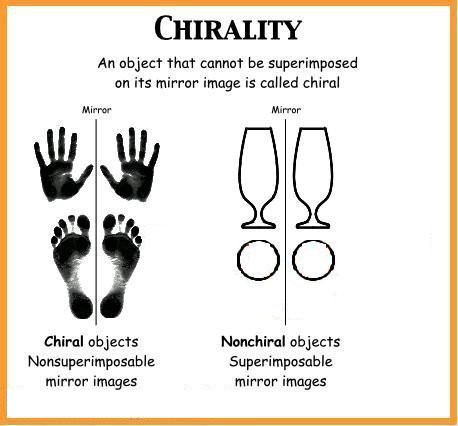
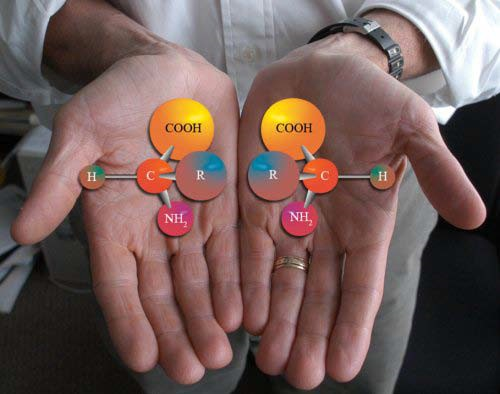
Certain things have a handedness or a specific structure of the electrons so as to divert photons to the right of left. This is the handedness of the molecule. Dextro is for right, Levulo for left. Our biology has been made so as this is very important. We need left handed amino acids and proteins and right handed sugars for cellular metabolism. We have made the full thesis on sugars and now we will address the issue of proteins. All of this is based on Quantum theory and this Biology is quantic in nature. The term „chiral” (from the Greek for „hand”) is applied to molecular systems whose asymmetry results in handedness; that is, the existence of a pair of nonsuperimposable mirror-image shapes (as illustrated by the relationship between one’s right and left hands). Lord Kelvin coined the term „chirality” in 1884, but it did not come into common usage until the 1960s. Many macroscopic examples of handed systems exist, including any object that features an inherent spiral or twist that can exhibit a left- and right- handed form: scissors, spiral staircases, screw threads, gloves, and shoes. Some mineralogical materials exhibit handedness in the solid state. In 1801 the crystallographer René-Just Haüy (1743–1822) observed that there were right- and left-handed quartz crystals, a phenomenon known as hemihedrism. The term „enantiomorphous” („in opposite shape”) was created to describe the macroscopic relationships between nonsuperimposable, mirror-image crystalline forms.
Left or right: why does nature have such a clear a preference?

Researchers in the US have shown that the presence of spin-polarized electrons can make a chemical reaction involving “right-handed” molecules occur faster than the same reaction involving “left-handed” molecules. The discovery could help scientists understand why nature favors a certain handedness in many biological molecules. So electron spin can directly affect the formation of the handedness of the biological molecule. So now we have the proof we needed to show that electron spin is involved in health.
An important question facing those trying to understand the origins of life is why important biological molecules have a certain handedness or “chirality”? Amino acids, for example, can be either right- or left- handed mirror-images of each other. However, they are always left handed when produced by living organisms. This is important because chirality can affect how a molecule takes part in the chemical reactions crucial for life.
Scientists believe that two external agents could be responsible for chirality in biological molecules: circularly polarized light and spin-polarized electrons.
Life from outer space?
While circularly polarized light is rare on Earth, astronomers know that it can be produced in the interstellar medium — leading some to speculate that the precursors to chiral biological molecules were created in space and somehow transported to Earth. The origin of this homochirality in biology is the subject of much debate.[10] Most scientists believe that Earth life’s „choice” of chirality was purely random, and that if carbon-based life forms exist elsewhere in the universe, their chemistry could theoretically have opposite chirality. However, there is some suggestion that early amino acids could have formed in comet dust. In this case, circularly polarised radiation (which makes up 17% of stellar radiation) could have caused the selective destruction of one chirality of amino acids, leading to a selection bias which ultimately resulted in all life on Earth being homochiral
Low-energy spin-polarized electrons are produced when X-rays and other ionizing radiation strike iron, nickel and other magnetic materials. These materials are relatively abundant and such interactions could have occurred on the early Earth, on other planets and even in space.
What is the difference between L-Taurine and Taurine, or between L-Glycine and Glycine?
The
natural plant
and animal
amino acids
are typically
the “L
form”, as
in L-arginine,
L-cysteine, etc.
Synthetic forms
are denoted
as “D forms”,
such as D-Methionine and D-Carnitine. But there are 2 aminos that have only one form without
these variations: Glycine and Taurine. These two aminos are sometimes called L-Taurine or L-Glycine, but are more properly called just “Taurine” and “Glycine”. Regardless of the name used, they are always
natural amino acids.
Most aminos have a property that, when the molecule is put into a solution, it will polarize and rotate light photons either to the left or right. The Greek words denoting left and right are Levo for left and Dextro for right, so the letters L and D are used to distinguish these forms. This polarization and rotation of light is called “optical rotation”. The differing L and D forms are called stereoisomers. For amino acids that polarize light, the L form is the natural form.
However, Taurine is an amino acid that does not polarize light. It thus is properly called just “Taurine”, without L or D configurations. While some label Taurine as “L-Taurine”, that name is not technically correct. “Taurine” is the same exact molecule and form as what is commonly mislabeled as “L-Taurine”. This why taurine is in the energy drinks. Taurine for bull is in the Red Bull drink.
There is another amino acid that lacks a potential optical rotation. Glycine is a very simple molecule that comes only as “Glycine”, also lacking different L or D stereoisomer forms. Glycine, Glutamic acid and Taurine can cross the blood brain barrier easier for this reason. They act as secondary suppliers of energy to the brain cells. And thus are key components of the energy drink.
The D forms of amino acids sold commercially are considered to be synthetic. However, D forms of amino acids are not always synthetic. There are several D forms that exist in nature. In addition, amino acids can be racemized by the body and go back and forth between the D form and the L form quite easily. However, only L forms can be incorporated into proteins. For the purposes of dietary supplements, the L forms are natural and the D forms are synthetic. DLPA and DL-methionine are actually racemic mixtures of both L and D forms.
But there is no such thing as D-Taurine or D-Glycine; in other words, no synthetic forms exist of these two aminos since each only comes as one isomer that doesn’t polarize and rotate light to the right. Nor are there really L forms of these, since they do not polarize and rotate light to the left, either. There are simply single, natural isomers of just plain Glycine and Taurine.
Don’t assume that all D or L forms of molecules are good or bad, since it really depends on the individual substance concerned. For example, the D isomers of vitamin E are the natural forms and the L isomers are synthetic; just the opposite of amino acids. Thus the terminology and forms of what is natural or synthetic will vary by substance. Some natural molecules exist as L form, some as D form and some have only one form, whether in food or if synthesized.
In nature we need left handed amino acids in our cells, only right handed sugars will enter the cell, and we need many right handed fatty acids. The Handedness is very important to life.
Because cancer tumors have much more D form of amino acids and proteins it was thought that ingestion of them causes cancer. This has not been fully dismissed but it is not such a rule. We believe that ingestion of synthetic proteins will aggravate cancer and possibly contribute to the growth. So in putting together or good protein bad protein list we need to say that items that have or cause D-amino acid formation should be avoided. Artificial sugars when heated as in cooking form D amino acids. Synthetic proteins and artificial food additives contain D amino acids and also make them on cooking.

D-form amino acids tend to taste sweet,
whereas L-forms are usually tasteless. Spearmint
leaves and caraway seeds, respectively, contain L-carvone and D-carvone – enantiomers of carvone. These smell different
to most people because our olfactory
receptors also contain
chiral molecules that behave differently in the presence
of different enantiomers. Thus the artificial sweeteners with
the Dextro (poisonous) amino
acids are to be avoided and specifically not used in cooking.
L-amino acids and plant stimulation
THE EFFECT OF ENZYMATICALLY EXTRACTED L AMINO ACIDS ON PLANTS
Amino acids – the components in protein – are the building blocks of all cell formation. Amino acids are necessary components in many processes in the plant, among them the photosynthesis which produces carbohydrates necessary for plant growth. All plants are capable of synthesizing amino acids, but it is a complex and energy demanding process that requires carbon and oxygen, hydrogen and nitrogen. The application of amino acids allows therefore for energy saving and better plant development during the critical stages of a plant’s cycle when it requires highly available elements.
Amino acids:
Amino acids are organic substances formed by an asymmetrical carbon atom that is joined to:
- An Amine group –NH2
- A Carboxylic group –COOH
- Two radicals –R and R´ characteristic of each amino acid.
Theoretically, the number of possible amino acids in nature is infinite. However, for plant nutrition purposes, the relevant amino acids are L-Alfa types in which the R generic radical is substituted by a Hydrogen one.
Plants, like any other organism, need certain components to promote their growth, as well as soil, sun, rain and air. The basic components of living cells are proteins, with their basic units, amino acids.
Proteins are formed by amino acid sequences. Plants synthesize amino acids from primary elements: Carbon and oxygen obtained from the air, hydrogen from water. This helps to form carbohydrates through photosynthesis, and combined with the nitrogen obtained by the plants through the soil, it conducts the synthesis of amino acids through metabolic routes.
L and D amino acids
Stereochemistry is important in living organisms because its properties can change depending on the spacial distribution of its atomic components. All amino acids, with the exception of glycine (which doesn’t have asymmetric carbon), can be found in forms L and D, in function of the spacial disposition of the groups that join asymmetric carbon. This disposition diverts polarized light in one way or another.
This optical characteristic is what divides amino acids into L or D.
Only L-Alfa amino acids form part of the proteins utilized by plants and promote changes in plant metabolic activity.
Total Amino Acids:
All amino acids are found as either free form, peptide or protein form:
- Free Amino Acids: Free amino acids are individualized in monomer form and not bound to another by peptic unions. Due to their lower molecular weight, plants assimilate this form of amino acids the most quickly and their effects on the metabolic processes of the plant are the most profound. As such, free amino acids are of primary importance in plant nutrition.
- Peptides: When two or more amino acids are bound to one another (by peptic union), they form a peptide. The greater the length of the peptide (more amino acids bound together), the more difficult the direct assimilation by plants.
- Proteins: The joining of different chains of polypeptides forms a protein. The structural units of proteins are amino acids joined in a sequence and characteristic order of each type of protein.
Effect on plants:
Amino acid use in essential quantities is a well known method to increase crop yield and quality. Even though plants have the inherent capacity to biosynthesize all the amino acids needed from nitrogen, carbon oxygen and hydrogen, the biochemical process is quite complex and energy consuming. As such, the application of amino acids such as those contained in HYT B allow for the plant to save energy on this process, which can be dedicated to better plant development during critical growth stages.
Amino acids are fundamental ingredients in a protein’s biosynthetic process. Nearly twenty amino acids are involved in the biosynthetic process. Studies have shown that amino acids can directly or indirectly in a plant’s physiological activities.
Amino acids are applied through foliar feeding, absorbed through the plant’s stomata or via the root area when incorporated into the soil. This also helps improve micro flora, which in turn, facilitates the nutrient assimilation.
Protein biosynthesis:
Proteins have different functions: Structural (supportive), metabolical (enzymes), transport, amino acid reserve, and other functions in which amino acids are involved. Only L-amino acids can be assimilated by plants. D-amino acids are not recognized by enzymes and do not participate in the protein biosynthetic process. Therefore, amino acids obtained through organic synthesis are not well assimilated. Some amino acids like L-methionine do not have a structural function the protein’s metabolism. It does, however, act a bio-stimulant as it activates its biosynthesis.
Stress resistance:
Stressful conditions, such as high temperatures, low moisture, frosts, parasite attacks, hail, flooding, disease or phytotoxic effects due to the application of pesticides, have a negative effect on plant metabolism with a corresponding decrease in crop quality and quantity.
The application of amino acids before, during and after stressful conditions, provides plants with amino acids that are directly related to physiological stress therefore providing a prevention and recuperation effect. This frees the plant from toxins that were accumulated during the tense period.
Effects of photosynthesis:
Photosynthesis is a plant’s most metabolically important pathway. Through it, a plant synthesizes sugars from carbon dioxide, water and luminous energy. These sugars (carbohydrates) are the source of energy for a plant’s other metabolic processes. A low photosynthetic rate caused by stress can decrease a plant’s growth, and ultimately cause its death. Chlorophyll is the pigment molecule that gives leaves their green color, and it is responsible for the harvesting of solar energy. This energy will be employed for the synthesis of sugars from water and carbon dioxide.
Glycine and glutamic acid are fundamental metabolites in the formation of vegetable tissue and chlorophyll synthesis. These amino acids raise the concentration of chlorophyll in plants. This increases the absorption of luminous energy, which leads to greater degrees of photosynthesis.
Effect on stomata:
Stomata are cellular structures that control a plant’s hydro balance, as well as the absorption of gases and macro and micro nutrients. A stoma’s openings are controlled by external factors (light, moisture, temperature and concentration of salts), and by internal factors (amino acid concentration, abscisic acid, etc.).
Stomata close when
light and moisture are low, and
temperature and salt concentration
are high. When stomata close, photosynthesis and transpiration (low macro
and micro nutrient absorption)
are
reduced,
and respiration (destruction of carbohydrates) is increased. When this occurs, a plant’s metabolic balance is negative. Catabolism is greater than anabolism (greater molecule destruction). This causes metabolism to decrease and plant growth to stop. L- glutamic acid acts as an osmotic agent for the protective cells cytoplasm, which favors the opening of stomata.
Chelating effect:
Amino acids have a chelating effect for micronutrients. When jointly applied with micro elements, their absorption and transportation inside the plant simplifies. This is caused by chelation and membrane permeability. L-glycine and L-glutamic acid amino acids are known as very effective chelating agents.
Amino acids and Phytohormones:
Amino acids are the precursors or activators of phytohormones and growth substances. L-Methionine is a precursor of ethylene and other growth factors such as spermine and spermidine, which are synthesized from 5-adenosyl methionine.
L-tryptophan is a precursor of auxin synthesis. L-tryptophan is used in plants only in its L-form. L- tryptophan is available only if protein hydrolysis is carried out by enzymes. If the hydrolysis is acid or alkaline, as it is performed in some European countries, L-tryptophan is destroyed.
The L-arginine amino acid induces flower and fruit related hormone biosynthesis.
Pollination and fruit formation:
Pollination is the transportation of pollen to the carpel that makes fecundation and fruit formation possible.
L-proline helps pollen fertility. L-lysine, L-methionine, and L-glutamic acid are essential amino acids for pollination. These amino acids increase pollen germination and the length of the pollen tube.
Floral Balance in the Soil:
Microbial floral balance in an agricultural soil is a basic factor for a good organic matter mineralization, as well as providing sound structure and fertility in the root area. L-methionine is a precursor of growth factors that stabilize cell membranes in microbial flora.
In General:
L-glutamic acid and L-aspartic acid, through transamination, give make way for the rest of the amino acids. L-proline and hydroxiproline act mainly in the plant’s hydro balance. They act on a cell’s wall by increasing resistance to unfavorable weather conditions.
- alanine, L-valine, and L-leucine increase the quality of fruits. L-histidine assists in the appropriate fruit maturation.
Observations When Applying Amino Acids to Plants: Trophic effect:
Free amino acids, when quickly metabolized, give birth to biologically active substances. They also invigorate and stimulate vegetation.
Hormonal effect:
Free amino acids stimulate the formation of:
- Chlorophyll
- Indole-3-Acetic acid
- Vitamins
- Various enzymatic systems
Trophic + Hormonal effect
- Flowering is stimulated
- Better fruit setting
- Higher precociousness, size and coloration of fruits.
- Greater sugar richness
- Greater vitamin content in fruits.
Amino acid effect on plants:
| L-Aspartic Acid: | Promotes Germination |
| L-Glutamic Acid: | Chelation Stimulates Growth Promotes Germination |
| L-Arginine: | Cold Resistance |
| L-Cysteine : | Chelation |
| L-Phenylaninine : | Promotes Germination |
| L-Glycine : | Chelation |
| L-Histidine : | Chelation |
| L-Alanine : | Cold Resistance Chlorophyll synthesis stimulation |
| L-Lysine : | Chelation Chlorophyll synthesis stimulation Promotes Germination |
| L-Methionine : | Promotes Germination Stimulates Ethylene Production |
| L-Proline : | Anti-stress action |
| L-Serine : | Auxin Precursor |
| L-Threonine : | Promotes Germination |
| L-Tryptophan : | Auxin Precursor |
| L-Valine : | Auxin Precursor |
Plants make Amino Acids from the Primary elements, the Carbon and Oxygen obtained from air, Hydrogen from water in the soil, forming Carbon Hydrate by means of photosynthesis and combining
it with the Nitrogen which the plants obtain from the soil, leading to synthesis of amino acids, by collateral metabolic pathways. Only L-Amino Acids are part of these Proteins and have metabolic activity.
See Quantum Nutrition for more details
Quantum number
www.olemiss.edu/…/lectures/ch2/slide9.html
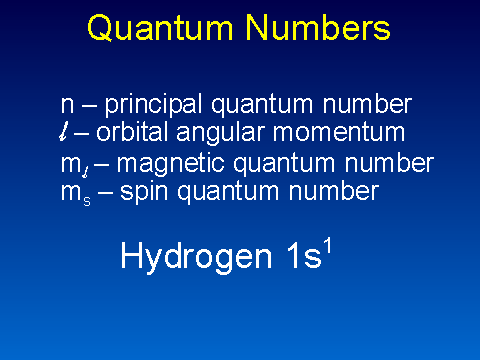
Quantum numbers describe values of conserved quantities in the dynamics of the quantum system. Perhaps the most peculiar aspect of quantum mechanics is the quantization of observable quantities. This is distinguished from classical mechanics where the values can range continuously. They often describe specifically the energies of electrons in atoms, but other possibilities include angular momentum, spin etc. Since any quantum system can have one or more quantum numbers, it is a rigorous job to list all possible quantum numbers.
How many quantum numbers?
The question of how many quantum numbers
are needed to describe any given system has no universal
answer, although for each system one must find the answer for a full analysis
of the
system. The dynamics of any quantum system are described by a quantum Hamiltonian, H. There is one quantum number of the system corresponding to the energy, i.e., the eigenvalue of the Hamiltonian. There is also one quantum number for each operator O that commutes with the Hamiltonian (i.e. satisfies the relation HO = OH). These are all the quantum numbers that the system can have. Note that the operators O defining the quantum numbers should be independent of each other. Often there is more than one way to choose a set of independent operators. Consequently, in different situations different sets of quantum numbers may be used for the description of the same system.
To completely describe an electron in an atom, four quantum numbers are needed.
Traditional nomenclature
Many different models have been proposed throughout the history of quantum mechanics, but the most prominent system of nomenclature spawned from the Hund-Mulliken molecular orbital theory of Friedrich Hund, Robert S. Mulliken, and contributions from Schrodinger, Slater and John Lennard-Jones. This system of nomenclature incorporated Bohr energy levels, Hund- Mulliken orbital theory, and observations on electron spin based on spectroscopy and Hund’s rules.
This model describes electrons using four quantum numbers, , , , and . It is also the common nomenclature in the classical description of nuclear particle states (e.g., proton and neutrons.)
- The first, , describes the electron shell, or energy level.
- The value of ranges from 1 to „n”, where „n” is the shell containing the outermost electron of that atom. For example, in cesium (Cs), the outermost valence electron is in the shell with energy level 6, so an electron in cesium can have an value from 1 to 6.
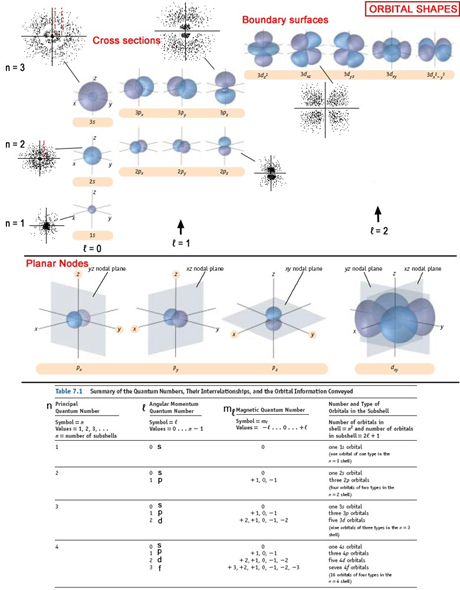
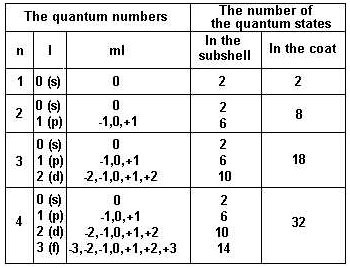
- The second, , describes the subshell (0 = s orbital, 1 = p orbital, 2 = d orbital, 3 = f orbital, etc.). o The value of ranges from 0 to . This is because the first p orbital (l=1) appears in the second electron shell (n=2), the first d orbital (l=2) appears in the third shell (n=3),
and so on. A quantum number beginning in 3,0,… describes an electron in the s orbital of the third electron shell of an atom.
- The third, , describes the specific orbital (or „cloud”) within that subshell.*
- The values of range from to . The s subshell (l=0) contains only one orbital, and therefore the ml of an electron in an s subshell will always be 0. The p subshell (l=1) contains three orbitals (in some systems, depicted as three „dumbbell-shaped” clouds), so the ml of an electron in a p subshell will be -1, 0, or 1. The d subshell (l=2) contains five orbitals, with ml values of -2,-1,0,1, and 2.
- The fourth, , describes the spin of the electron within that orbital.*
- Because an orbital never contains more than two electrons, will be either or , corresponding with „spin” and „opposite spin”.
* Note that, since atoms and electrons
are in a state of constant motion, there is no universal
fixed value for
ml and ms values. Therefore,
the
ml and ms values are defined somewhat
arbitrarily. The only requirement is that the naming schematic used within a particular set of calculations or descriptions must be consistent (e.g. the orbital occupied by the first electron in a p subshell could be described as ml=-1 or ml=0, or ml=1, but the ml value of the other electron in that orbital must be the same, and the ml assigned to electrons in other orbitals must be different).
These rules are summarized as follows:
| name | symbol | orbital meaning | range of values | value example |
| principal quantum number | shell | |||
| azimuthal quantum number (angular momentum) | subshell (s orbital is listed as 0, p orbital as 1 etc.) | for : | ||
| magnetic quantum number, (projection of angular momentum) | energy shift (orientation of the subshell’s shape) | for : | ||
| spin projection quantum number | spin of the electron (-1/2 = counter- clockwise, 1/2 = clockwise) | for an electron, either: |
Example: The quantum numbers used to refer to the outermost valence electron of the Carbon
- atom, which is located in the 2p atomic orbital, are; n = 2 (group 2), l = 1 or 0, ml = 1, or 0, or
−1, ms = −1/2 or 1/2.
As applied to the Hamiltonian and Schrodinger equation
- The principal quantum number (n = 1, 2, 3, 4 …)
denotes the eigenvalue of H with the
J2 part removed[ambiguous]. This number therefore has a dependence only on the distance
between the electron and the nucleus
(i.e., the radial coordinate,
r). The average distance
increases with
n, and hence
quantum states with
different principal quantum numbers are said to
belong to different
shells.
- The azimuthal quantum number (l = 0, 1 … n−1) (also known as the angular quantum number or
orbital quantum number) gives the orbital angular momentum through the relation
. In chemistry, this quantum number is very important,
since it specifies the shape of an atomic orbital and strongly influences chemical bonds and bond angles. In some contexts, l=0 is called an
s orbital, l=1 a p
orbital, l=2 a d orbital, and l=3 an f orbital.
- The magnetic quantum number (ml = −l, −l+1 … 0 … l−1, l) is the eigenvalue, . This is the projection of the orbital angular momentum along a specified axis.
- The spin projection quantum number (ms = −1/2 or +1/2), is the intrinsic angular momentum of the electron or nucleon. This is the projection of the spin s=1/2 along the specified axis.
o Results from spectroscopy indicated that up to two electrons can occupy a single orbital. However two electrons can never have the same exact quantum state nor the same set of quantum numbers according to Hund’s Rules, which addresses the Pauli exclusion principle. A fourth quantum number with two possible values was added as an ad hoc assumption to resolve the conflict; this supposition could later be explained in detail by relativistic quantum mechanics and from the results of the renowned Stern-Gerlach experiment.
Molecular orbitals require different quantum numbers, because the Hamiltonian and its symmetries are quite different.
Quantum numbers with spin-orbit interaction
For more details on this topic, see Clebsch-Gordan coefficients.
When one takes the spin-orbit interaction into consideration, l, m and s no longer commute with the Hamiltonian, and their value therefore changes over time. Thus another set of quantum numbers should be used. This set includes
- The total angular momentum quantum number (j = 1/2,3/2 … n−1/2) gives the total angular momentum through the relation .
- The projection of the total angular momentum along a specified axis (mj = -j,-j+1… j), which is analogous to m, and satisfies mj = ml + ms.
- Parity. This is the eigenvalue under reflection, and is positive (i.e. +1) for states which came from even l and negative (i.e. -1) for states which came from odd l. The former is also known as even parity and the latter as odd parity
For example, consider the following eight states, defined by their quantum numbers:
1. n = 2, l = 1, ml = 1, ms = +1/2
2. n = 2, l = 1, ml = 1, ms = -1/2
3. n = 2, l = 1, ml = 0, ms = +1/2
4. n = 2, l = 1, ml = 0, ms = -1/2
5. n = 2, l = 1, ml = -1, ms = +1/2
6. n = 2, l = 1, ml = -1, ms = -1/2
7. n = 2, l = 0, ml = 0, ms = +1/2
8. n = 2, l = 0, ml = 0, ms = -1/2
The quantum states in the system can be described
as linear combination of these eight states.
However, in the
presence of spin-orbit interaction, if one wants
to describe
the same system by
eight states which are eigenvectors of the Hamiltonian (i.e. each represents a state which does not mix with others over time), we should consider the following eight states:
- j = 3/2, mj = 3/2, odd parity (coming from state (1) above)
- j = 3/2, mj = 1/2, odd parity (coming from states (2) and (3) above)
- j = 3/2, mj = -1/2, odd parity (coming from states (4) and (5) above)
- j = 3/2, mj = -3/2, odd parity (coming from state (6))
- j = 1/2, mj = 1/2, odd parity (coming from states (2) and (3) above)
- j = 1/2, mj = -1/2, odd parity (coming from states (4) and (5) above)
- j = 1/2, mj = 1/2, even parity (coming from state (7) above)
- j = 1/2, mj = -1/2, even parity (coming from state (8) above)
Elementary particles
For a more complete description of the quantum states of elementary particles, see Standard model and Flavour (particle physics).
Elementary particles contain many quantum numbers which are usually said to be intrinsic to them. However, it should be understood that the elementary particles are quantum states of the standard model of particle physics, and hence the quantum numbers of these particles bear the same relation to the Hamiltonian of this model as the quantum numbers of the Bohr atom does to its Hamiltonian. In other words, each quantum number denotes a symmetry of the problem. It is more useful in field theory to distinguish between spacetime and internal symmetries.
Typical quantum numbers related to spacetime symmetries are spin (related to rotational symmetry), the parity, C-parity and T-parity (related to the Poincare symmetry of spacetime). Typical internal symmetries are lepton number and baryon number or the electric charge. (For a full list of quantum numbers of this kind see the article on flavour.)
It is worth mentioning here a minor but often confusing point. Most conserved quantum numbers are additive. Thus, in an elementary particle reaction, the sum of the quantum numbers should be the same before and after the reaction. However, some, usually called a parity, are multiplicative; i.e., their product is conserved. All multiplicative quantum numbers belong to a symmetry (like parity) in which applying the symmetry transformation twice is equivalent to doing nothing. These are all examples of an abstract group called Z2.
Electron Spin Resonance
When the molecules of a solid exhibit paramagnetism as a result of unpaired electron spins, transitions can be induced between spin states by applying a magnetic field and then supplying electromagnetic energy, usually in the microwave range of frequencies. The resulting absorption spectra are described as electron spin resonance (ESR) or electron paramagnetic resonance (EPR). Electron spin resonance has been used as an investigative tool for the study of radicals formed in solid materials, since the radicals typically produce an unpaired spin on the molecule from which an electron is removed. Particularly fruitful has been the study of the ESR spectra of radicals produced as radiation damage from ionizing radiation. Study of the radicals produced by such radiation gives information about the locations and mechanisms of radiation damage. The interaction of an external magnetic field with an electron spin depends upon the magneticmoment associated with the spin, and the nature of an isolated electron spin is such that two and only two orientations are possible. The application of the magnetic field then provides a magnetic potential energy which splits the spin states by an amount proportional to the magnetic field (Zeeman effect), and then radio frequency radiation of the appropriate frequency can cause a transition from one spin state to the other. The energy associated with the transition is expressed in terms of the applied magnetic field B, the electron spin g-factor g, and the constant B which is called the Bohr magneton.
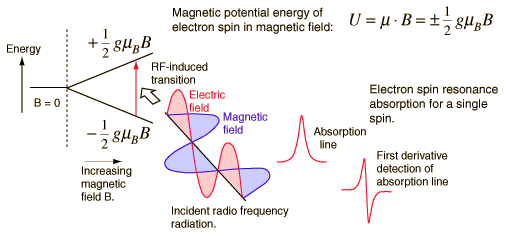
If the radio frequency excitation was supplied by a klystron at 20 GHz, the magnetic field required for resonance would be 0.71 Tesla, a sizable magnetic field typically supplied by a large laboratory magnet.
If you were always dealing with systems
with a single spin like this example,
then ESR would always consist of just one line, and would have little value as an investigative tool, but several factors influence
the effective
value
of
g
in
different settings. Much
of
the information
obtainable from ESR comes from the splittings caused by interactions with nuclear spins in the vicinity of the unpaired spin, splittings called nuclear hyperfine structure.
Spin Quantum Number
In atomic physics, the spin quantum number is a quantum number that parameterizes the intrinsic angular momentum (or spin angular momentum, or simply spin) of a given particle. The spin quantum number is the fourth of a set of quantum numbers (the principal quantum number, the azimuthal quantum number, the magnetic quantum number, and the spin quantum number) which describe the unique quantum state of an electron and is designated by the letter s.
Derivation
As a quantized angular momentum it holds that
where
is the quantized spin vector, is the norm of the spin vector,
s is the spin quantum number associated with the spin angular momentum,
is the reduced Planck constant.
Given an arbitrary direction z (usually determined by an external magnetic field) the spin z– projection is given by
where ms is the secondary spin quantum number, ranging from− s to +s in steps of one. This generates 2s+1 different values of ms.
The allowed
values for s are
non-negative integers or half-integers. Fermions (such as the electron, proton or neutron) have half-integer values, whereas bosons (e.g. photon, mesons) have integer spin values.
Algebra
The algebraic theory of spin is a carbon copy of the Angular momentum in quantum mechanics theory. First of all, spin satisfies the fundamental commutation relation:
where εlmn is the (antisymmetric) Levi-Civita symbol. This means that is impossible to know two coordinates of the spin at the same time because of the restriction of the Uncertainty principle.
Next, the eigenvectors of S2 and Sz satisfy:
where are the creation and annihilation (or „raising” and „lowering” or „up” and „down”) operators.
Electron spin
Early attempts to explain the behavior of electrons in atoms focused on solving the Schrödinger wave equation for the hydrogen atom, the simplest possible case, with a single electron bound to the atomic nucleus. This was successful in explaining many features of atomic spectra.
The solutions required each possible state of the electron to be described by three „quantum numbers”, n, l, and m. These were identified as, respectively, the electron „shell” number, n, the „orbital” number, l, and the „orbital angular momentum” number m. Angular momentum is a so- called „classical” concept measuring the momentum of a mass in circular motion about a point. The shell numbers start at 1 and increase indefinitely. Each shell of number n contains n² orbitals. Each orbital is characterized by its number l, where l takes integer values from 0 to n-1, and its angular momentum number m, where m takes integer values from +l to -l. By means of a variety of approximations and extensions, physicists were able to extend their work on hydrogen to more complex atoms containing many electrons.
Atomic spectra measure radiation
absorbed or emitted
by electrons „jumping” from one „state” to another, where a state is represented by values
of n, l, and m.
The so-called „Transition rule” limits what „jumps” are possible. Generally a jump or „transition” is only allowed
if all three numbers change in the process.
This is because a transition will only be able to cause the
emission or absorption of electromagnetic radiation if it involves a change in the electromagnetic dipole of the atom.
However, it was recognized in the early years of quantum mechanics that atomic spectra measured in an external magnetic field (see Zeeman effect) cannot be predicted with just n, l, and m. A solution to this problem was suggested in early 1925 by George Uhlenbeck and Samuel Goudsmit, students of Paul Ehrenfest (who rejected the idea), and independently by Ralph Kronig, one of Landé’s assistants. Uhlenbeck, Goudsmit, and Kronig introduced the idea of the self-rotation of the electron, which would naturally give rise to an angular momentum vector in addition to the one associated with orbital motion (quantum numbers l and m).
The spin angular momentum is characterized by a quantum number; s = 1/2 specifically for electrons. In a way analogous to other quantized angular momenta, L, it is possible to obtain an expression for the total spin angular momentum:
where
is the reduced Planck constant.
The hydrogen spectra fine structure is observed as a doublet corresponding to two possibilities for the z-component of the angular momentum, where for any given direction z:
which solution has only two possible z components for the electron. In the electron, the two different spin orientations are sometimes called „spin-up” or „spin-down”.
The spin property of an electron would classically give rise to magnetic moment which was a requisite for the fourth quantum number. The electron spin magnetic moment is given by the formula:
where
e is the charge of the electron g is
the Lande g-factor
and by the equation:
where
g is the Lande g-factor
μB is the Bohr magneton
When atoms have even numbers of electrons the spin of each electron in each orbital has opposing orientation to that of its immediate neighbor(s). However, many atoms have an odd number of electrons or an arrangement of electrons in which there is an unequal number of „spin-up” and „spin-down” orientations. These atoms or electrons are said to have unpaired spins which are detected in electron spin resonance.
Detection of spin
When lines of the hydrogen spectrum are examined at very high resolution, they are found to be closely-spaced doublets. This splitting is called fine structure, and was one of the first experimental evidences for electron spin. The direct observation of the electron’s intrinsic angular momentum was achieved in the Stern-Gerlach experiment.
Dirac equation solves spin
When the idea of electron spin was first introduced in 1925, even Wolfgang Pauli had trouble accepting Ralph Kronig’s model. The problem was not that a rotating charged particle would have given rise to a magnetic field, but that the electron was so small that the equatorial speed of the electron would have to be greater than the speed of light for the magnetic moment to be of the observed strength.
In 1930, Paul
Dirac developed
a new version of the Schrödinger Wave Equation
which was relativistically invariant, and predicted
the magnetic moment correctly, and at the same time treated the electron as a point particle. In the Dirac equation all four
quantum numbers including the additional quantum number s arose
naturally during
its solution.
THE IMPROVED BOHR’S THEORY
The Bohr’s theory explained very well the spectral lines of the hydrogen – like atoms. Soon it was discovered that the spectral lines are not homogenous but consist of several convenient lines.
Arnold Sommerfeld (1868-1951) – was the German scientist who assumed that the orbits of electrons doesn’t have to be spherical but can also be elliptic. The electrons can move only on some, allowed ellipses. He coined a second l number which was called the secondary quantum number or the azimuthal quantum number. The number defined the shape, the oblateness of an orbit. For n=1 the orbit can be only spherical (l=0), for n=2 there are two orbits of different shapes (l=0 – the elliptic one, l=1 – the spherical one). For any n there are n kinds of shapes of the orbits. The electrons moving on the two orbits of the same n number but of different shape have a bit different energies. That explaines the discovered structure of the spectral lines.
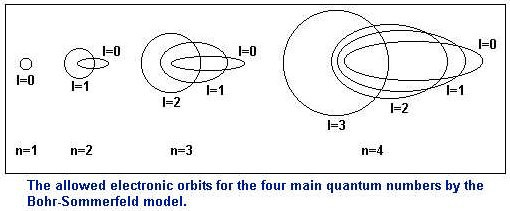
Another thing improving the Bohr atom was the discovery that the orbits don’t have to lay in the same plane. They can be oriented in space on some defined
directions. Their orientation is defined by the magnetic quantum number ml. The electron circulating on an orbit causes
the magnetic field. If the system is also placed in the outer magnetic field than the orbit of the electron
places itself in a special
way. That means that its
position makes the direction and the sense of the magnetic
field created by the electron the same as in the outer field. To deflect it to another
position there should be some more energy given to the system. Sommerfeld proved that there is only some defined number of the possible orbit’s positions. The number is equal 2*l+l. Each position in the magnetic field is of a bit different energy. The m number can name the values of 1 to -1. The phenomena of taking in the magnetic
field the orbits of different
energies for the same n is the explanation of the splitting
of spectral lines – the
Zeeman effect.
For a better understanding of the quantum numbers n,l,ml the values for n=1, n=2, n=3, n=4 are given in the table.
Beside the described facts the one more was discovered – that the spectral line consist of the two lines placed very close to each other – much closer than for the two shapes of orbits. The fact couldn’t be explained by the Bohr–Sommerfeld model. Just the two Danish physicists – Uhlenbeck and Goudsmit explained the phenomena. The noticed that the electron circulates not only around the nucleus but also rotates. It can rotate in the two directions creating the rotary current flowing in the direction of the rotation. The current induces the magnetic field which is directed with the field created by the electron moving on the orbit or oppositely to it. So the fields sum or substract. The electron causing the oppositely directed field is of a bit smaller direction than the one causing the with directed field. So the spectral lines split. The spin, magnetic quantum number is used for defining the direction of rotation.
The spin can be equal +1/2 or -1/2. That causes the noticed split of the spectral line on the two close placed ones.
After being improved the Bohr’s theory very well described the spectrums of hydrogen. The main lines are caused by the electron taking different orbits (defined by the n). The lines consist of some very close placed lines for the different shapes of orbits (defined by the l). In the magnetic field the lines undergo a split because of the orbits taking defined planes in space. The last thing is that the electron can rotate in two directions what causes the split of the spectral lines on the two more ones.
The theory described the spectrum
of hydrogen and the other hydrogen
– like atoms (f. e. He+). It described the construction of atoms
and
of the orbits. So it was found
a success. But for some scientists its assumptions looked artificial. The often asked question was: Why should the electrons circulate
around the nucleus only on the defined orbits. The answer was given after 1925 by de Broglie, Schrodinger and Planck.
Health Physics:
Papers: ABSTRACT Only
In Vivo Dosimetry by Electron Spin Resonance Spectroscopy
Brady, John M.; Aarestad, Norman O.; Swartz, Harold M.
Abstract
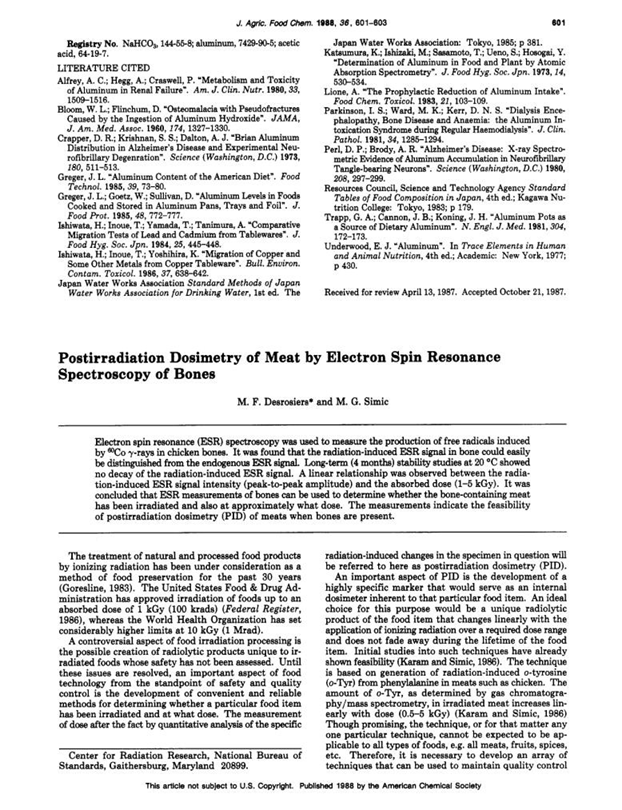
Several tissues, especially hard tissues, showed persistent electron spin resonances following in vivo or in vitro irradiations. The resonances had a linear relation to dose. Dose measurements were made in teeth at less than 100 rads of 60Co radiation. The method appears to be applicable for dosimetry of accidental irradiations, especially X- or gamma-ray exposures.
Electronic Spin Inversion: A Danger to Your Health
© Copyright 2003 by Foreign Correspondent Dr. Johan Boswinkel, Managing Director, Health Angel GmbH, Switzerland; Technical Director, International Institute for Bio-energetic Medicine, UK (Explore Issue: Volume 12, Number 5)
Many people suffer these days from chronic fatigue, also called Myalgic Encephalomyelitis (M.E.), or Fibromyalgia. There does not seem a cause for it; at least not one that can easily be found by the medical profession.
There are theories that it is caused by a virus. Some experts claim it is the Coxsackie virus; others claim it is caused by the Epstein-Barr virus. But these remain theories.
The two viruses can definitely cause a lot of problems, but chronic fatigue does not seem to be one of them. Of course, these viruses may be found in those who have chronic fatigue, but they may not be there as the causal factor, but as a result.
The helicobacter bacteria is often regarded as a possible cause of stomach ulcers, but is not. The two are often found together, but cause and effect have been confused. The same applies to smoking and lung cancer, or heart and vascular diseases. ‘Specialists’ say smoking is the cause of those illnesses. Again, they often go together, but not in a cause-effect relationship. Lung cancer, heart and vascular diseases, and smoking are all a result of the same thing; namely stress.
You experience stress because you are not capable of doing the things you need to do, or think you have to do them. You may do them on will power alone. Willpower is often seen as something very positive, but it does not have to be like that. If it is not coupled to being stark and powerful with a lot of drive, then it is useless. Then will power takes energy of which you do not have enough anyway. This willpower causes stress, which takes away even more energy.
But how can such a thing get into motion at all?
We hear ever more of the chronic fatigue syndrome. More and more people seem to suffer from it. It definitely is a civilization problem. But what is the main cause? It is electron spin inversion. What is this?
Every atom has its own nucleus, and around the nucleus turn the electrons. Just like the planets turn around the sun. Every planet also turns around its own axis, as do the electrons. If one has an electron spin inversion, those electrons start turning the other way, around their own axis.
This event is very detrimental to the body. The first symptoms are:
- You are tired even after a good night sleep, and
- You get ever more environmental allergies.
If this is the case, people are absolutely therapy- resistant. They will not react positively to any therapy. They may react the opposite way on medicine, on massage, on acupuncture, on homeopathy; simply on everything. The body works against itself. It does not absorb any nutrients anymore. Simply nothing will work, or works the other way. All kinds of things that patients used to enjoy, are not enjoyable anymore. These patients often become electro-sensitive, meaning that a TV or a computer puts them down.
This electron spin inversion is always caused by an external magnetic field. It can be electromagnetic or geo-magnetic, meaning it can be produced by electrical appliances, or wires, or by disturbances in the field of the earth.
J APPL PHYSIOL 87(6):2032-2036
8570-7587/99 Copyright © 1999 the American Physiological Society
28 December 2001
Controlling Electron Spin Electrically
Researchers at the University of California at Santa Barbara (UCSB) report in the Dec. 6 issue of Nature the first demonstration of continuous electrical tunability of spin coherence in semiconductor nanostructures.
The six person research team is headed by physicist David Awschalom, director of the Center for Spintronics and Quantum Computation. Awschalom’s research is conducted under the auspices of the California NanoSystems Institute (CNSI), a multi-million-dollar State initiative conceived by Gov. Gray Davis to develop the science and technology that will propel the state’s economic future. Funding for Awschalom’s research is provided by the Defense Advanced Research Projects Agency (DARPA), an agency which promotes speculative but potentially groundbreaking research projects.
An approximate understanding of the nature of spin can be gleaned by
analogy with the orbit of planets in the solar system. In this analogy, electrons orbit a nucleus in a fashion similar to the Earth’s orbit around the Sun. Just as the Earth rotates about it’s axis during the orbit, electrons have a quality of rotation called 'spin.’ The spin of electrons is characterized by the direction of rotation, so that spin 'up’ or 'down’ electrons rotate in opposite directions (i.e., clockwise or counter-clockwise).
While magnetic fields are conventionally used to manipulate spins in familiar magnetic devices like hard- disk drives, this demonstration of electrical control
of aligned spins represents a significant step towards making new spin-based technologies. One future technology is quantum computing, where many schemes make use of electron spin states as bits of information analogous to the 0’s and 1’s of binary computing. Unlike ordinary bits, 'quantum bits’ can be any combination of both 0 and 1 simultaneously, corresponding
to a continuous range of possible directions.
Magnetic fields can change the direction of spins by inducing „precession” which is an additional rotation of the spin orientation about the magnetic field, similar to the periodic movement of the axis of a top after it is spun. While the speed of electron spin precession in a magnetic field is generally fixed by the particular materials used, the research reported in Nature has shown that both the speed and direction of precession can be continuously adjusted by applying electric fields in specially engineered quantum structures.
Said Awschalom, „We would like to electrically manipulate the electron spin because that’s the bridge to a scalable technology. Today’s charge-based electronics all use electrical gates–a sandwich of electrical plates–to guide electrons. We want to use the electrical control methods of today’s technology to fabricate a spin gate. This paper reports spin gates that can make the electron spin go one way or the other or just stay put. And the gate works at room temperature.”
Awschalom refers to the invention as a gate, rather than a switch because it performs continuous tuning of electron spin. Instead of the „off” and „on” options for a switch, a gate operates across a continuum the way lights can be dimmed by a rheostat, for instance.
The spin gate device is made of sandwiches of the semiconductor materials Gallium Arsenide (GaAs) and Aluminum Gallium Arsenide (AlGaAs) only a hundred nanometers thick.
Semiconductor heterostructures operate by trapping electrons in a 'quantum well’ that is shaped like a square box. The trick that Awschalom’s research team devised to construct their device was to use a parabolically shaped quantum well instead of the usual square box.
A decade ago Awschalom’s UCSB colleague, Art Gossard, professor of electrical and computer engineering, led a research group that conceived and used Molecular Beam Epitaxy (MBE) techniques to build semiconductor heterostructures with parabolic quantum wells. Klaus Ensslin, then a postdoc in the Materials Department at UCSB, described how the trapped electrons behaved in the parabolic structure. Ensslin is now a physics professor at Switzerland’s Eidgenössische Technische Hochschule (ETH) in Zurich, which entered last June into a research agreement with UCSB.
At UCSB on sabbatical from ETH Zurich, Ensslin returned to collaborate with his old mentor Gossard. Both assisted the Awschalom research effort and are authors of the Nature paper. Two of the other three authors are affiliated with Awschalom: his postdoc Gian Salis, the first author and now a permanent staff member at IBM Zurich, and his physics graduate student Yuichiro Kato both worked on measuring the devices. Dan Driscoll is Gossard’s materials graduate student who helped in the device fabrication.
„It was our colleagues ability to fabricate the specially-engineered structures that made these experiments possible, said Awschalom.”
Why does a parabolic quantum well enable electrical control of spin coherence when a box-shaped well does not?
Salis explained, „Mathematically speaking, when you add a line to a parabola the parabola
is displaced, but doesn’t change shape. But when you add a line to a box, you only distort the box into a trapezoidal structure. This is essentially what happens when we apply a voltage to our device: the voltage tilts the
whole structure like pushing down on a see-saw. So we used the two different semiconductors (GaAs, AlGaAs) to form the parabola and to trap the electrons. We then applied electrical voltages to displace the parabola and thereby moved the pooled electrons in the well from one material to another. The effects were large! We were able to control spin electrically exactly as we had thought we could when we conceived the experiments.”
„With the application of just a few volts,” added Awschalom, „the electrons begin to sample different regions of space, and that’s when their spin precesses faster or slower or stops. We are moving electrons out of Gallium Arsenide into Alumnium Gallium Arsenide continually without changing their wave function or profile in space, and that’s what is unique.”
The spin-gates discussed in the Nature report are an example of the rapidly developing field of 'spintronics,’ which studies electronic devices that are based on electron spin.
This raises the question: What might spintronics do that electronics can’t?
In addition to the longer-term goal of quantum computing, spintronics offer the near-term possibility of revolutionizing the way we think about piecing together different technologies.
„Think of one combined unit that integrates logic, storage, and communication for computing,” said Awschalom. „We envision using a mixture of optical, electronic, and photonic techniques to prepare and manipulate spin-based information. The spin could be stored in semiconductors, run at frequencies many times faster than today’s technology and work at room temperature. And all in a single nanostructure. Then imagine millions of these nanostructures working together in a device small by human standards. What such devices will do is up to scientists and engineers to determine. But the most exciting prospects are the revolutionary ones rather than simple extrapolations of today’s technology.”
In addition to applications in the emerging field of spintronics, the last sentence of the Nature
paper points to possible advances in fundamental physics using the findings: „Furthermore,
the
large tunability and quenching of the electronic spin splitting offers the potential for new insights
into other phenomena, such as ferromagnetic quantum Hall states or the dynamics
of electrically inverted
spin populations through non-adiabatic gating.” Studies of the quantum Hall effect are very important, and have already garnered
two Nobel physics prizes for
its
explorers. What’s being
offered here is a new way of looking
at some tantalizing aspects of condensed
matter physics.
Electron spin resonance spectroscopy, exercise, and oxidative stress: an ascorbic acid intervention study
Tony Ashton1, Ian S. Young2, John R. Peters3, Eleri Jones4, Simon K. Jackson5, Bruce Davies1, and Christopher C. Rowlands6
1 School of Applied Sciences, University of Glamorgan, Pontypridd, Wales, CF37 1DL; 2 Department of Clinical Biochemistry, Institute of Clinical Science, Queens University, Belfast, Northern Ireland, BT12 6BL; 3 Department of Medicine, University Hospital of Wales, Cardiff, Wales, CF4 4XW; 4 University of Wales Institute Cardiff, Cardiff, Wales, CF3 7XR; 5 Department of Medical Microbiology, Section of Immunology, University of Wales College of Medicine, Cardiff, Wales, CF4 4XN; and 6 Department of Chemistry, National EPSRC ENDOR Centre, Cardiff University, Cardiff, Wales, CF1 3TB, United Kingdom
ABSTRACT
Oxygen free radicals are highly reactive species that are produced in increased quantities during strenuous exercise and can damage critical biological targets such as membrane phospholipids. The present study examined the effect of acute ascorbic acid supplementation on exercise- induced free radical production in healthy subjects. Results demonstrate increases in the intensity of the -phenyl-tert-butylnitrone adduct (0.05 ± 0.02 preexercise vs.
0.19 ± 0.03 postexercise, P = 0.002, arbitrary units) together with increased lipid hydroperoxides (1.14 ± 0.06 µmol/l preexercise vs. 1.62 ± 0.19 µmol/l postexercise, P = 0.005) and malondialdehyde (0.70 ± 0.04 µmol/l preexercise vs. 0.80 ± 0.04 µmol/l postexercise, P = 0.0152) in the control phase. After supplementation with ascorbic acid, there was no significant increase in the electron spin resonance signal intensity (0.02 ± 0.01 preexercise vs.
0.04 ± 0.02 postexercise, arbitrary units), lipid hydroperoxides (1.12 ± 0.21 µmol/l preexercise vs. 1.12 ± 0.08 µmol/l postexercise), or malondialdehyde (0.63 ± 0.07 µmol/l preexercise vs.
0.68 ± 0.05 µmol/l postexercise). The results indicate that acute ascorbic acid supplementation prevented exercise-induced oxidative stress in these subjects.
lipid peroxidation; vitamin C; free radicals; superoxide
INTRODUCTION
INCREASED WHOLE BODY OXYGEN FLUX during exhaustive aerobic exercise may elicit
potentially toxic pertubations in cellular
homeostasis via increased free radical
production. The measurement of
free radicals in biological systems is difficult because of their high reactivity and low steady- state concentration. Electron spin resonance (ESR) spectroscopy is arguably the most sensitive, specific, and direct method of measuring free radical species and is currently underutilized in the clinical and physiological environment. Until recently, ESR spectroscopy had only been used in the animal model to demonstrate increases in free radical concentration after exercise (4, 18). Using ESR spectroscopy, we recently reported that maximal aerobic exercise resulted in significant increases in the concentration of the -phenyl-tert-butylnitrone (PBN) adduct and also lipid hydroperoxides (LH) and malondialdehyde (MDA) in the venous circulation of healthy human volunteers (2). LH are considered to be the major initial reaction products of free radical attack on the cell membrane, whereas MDA is formed as a decomposition product of LH, thus justifying their use as indirect determinants of free radical-mediated oxidative damage. Free radicals, defined as any species containing an unpaired electron that is capable of independent existence, are, by definition, highly reactive and cause damage to DNA, cell membranes, and proteins (8). Oxygen radicals such as superoxide anion are continually generated in vivo by a number of pathways including mitochondrial electron-transport chain, xanthine oxidase, and activated phagocytes (17). Additionally, superoxide may combine with nitric oxide (NO ·) to form the damaging peroxynitrite (ONOO ), as shown in Eq. 1.
(1)
Therefore, if superoxide is produced at an increased rate during exercise because of highly respiring mitochondria, one potential consequence of this may be increased endothelial damage via increased peroxynitrite formation. Alternatively, superoxide may inhibit the vascular relaxant effects of nitric oxide, leading to altered endothelial function.
Ascorbic acid is a water-soluble antioxidant, able to scavenge aqueous superoxide, peroxyl, and alkoxyl radicals and inhibit lipid peroxidation (3). Importantly, decreased levels of plasma ascorbic acid have been reported in physically active men in the United Kingdom (9). Recently, however, it has been suggested that ascorbic acid exhibits both antioxidant and prooxidant properties in vivo (15). Thus the aim of the present study was to determine the effect of ascorbic acid supplementation on the ESR signal intensity of the PBN adduct in the venous circulation of healthy human volunteers after maximal aerobic exercise. In addition to this, the effect of ascorbic acid supplementation on supporting assays of exercise-induced lipid peroxidation is also reported.
METHODS
Subject
characteristics. Ten subjects
volunteered for this study and
were required to perform
an incremental exercise
test to exhaustion (control phase).
The same subjects were then required 8 wk later
to repeat the
exercise test after
supplementation with ascorbic acid
(supplementation phase). Subjects were healthy male students (aged 18-30 yr; height
1.77 ± 1.6 m; body mass 78.6 ± 3.3 kg). All were nonsmokers and free of any physician- diagnosed disease. Subjects taking vitamin supplements were excluded. Written informed consent was obtained before participation, and ethical approval was obtained from a Local Research Ethics Committee.
Ascorbic acid supplementation. An acute oral dose of 1,000 mg of L-ascorbic acid (Hoffman- LaRoche, UK) was given in two 500-mg tablets 2 h before the subjects performed the maximal oxygen uptake (O2 max) test, allowing plasma levels to increase and resulting in saturation of the plasma with ascorbic acid.
Blood sampling. Blood was collected from an antecubital forearm vein by using a vacutainer system (Becton-Dickinson, Oxford, UK). The resting (preexercise) blood sample was taken with the subject seated in a chair and resting for 5 min, whereas the postexercise samples were taken immediately on cessation of exercise. After immediate centrifugation at 3,500 rpm for 12 min, the samples were frozen within 30 min to 80°C and stored for a maximum of 8 wk before analysis. However, without exception, all ESR samples underwent same-day analysis. Additional blood samples were taken and used to detect exercise-induced hemoconcentration via changes in hematocrit level.
Sample extraction procedure and ESR analysis. The sample extraction procedure using HPLC- grade toluene that was previously scanned by ESR for the presence of artifactual radicals, combined with vacuum degassing employed in the present study, is identical to that previously reported (2). Room-temperature ESR analysis was carried out on a JEOL RE2X series X-band spectrometer with 100-KHz field modulation by using the following operating conditions: microwave frequency 9.436 GHz; incident microwave power 10 MW; scan width ± 4.000 mT; modulation amplitude 0.1000 mT; magnetic field center 334.6 mT; scan time 4.0 min; time constant 0.10 or 0.30 s. ESR conditions were identical before and after exercise and between studies, with the exception of spectrometer gain. Additionally, samples from the ascorbic acid- supplemented subjects were analyzed by using increased spectrometer gain to attempt to detect the presence of any small ESR signal.
Measurement of plasma lipid peroxidation and ascorbic
acid concentration. Lipid peroxidation was assessed by using two established assays. MDA was measured
by HPLC with fluorometric detection in EDTA plasma
(23). This method overcomes
the lack of specificity generally associated with the measurement of MDA. LH concentration was measured
by using the ferrous iron-xylenol orange
assay in a clotted
serum sample (13). This method measures the susceptibility to iron-induced LH formation in serum. The presence of iron ions in the assay procedure
may, therefore, yield slightly higher LH values compared with other
methods. Plasma ascorbic acid was measured by using a fluorometric technique (20). The technique is based on the kinetics
of fluorescence development by condensation of dehydroascorbic acid with 1,2- phenylenediamine. The enzymatic oxidation of ascorbic
acid with ascorbate oxidase confers specificity to the assay without the need for chromatographic separation. After centrifugation, the blood plasma was immediately stabilized and deproteinated by the addition
of 900 µl of 5%
metaphosphoric acid to 100 µl EDTA plasma. Plasma total antioxidant capacity was measured by using enhanced chemiluminescence and is expressed as Trolox equivalents (22).
Exercise protocol. The exercise test employed in this study is identical to that previously reported (2). Briefly, the subjects were required to cycle to volitional exhaustion on a calibrated cycle ergometer (Monark 824 , Monark, Stockholm, Sweden). The test is incremental and progressive and designed to elicit O2 max. Breath-by-breath oxygen uptake was continually recorded during the test by using a computerized on-line gas-analysis system (Medgraphics, Manchester, UK). Heart rate was also continually recorded by using a portable electrocardiograph-calibrated heart rate telemetry system (Polar Sport Tester, Kenilworth, UK). Subjects were instructed to refrain from exercise and alcohol for 24 h before the test. Criteria for objective determination of O2 max were as follows: respiratory exchange ratio >1.15 at termination of test; plateauing of oxygen uptake curve where observed; heart rate approximating 220 beats/min age; and failure of subjects to cycle at 60 rpm despite verbal encouragement. The tests were carried out in the morning after an overnight fast.
Statistical analysis. Statistical analysis was carried out by using a statistical package for social sciences (SPSS, Surrey, UK). Results are expressed as means ± SE, and P < 0.05 was considered statistically significant. Identification of significant differences was carried out via the Wilcoxon signed-rank matched-pairs test, whereas the Spearman correlation coefficient was used to determine the strength of relationship between two dependent variables.
There was no significant difference in any of the physiological parameters between the control and supplementation phases. Mean whole body O2 max was measured as 49.85 ± 2.12 and 47.43 ± 1.95 ml
- kg 1 · min 1, whereas mean postexercise respiratory exchange ratio was measured as 1.22 ± 0.01 and
1.21 ± 0.02 for the control and supplementation groups, respectively. Maximal postexercise heart rates were 192 ± 4 and 187 ± 3 beats/min for the control and supplementation groups, respectively, whereas time to exhaustion was 15.30 ± 0.30 and 16.29 ± 1.03 min, again, for control and supplementation groups, respectively. There was no significant change in hematocrit values after exercise for either the control group (43.2 ± 1.1% packed cell volume preexercise vs. 44.8 ± 1.9% packed cell volume postexercise) or supplementation group (42.8 ± 1.5% packed cell volume preexercise vs. 43.9 ± 2.4% packed cell volume postexercise). Supplementation with 1,000 mg of ascorbic acid resulted in significant increases in plasma ascorbic acid concentration, from 26.28 ± 5.77 µmol/l presupplementation to
117.54 ± 8.96 µmol/l postsupplementation, P = 0.005; and plasma total antioxidant capacity increased from 510 ± 45.1 µmol/l presupplementation to 1,680
± 36.1 µmol/l postsupplementation (Trolox equivalents), P = 0.002. Results for the unsupplemented group demonstrate a parallel
stimulation by exercise in all oxidative stress-related assays, whereas after supplementation with ascorbic acid, strenuous aerobic
exercise resulted in no significant increase in free radical production in vivo (see Table 1).
DISCUSSION
The purpose of the present study was to examine the effect of antioxidant intervention on exercise-induced increases in free radical production as measured by ESR and indexes of free radical-mediated lipid peroxidation. Figure 1 demonstrates clear postexercise increases in the intensity of the PBN adduct, indicating increased free radical production, since the intensity of the signal is proportional to the concentration of radicals in the sample. The administration of an acute dose of 1,000 mg of L-ascorbic acid prevented significant increases by exercise in all of the free radical-related parameters measured, which suggests that ascorbic acid is an effective antioxidant in the prevention of exercise-induced oxidative stress. Importantly, the postexercise ESR intensity seen in the supplemented subjects (Fig. 2) was similar to the resting ESR signal in the controls. Thus the dramatic increase in postexercise PBN adduct formation is not seen after ascorbic acid supplementation.
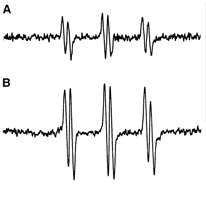
Fig. 1. Pre- (A) and postexercise (B) electron spin resonance (ESR) spectra of -phenyl-tert-butylnitrone (PBN) adduct in human plasma after maximal aerobic exercise (control phase) without ascorbic acid supplementation.
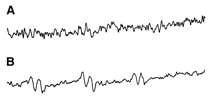
Fig. 2. Pre- (A) and postexercise (B) ESR spectra of PBN adduct in human plasma after supplementation with ascorbic acid.
The hyperfine coupling constants recorded from the ESR spectra of the PBN adduct were, for nitrogen and hydrogen, respectively, aN = 1.37 mT, aH = 0.19 mT for control group and aN = 1.37 mT, aH = 0.16 mT for the supplemented group, suggesting that the species detected in the present study are secondary alkoxyl radicals formed as a consequence of primary oxygen- centered radical attack on membrane phospholipids. The coupling constants seen in the present study compare favorably to those previously reported (aN = 1.36 mT; aH = 0.15 mT) in reperfused rat heart (7). Garlick et al. (7) suggested that the species found in the reperfused rat heart were either carbon-centered or alkoxyl radicals formed via reaction of primary oxygen- centered radicals with membrane lipids, which supports the conclusion drawn in the present study. Additionally, Tortolani et al. (19) have reported similar values of coupling constants (aN = 1.36 mT and aH = 0.19 mT), which they attributed to secondary carbon-centered or alkoxyl radical formation in the blood of patients undergoing elective cardioplegia, again supporting the interpretation of the ESR data seen in the present study. However, whereas the hyperfine coupling constants are similar among the various reported studies, the observed differences may reflect differences in experimental design, e.g., choice of solvent, which may influence the hyperfine coupling constants.
The most common aqueous
radical is the hydroperoxyl radical,
which is generated
in equal amounts with superoxide and is scavenged by ascorbic
acid, whereas ascorbic
acid may make a relatively greater contribution than vitamin
E to the plasma
antioxidant defense mechanism (21). If this is the case, then ascorbic
acid will scavenge peroxyl and alkoxyl radicals, preventing any increase in the postexercise ESR signal intensity. This is further supported by a lack of increase in the supporting assays of free radical-mediated lipid peroxidation, which is a radical chain reaction.
Supplementation with ascorbic
acid resulted in a 50% decrease in the baseline ESR signal compared
with controls, suggesting a suppression of resting free radical
production, whereas
increases in the plasma
total antioxidant capacity
imply improved antioxidant status. The mechanism
of action of the antioxidant properties of ascorbic acid involves direct interaction and scavenging of aqueous lipid-derived peroxyl radicals and chain breaking in lipid peroxidation (3). Additionally, the indirect antioxidant properties of ascorbic
acid include regeneration of vitamin
E from the tocopheroxyl radical
at the aqueous-lipid interface (12), whereas
ascorbic acid is itself regenerated by glutathione (10). The two-step
reversible oxidation
of ascorbic acid yields dehydroascorbic acid with the formation of the intermediate ascorbate free radical.
The delocalized nature of the unpaired
electron on the ascorbyl
radical makes it comparatively unreactive, although it is able to donate an electron
to other free radicals,
thereby stabilizing the radical
and preventing propagation of radicals
leading to lipid peroxidation. The identification of the species
as secondary alkoxyl radicals, probably
derived from membrane
phospholipids, and their location in the aqueous phase of the blood, provide a plausible biochemical explanation for the effectiveness of ascorbic acid in the present study.
However, what is not clear from the present study is precisely
where ascorbic acid acted to scavenge
the radicals produced by exercise. It is possible
that ascorbic acid acted intracellularly, since cells are saturated at doses of 200 mg. We suggest
that the most likely site of ascorbic acid scavenging is at the aqueous-lipid interface of the cell, which would allow ascorbic acid to not only scavenge intracellular aqueous radicals but also regenerate vitamin E in the phospholipid bilayer. However,
it is equally plausible that the effect of ascorbic
acid was only a
blood phenomenon, since plasma is saturated at doses of 1,000 mg, and thus ascorbic acid could scavenge any blood-borne radicals. Further work is undoubtedly required to answer this question.
Mean baseline levels of lipid peroxidation also appeared to be decreased after ascorbic acid supplementation compared with the control phase, although this difference was not statistically significant. Ascorbic acid supplementation did, however, prevent a significant increase in LH and MDA after maximal aerobic exercise. This may be an unusual observation in that ascorbic acid is a water-soluble antioxidant and perhaps as such would not be expected to inhibit lipid peroxidation or scavenge what may be lipid-derived radicals in origin. However, it has been recently reported (1) that exercise-induced lipid peroxidation was highest in healthy, physically active male subjects when they were not supplemented with ascorbic acid; thus the lipid peroxidation data in the present study are in agreement with reports in the literature. Also, in a randomized, placebo-controlled trial, supplementation with 1,000 mg of ascorbic acid was reported to enhance the total radical-trapping ability of the plasma (11). One possible mechanism by which the effect of ascorbic acid may be explained is that, since it is an effective reducing agent, donation of an electron by ascorbic acid to a peroxyl radical would have the effect of stabilizing the radical, thus preventing propagation of lipid peroxidation; it may also act further up the chain by scavenging superoxide.
Increased oxygen flux through intermediate metabolism during exercise increases the rate of oxygen free radical
production and alters cellular
antioxidant status (14). Furthermore, exercise participation can itself modulate interactions between nutritional status and immune function, especially via increased intake of antioxidants to protect the physically active person against an augmented production of free radicals due to increased
tissue metabolism and minor muscle injuries (16). Ascorbic acid has been described
as an outstanding antioxidant in human blood plasma (5), and Frei et al. (6) have further suggested that a simple controlled regimen of ascorbic acid supplementation may prove helpful in preventing the formation
of LH, which might not otherwise be detoxified by the endogenous plasma antioxidants, thus causing
damage to critical targets (6). The present study demonstrates a decrease
in all parameters associated with oxidative damage
and an enhancement of the antioxidant defenses in healthy human subjects before and after maximal aerobic exercise.
It demonstrates an attenuation by ascorbic
acid of the ESR signal and free radical-mediated lipid peroxidation products in human blood
pre- and postexercise. It is concluded
from these results that an acute ascorbic
acid supplementation prevents the significant increase in the concentration of the PBN adduct and lipid peroxidation and may be considered to be an effective antioxidant in the prevention of exercise-induced oxidative stress.
FOOTNOTES
The costs of publication of this article were defrayed in part by the payment of page charges. The article must therefore be hereby marked „advertisement” in accordance with 18 U.S.C.
§1734 solely to indicate this fact.
Address for reprint requests and other correspondence: T. Ashton, School of Applied Sciences, Univ. of Glamorgan, Pontypridd, Wales CF37 1DL, UK (E-mail: tashton@glam.ac.uk ).
Received 22 March 1999; accepted in final form 12 August 1999.
REFERENCES
- Alessio, H. M., A. H. Goldfarb, and G. Cao. Exercise-induced oxidative stress before and after vitamin C supplementation. Int. J. Sport Nutr. 7: 1-9, 1997[Medline].
- Ashton, T., C. C. Rowlands, E. Jones, I. S. Young, S. K. Jackson, B. Davies, and J. R. Peters. Electron spin resonance spectroscopic detection of oxygen-centred radicals in human serum following exhaustive exercise. Eur. J. Appl. Physiol. 77: 498-502, 1998.
- Bendich, A., L. J. Machlin, O. Scandurra, G. W. Burton, and D. D. M. Wayner. The antioxidant role of vitamin C. Adv. Free Radical Biol. Med. 2: 419-444, 1986.
- Davies, K. J. A., A. T. Quintanilha, G. A. Brooks, and L. Packer. Free radicals and tissue damage produced by exercise. Biochem. Biophys. Res. Commun. 107: 1198-1205, 1982[Medline].
- Frei, B., L. England, and B. N. Ames. Ascorbate is an outstanding antioxidant in human blood plasma. Proc. Natl. Acad. Sci. USA 86: 6377-6381, 1989[Abstract/Free Full Text].
- Frei, B., R. Stocker, and B. N. Ames. Antioxidant defences and lipid peroxidation in human blood plasma. Proc. Natl. Acad. Sci. USA 85: 9748-9752, 1988[Abstract/Free Full Text].
- Garlick, P. B., M. J. Davies, D. J. Hearse, and T. F. Slater. Direct detection of free radicals in the reperfused rat heart using electron spin resonance spectroscopy. Circ. Res. 61: 757-760, 1987[Abstract/Free Full Text].
- Gutteridge, J. M. C., and B. Halliwell. Antioxidants in Nutrition, Health and Disease. Oxford, UK: Oxford Univ. Press, 1994.
- Hemila, H. Vitamin C and the common cold: a review of studies with subjects under heavy
physical stress. Int. J. Sports Med. 17: 379-383, 1996[Medline].
- Meister, A. On the antioxidant effects of ascorbic acid and glutathione. Biochem. Pharmacol. 44: 1905-1915, 1992[Medline].
- Mulholland, C. W., and J. J. Strain. Total radical-trapping antioxidant potential (TRAP) of plasma: effects of supplementation of young healthy volunteers with large doses of – tocopherol and ascorbic acid. Int. J. Vitam. Nutr. Res. 63: 27-30, 1992.
- Niki, E. Interaction of ascorbate and -tocopherol. Ann. NY Acad. Sci. 498: 186-198, 1987[Medline].
- Nourooz-Zadeh, J., J. Tajaddini-Sarmadi, and S. P. Wolff. Measurement of plasma hydroperoxide concentrations by ferrous oxidation-xylenol orange assay in conjunction with triphenylphosphine. Anal. Biochem. 22: 403-309, 1994.
- Packer, L., and C. Viguie. Human exercise: oxidative stress and antioxidant therapy. In: Advances in Myochemistry 2. Proceedings of the 3rd Congress of Myochemistry, edited by G. Benzi. London: Libbey Eurotext, 1989.
- Podmore, I. D., H. R. Griffiths, K. E. Herbert, N. Mistry, P. Mistry, and J. Lunec. Vitamin C exhibits pro-oxidant properties. Nature 392: 559, 1998[Medline].
- Shephard, R. J., and P. N. Shek. Heavy exercise, nutrition and immune function: Is there a connection? Int. J. Sports Med. 16: 491-497, 1995[Medline].
- Sjodin, B., Y. H. Westing, and F. S. Apple. Biochemical mechanisms for oxygen free radical formation during exercise. Sports Med. 10: 236-254, 1990[Medline].
- Somani, S. M., and C. M. Arroyo. Exercise training generates ascorbate free radicals in rat heart. Indian J. Physiol. Pharmacol. 39: 323-329, 1995[Medline].
- Tortolani, A. J., S. R. Powell, V. Misik, W. B. Weglicki, G. J. Pogo, and J. H. Kramer. Detection of alkoxyl and carbon-centred free radicals in coronary sinus blood from patients undergoing elective cardioplegia. Free Radic. Biol. Med. 14: 421-426, 1993[Medline].
- Vuilleumier, J. P., and E. Keck. Fluorometric assay of vitamin C in biological materials using a centrifugal analyser with fluorescence attachment. J. Micronutr. Anal. 5: 25-34, 1989.
- Wayner, D. D. M., G. W. Burton, K. U. Ingold, L. R. C. Barclay, and S. J. Locke. The relative contributions of vitamin E, urate, ascorbate, and proteins to the total peroxyl radical trapping antioxidant activity of human plasma. Biochim. Biophys. Acta 924: 408-419, 1987[Medline].
- Whitehead, T. P., G. H. G. Thorpe, and S. R. J. Maxwell. An enhanced chemiluminescent
assay for antioxidant capacity in biological fluids. Anal. Chim. Acta 266: 265-277, 1992.
- Young, I. S., and E. R. Trimble. Measurement of malondialdehyde in plasma by high- performance liquid chromatography. Ann. Clin. Biochem. 28: 504-508, 1991.
J APPL PHYSIOL 87(6):2032-2036
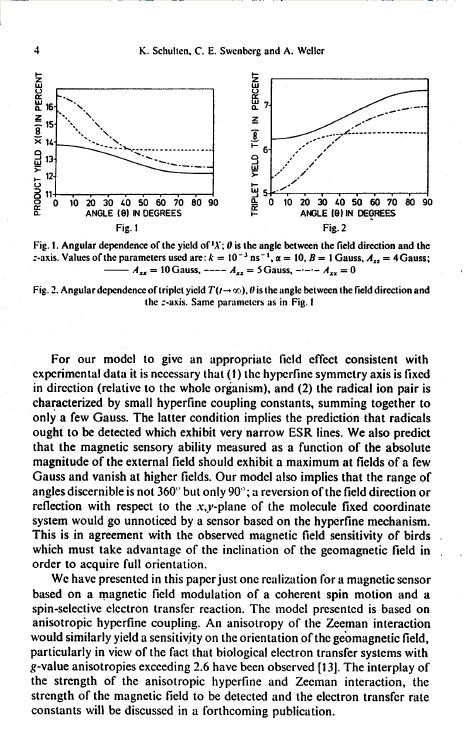
Twin photons prove Bell’s Theorem and non-locality of universe
Physicist RAYMOND Y. CHIAO is widely known for pioneering experiments in the twilight zone of quantum mechanics where objects can pass through solid walls. His recent work involves investigations of faster-than-light phenomena. He has measured how long photons take to “tunnel” through a barrier that ought to be impenetrable and found that they appear to outpace the speed of light when they are successful in reaching the other side. Born in Hong Kong and educated in the United States, he earned a bachelor’s degree from Princeton University, where he was elected to Phi Beta Kappa in his junior year, and a Ph.D. in physics from the Massachusetts Institute of Technology in 1965. After teaching at MIT for two years, he joined the physics faculty of the University of California, Berkeley and was named a full professor in 1977. Dr. Chiao has held a Woodrow Wilson Fellowship and an Alfred P. Sloan Fellowship. A member of Sigma Xi, he won the second prize of the Gravity Research Foundation in 1981 and the Scientific Innovation Award for Outstanding Work in Modern Optics from the Center for Advanced Study at the University of New Mexico in 1986. He is a fellow of both the American Physical Society and the Optical Society of America. Dr. Chiao has published some 125 papers in major scientific journals. He edited Amazing Light (1996), a volume dedicated to the Nobel laureate Charles H. Townes on the occasion of his eightieth birthday.
Nature 419, 577 (10 October 2002) | doi:10.1038/419577a
Quantum physics Single photons stick together
Philippe Grangier
ABSTRACT
In the right circumstances, two photons can meet and 'coalesce’. This effect has now been observed for photons emitted independently from a single-photon source, and has implications for quantum computing.
Can two photons that have never met know something
about each other? The question bothered Einstein, and, reporting on page 594 of this issue, Santori et al.1 demonstrate in a new context that the answer
is
'yes’.
Quantum Theory and Reality
| A new scientific truth does not triumph by convincing its opponents and making them see light, but rather because its opponents eventually die, and a new generation grows up that is familiar with it. Max Planck What we observe is not nature itself, but nature exposed to our method of questioning. Werner Heisenberg | |
| Anyone who has not been shocked by quantum physics has not understood it. Niels Bohr One can’t believe impossible things. Alice in Wonderland | |
| What is an Electron? Of Particles and Waves | |
| Our story will be begin here because it is the electron, and our knowledge of it, that has been responsible for so much of the technology that we take for granted today. Without the electron there would be no electricity, no electric lights, no TV, radio, CDs, DVD’s, thumb drives, cell phones, computers and electronic social networking. We would not have supermarket doors that open automatically or computers to play video games, surf the Web, and do word processing and spreadsheets for business. But what exactly is an electron? In the early moments of the twentieth century scientists found themselves asking this very question. The discovery of radiation and the atom promised to open up a strange new world of knowledge, understanding, and power. At first physicists assumed that the atom was like a miniature solar system. At the center was a nucleus consisting of particles glued together somehow, and that circling this nucleus were the swiftly moving electrons, like little particle planets. This model did not last very long. Although we still use a version of this model today to have some visual handle on what the atom looks like, the pioneers of atomic physics discovered fairly quickly that mathematical calculations based on this model predicted that the electron would crash into the nucleus in an instant. Physicists also discovered that electrons could be stripped from the atoms and made into beams of radiation. This was a great breakthrough, because they could manipulate these beams, and begin to deduce from the behavior of these beams the nature of the |
| electron itself. A similar channel of investigation was taking place in attempting to understand the nature of light. From this another remarkable discovery was made: Beams of electrons behaved very much like beams of light. | |
| There is one simplification at least. Electrons behave in this respect in exactly the same way as photons; they are both screwy, but in exactly the same way. Richard Feynman | We saw that the speed of light was considered a paradox by many at the turn of the century. By this time the nature of light was also very controversial and something of a paradox. Under some conditions light seemed to behave as if it consisted of very small particles of matter (now called photons). Under other conditions, however, light showed clear signs of being a wave of energy, a disturbance of a medium, the intensity of which could be measured. To understand how this is a problem, we must first clearly understand that a particle and a wave are very different phenomena. A particle is a localized piece of matter, like a baseball, that at any given time has a definite size. It can be in only one place at a time. A baseball thrown in Hawaii cannot be in New York at the same time. Furthermore, we assume, ontologically speaking, that we may discover in this marvelous universe some very strange objects but that, regardless of how strange they are, if they are objects, then they will have a definite location at any given definite time. A wave, on the other hand, is a very different kind of thing. In fact it is appropriate not to refer to it as a thing at all, but rather as an event or phenomenon. Things by definition have a definite localized size at a given definite time. Waves do not. Imagine dropping a pebble into a still pond of water. At first there is a small splash, and then circular waves move away from the spot where we dropped the pebble. The wave spreads out; it does not stay in one place, but can be in many places at the same time. Also, it is the medium of the water that transmits the energy of the dropped pebble. The wave is simply a disturbance of the medium. It does not have an existence of its own like the smile of the Cheshire cat in Alice in Wonderland. Without the water being in the pond there would be no waves. On the north shore of the Island of Oahu in the State of Hawaii, every winter large waves pound the shoreline. These waves are caused by the seasonal winter storms migrating northeast of the state in the jet stream on their way to make life miserable for people in the Pacific Northwest, and eventually much of the rest of the continental United States. The winds from the migrating storms cause a significant disturbance in the sea and a series of undulations are transmitted many miles until finally, reaching the reef on the north shore of Oahu, |
| spectacular waves of thirty feet or higher break and push forward a mountain of water and foam toward the beach. On the cliffs overlooking Waimea Bay you can watch a gigantic half circle of water march relentlessly toward the beach and then simultaneously, across a quarter mile area, surge onto the beach. It is a very spectacular sight. Tourists travel many thousands of miles to see it, and single- intentioned surfers wait in anticipation all year, hoping to be the first to ride the biggest wave on record and survive. | |
| It would be a strange event indeed, if one day while watching wave after wave break, we saw one wave flow in its normal way toward the beach, and then, just as the wave was about to touch the fringes of the vulnerable beach, the entire half circle of water collapsed instantly to a single unpredictable point on the beach and exploded! The wave would have turned into a massive particle located at one place, rather than spread out as waves normally are. Imagine wave after wave doing this, with the location of the collapse being unpredictable each time. Strange indeed this would be, but something like this is what electrons and photons seem to do! | |
| Thought Experiments | |
| All of modern physics is governed by that magnificent and thoroughly confusing discipline called quantum mechanics …. | The science of the subatomic realm is called quantum physics or quantum mechanics. The word „quantum” refers to the fact that energy at the subatomic realm comes in packets, or quanta; energy is said to be „discrete” rather than continuous. The best way of understanding the implications of discrete motion is to understand the most famous phrase in this science, the „quantum jump.” As we will see, this does not refer to a continuous quick motion, such as a child jumping from one place to another, but rather a discontinuous, instantaneous movement from one place to another. In other words, quantum objects seem to be able to move from place to place without being anywhere in between. They seem to „pop” in and out of existence. In the following pages we are going to retrace the same baffling steps taken by physicists in the twentieth century. The goal was simply to understand the nature of subatomic objects such as the electron and the photon. The result was a revolution in thought so radical that even Einstein could not accept it. We will be using though a method Einstein would have approved of, what are called „thought” experiments. Instead of looking at the actual technical experiments, we will imagine a series of composite pictures that remain true to the |
It has survived all tests and there is no reason to believe that there is any flaw in it …. we all know how to use it and how to apply it to problems; and so we have learned to live with the fact that nobody can understand it. Murray Gell-Mann
actual experimental findings.(1)
Imagine first a lead box impenetrable except for two microscopic slits on one side. Inside the box the side opposite the slits is coated with photographic film. Imagine that on the outside facing the two slits we have a source of radiation, beams of electrons or light, and that we aim this radiation at the face of the box with the two slits. By looking at the kind of exposure that results on the photographic film, we can infer what kind of radiation is penetrating the box. For instance, if the radiation consists of beams of particles, then only those particles that happen to be aligned with the two slits will pass through into the box, and the result should be a „particle effect”: The photographic film should show a diffused piling up of little hits adjacent to the two slits.
On the other hand, if the radiation is a wave, then a much different effect should result. We should see a „wave effect,” roughly the same result we would see if we dropped two stones into a still pond of water at the same time. Two circular undulations would collide into each other and interfere with each other. In our example, a wave would split in two as it enters the two slits, and then the two waves would begin to spread out again, eventually colliding with each other as in our pond example. This should cause an „interference effect,” a wave picture, on the photographic film. Instead of a piling effect adjacent to the two slits, the radiation would spread throughout the length of the photographic film, producing alternating bands of exposure. Some of the wave crests would meet and accentuate each other, and some would meet the troughs of other waves and cancel each other. This is similar to a wave approaching the beach and a backwash wave meeting it and producing a bigger wave, or a crest meeting a trough of another wave and canceling each other. The exposed bands on the photographic film would be the result of the crests meeting. Such a resourceful experimental process is what Einstein had in mind with his clock analogy. We may not be able to see the invisible electron, but we can infer a reasonable representation of what it is by observing the effects it has on macroscopic objects.
When
similar experiments are done, the result is remarkable. The photographic film always shows an interference effect indicating a wave Amazingly, the radiation
produces this same effect in passing through a vacuum,
presumably a physical
state with no wave medium
such as air or water. How can a wave exist without a substance
of some sort to disturb?
Also, when we look closely at the exposure of
| the film, the exposed areas show piles of little hits, as if millions of individual particles hit the film, each blackening only a single grain of film in unpredictable locations. Remember that if the radiation is a wave, then as it reaches the film, it should be spread out along the entire length of the film like a wave breaking on a beach. But how can it hit at only one unpredictable place? This is as ridiculous as the possibility of watching a wave march toward a beach and seeing the entire wave collapse at a single point on the beach! | |
| In the universe great acts are made up of small deeds. Lao Tsu | Obviously, more experiments are necessary. Baffling results are common in science. So let’s close one of the slits and see what happens. Perhaps the particles are so small that as they penetrate the slits they ricochet all over the interior of the chamber, bouncing off each other in a wild unpredictable manner which eventually somehow produces the illusion of an interference effect. After all, the electron is about 10,000 times smaller in mass than an average atom. Thus, in closing one of the slits, we would lessen this wild ricocheting, and a piling effect should result adjacent to the single slit. Sometimes nature cooperates. If we alternate in opening and closing each slit, the result appears consistent with the particle hypothesis — a double piling effect adjacent to each slit. But wait. To be sure that we are dealing with a particle, let’s return to our original experimental setup with two slits open simultaneously. This time, however, we will lower the intensity of the radiation. Another way to lessen the possibility of the ricocheting effect, and at the same time rule out once and for all the wave hypothesis, is to filter the radiation to such a point that only a single measure of radiation passes through into the chamber at a time. If the radiation consists of particles, if only a single particle is passing through at a time, it can go through only one slit or the other. If it is a particle, then it cannot ricochet off other particles or be in two places at the same time and ricochet off itself. |
| The „paradox” is only a conflict between reality | Conducting this experiment will take more time for an exposure to develop because millions of particle hits will be required to make an exposure, and there are three possible paths for each particle: to penetrate the chamber through either of the two slits or be stopped by the lead barrier. Nevertheless, we should eventually observe a particle effect — a double piling effect of hits adjacent to the two slits. Alas, nature fails to cooperate. The result is an interference effect, exactly as in our first case. Now we are really in trouble. Why should |
| and your feeling of what reality „ought to be.” Richard Feynman | we get a wave effect with two slits open, even though the exposure is the result of cumulative unpredictable hits, and a particle effect with only one slit open? With two slits open the radiation is acting as if it penetrates the chamber at two places simultaneously, something only a wave can do. With one slit, however, the radiation is more localized,(2) as we would expect from particles that can be in only one place at a time. It is easy to lose sight of the philosophical significance of these results. Many of the great names of science, however, who were working at understanding this baffling microscopic realm, also had a background in philosophy, and it was immediately apparent that there was something major at stake here. Since the time of the ancient Greeks and the fledgling beginnings of scientific exploration, we have assumed that we are dealing with one world, one consistent reality. That is, even though we expect the world to be baffling at times, with strange and new details of discoveries, we also expect that whatever these details are, they stay the same independent of our knowing. They are objectively „out there” waiting for us to discover, and they are what they are regardless of our knowledge or ignorance. We assume as Newton did that the world does not depend on us or how we choose to make our observations of it. We do not expect something to be a particle on Mondays, Wednesdays, Fridays, and Sundays, and a wave on Tuesdays, Thursdays, and Saturdays — especially when these phenomena are of entirely different types. What kind of a world would it be for us if dogs were dogs on certain days of the week but turned into cats on others? |
| If we take quantum theory seriously as a picture of what’s really going on, each | Let’s try one more example. What we want to know is, does the radiation pass through both open slits simultaneously or only one? Consider then the following experimental arrangement: both slits open, one measure of radiation entering the chamber at a time, but with one added feature — a detection device inside the chamber that will reveal whether or not the radiation is passing through both slits as a wave would or only one or the other of the slits as a particle would. Because the situation is almost identical to the case in which an interference effect was recorded, we would expect to see the detection device react as if a wave was surging through both openings simultaneously. On the other hand, if the radiation consists of particles, then only one instance of detection should be recorded at a time. Remarkably, the latter is the case — only one instance of detection is recorded at a time — and the photographic result is now consistent with the arrangement with only one slit or the other open!! |
measurement does more than disturb: it profoundly reshapes the very fabric of reality.
Nick
Herbert
As physicists conducted further experiments with subatomic phenomena, they found that all subatomic phenomena display this same ambiguity. This ambiguity has come to be known as wave- particle duality. This result was not easy to accept. One of the most fundamental principles of science seemed to be mocked by these results: the notion that we are dealing with, and can know the details of, an objective world. To use Einstein’s cosmic clock analogy, we expect that the internal mechanism stays the same regardless of our hypotheses and beliefs about what the internal mechanism is. We do not expect the internal mechanism to change as we change our experimental attempts to know the internal mechanism.
It is perhaps one of the greatest achievements of the twentieth century that in spite of this shock, a very successful mathematics was developed that not only allowed physicists to predict the results of the above experiments but also produced one of the greatest scientific and technological success stories in recorded history. In 1926 the physicist Erwin Schrodinger discovered a wave equation that predicts the above results, but with a high epistemological and ontological price.
As we would expect from the name, the equation literally portrays the radiation as a wave, but a very strange wave. According to the equation, in our two-slits-open configuration as soon as the radiation leaves its preparation point, it begins to spread out in a strange multidimensional „hyperspace.” As it encounters the slits it splits, as any real wave would, passing through into the chamber and interfering with itself. As the radiation touches the photographic film, however, all of the energy of the wave collapses to a single unpredictable point! We can never predict at what exact point the radiation will be received, but we can always, with a remarkable consistency, predict the probability of where it will strike and the overall statistical pattern, not only for this particular arrangement, but for all the others as well.
Because
of the influence of the twentieth century philosophy called logical positivism, most physicists have been taught to think of the equation
as
a calculation device,
not as depicting what is
literally real. The special mathematical function used
is thought to represent
only a „probability function” for, given initial
conditions, the probability of finding a hit, or a pattern of hits, at a particular location. Thus, the only waves that exist are said to be „probability waves.” Thus, just as some astronomers during the middle
ages thought
of Ptolemy’s
| epicycle as just a device used for making predictions where planets would be, the wave equation is just a device for predicting what electrons will do. For the logical positivists, the question of reality was a nonsolvable useless philosophical question. | |
| We have sought for firm ground and found none. The deeper we penetrate, the more restless becomes the universe; all is rushing about and vibrating in a wild dance. Max Born | But wait. Given the tremendous success of our electronic technology in the twentieth century are we really no longer interested in the foundational reality behind all this success? Don’t we still want to know what electrons and photons are? Let’s look at one more example. Imagine a light source directed at a half-silvered mirror, a mirror covered with a very light reflective coating. Such a mirror functions as a beam-splitter. Shining light on the mirror tilted at an angle will cause the light to split into two separate beams. If we assume that light consists of little particles called photons, then the physical properties of the half-silvered mirror should cause each individual photon to pass through the mirror or be reflected at an angle. Each photon must become part of one beam or the other. If we set up photon detectors at the appropriate angles, at points A and B, individual detections at A or B should result. With this experimental arrangement, the mathematics predicts that over a sufficient period of time 50 percent of the light will be received at A and 50 percent will be received at B. Furthermore, if the intensity is lowered through filtering, such that only a single photon approaches the mirror at a time, then only a single whole photon should be detected at a time. Detections at A and B should never be recorded simultaneously. This prediction is just common sense. If the photon is an individual object, it cannot be in two places at the same time. When such an experiment is actually conducted one whole unit of energy is detected at either A or B, confirming the particle interpretation of subatomic phenomena. If a photon is a particle, it will pass through the mirror and be detected at A or be reflected and detected at B. However, remember that the Schrodinger equation is a wave equation. If the equation is interpreted literally, the equation describes that the light energy is in both channels! The half-silvered mirror splits a wave packet into two „hyperspatial, virtual/real, probability” waves. Then at the exact moment that the energy reaches the detectors, some sort of strange decision is made, and the entire unit of energy is received at only one point, at either A or B! The wave packet „collapses.” If a whole unit is received at A, then the energy that was approaching B has jumped over to A. In addition, the equation predicts this will happen even if the two detectors are |
separated by many light years, and even if one detector is much closer to the half silvered mirror than the other. The latter case implies that the energy that is approaching the one that is closer, say B, waits?! until the energy approaches A, and then either jumps to A or the energy that was approaching A goes „backward in time” and collapses at B. The mathematics always works, but what it describes literally seems impossible. Like Alice in Wonderland, we cannot believe in impossible things can we? According to the mathematics, there is an instantaneous collapse of potentiality in multidimensional hyperspace to a three-dimensional location. Strange indeed. So physicists who follow the logical positivists party line tell us that we must not think of the split wave packets as real, but only as a description of the probability of where photons will go.
But wait. Can we prove that the light really passes through both channels? Quantum jumping and wave collapsing aside, we can at least test for the photons passing through both channels. Consider the following arrangement. This time we will create an interferometer by placing totally reflecting mirrors at the points where detectors A and B were. Thus, if the light beam is really split by the half-silvered mirror, the totally reflecting mirrors will now reflect the split beams of light. If we aim these totally reflecting mirrors so that the beams will meet again, it is possible to take a picture of the waves interfering with each other, just as we did in the two slit experiment. With this arrangement, interference fringes result similar to that found in the two slit experiment. The interference effect can be produced by having one of the totally reflecting mirrors slightly farther away than the other, so that the light waves will arrive out of phase. The beams are recombined by another half-silvered mirror and transmitted to a chamber with a photographic plate.
If the intensity of the light is reduced
to one photon at a time, the interference effect can only be accounted for by assuming the photon really splits into two wave packets
and then recombines. In fact, if we pick up an ordinary
playing card and block one of the paths, there is no interference picture. Instead, a defused piling exposure is created, similar to the particle picture
we received when only one slit was open in the previous
experiment. If the energy is a wave, then we can understand the interference picture. If the energy is a particle, then we can understand the fact that only one detector at a time receives one whole
unit of energy.
The result of one arrangement indicates that a wave of some kind is really passing through both channels simultaneously. The result of the other makes sense, if we assume
| that the energy is passing through only one channel at a time. If the energy is passing through both channels at the same time, why do the detectors not trigger simultaneously? How does the energy passing through one channel get over to the other detector? How could this possibly happen if the detectors are far enough away that any transmission of a signal between them would require a speed greater than the speed of light? It is time for a little philosophy. | |
| The Copenhagen Interpretation | |
| In a sense [for the Copenhagen Interpretation], the observer picks what happens. One of the unsolved questions is whether the observer’s mind or will somehow determines the choice, or whether it is simply a case of sticking in a thumb and pulling out a plum at random. Dietrick E. Thomsen Atoms are not things. Werner Heisenberg | Nature at the subatomic level apparently does not conform to normal logic. Since the time of the ancient Greeks, Western logic, through Aristotle’s law of excluded middle, has demanded an „either-or” in our relationship with the universe. Either light is a particle or it is not a particle. Either light is a wave or it is not a wave. Either the light splits and goes through both channels or it does not. If it goes through both channels, it should be detected at both channels. It is not detected at both channels, yet it does go through both channels. If it goes through both channels, why is one whole unit of energy detected at only one detector? How do two halves spatially separated become one whole unit instantaneously? No logical inconsistency exits within the mathematics itself. In the particle-effect case, the mathematics allows us to predict that approximately 50 percent of the time detector A will record a unit of energy and 50 percent of the time detector B will record a unit of energy. In the interferometer arrangement, the mathematics predicts an interference effect, and even allows a straightforward calculation of the wave length of light by measuring the interference fringes. The problem is more in our reaction to the results of these experiments and the success of the mathematics. We want to know what kind of a thing is producing these strange results. What is going on „out there” that enables the mathematics to be successful? Our minds desire a complete understanding. What is real? What is the truth? These questions reflect our natural curiosity about reality. We want to go deeper, to find the basic, hidden causes of all things. Western science since the ancient Greeks has assumed an ontology: The cosmos consists of one distinct, complete reality full of individual separated details. We have also assumed an epistemology: The details, whatever they might be, can be known, and the process of knowing these details does not affect what the details actually are independent of the knower. This is consistent with our common sense |
| and what each of us experiences everyday: a world undisturbed by human thoughts, wishes and desires, full of things, spatially separated from each other, and interacting with each other through distinct recognizable forces. If someone has a tangerine tree in his yard, he might wish that it would be an apple tree, but it will still be a tangerine tree. Similarly, we do not think of someone thinking cancer into existence or wishing it away. We think of the cancer being objectively „out there,” something beyond our mental control, like trees. We can cut down trees and operate on cancer, but they are distinct realities that we discover with our thinking, not something that we create with our thinking. | |
| Causality may be considered as a mode of perception by which we reduce our sense impressions to order. Niels Bohr | So it is natural for us to think of electrons or photons as some sort of independent things. They show signs of being particles, so we begin to think of them as if they really are particles independent of our observations of them. But they also shows signs of being waves, and they cannot be both waves and particles at the same time, no more than a tree can be both a tangerine and apple tree at the same time or someone can have cancer and not have cancer at the same time. In the 1920s a few philosophically minded physicists, led by the Nobel Prize-winning physicist Niels Bohr, realized that nature was trying to tell us something very important. Once again nature was using paradox to alert us to a fundamental error in the assumptions we were making and the way we were asking our questions. According to Bohr, and what is known as the Copenhagen interpretation,(3) the results of these encounters with subatomic phenomena amount to a major epistemological discovery. Descriptive terms such as „particle,” „wave,” „position,” „mass,” and „spin,” are human concepts. These concepts involving assumptions of space and time work for us at a normal macroscopic level and will always be indispensable for describing the results of our physical experiments. But nature is now making it very clear to us that we have reached a barrier in our attempt to describe it fully in terms of human concepts derived from ordinary experience. Wave-particle duality is nature’s way of informing us that cannot impose our human concepts on the subatomic level. Just as Einstein had discovered that we cannot impose our normal assumptions of space and time to all levels of reality, so quantum physics reveals that we have no empirical justification to impose our most basic thoughts about the nature of reality on the subatomic realm. The idea of an extended thing sitting in a three-dimensional space, waiting for us to discover it, is revealed as another human projection, a limited image |
| When Einstein has criticized quantum theory he has done so from the basis of dogmatic realism. Werner Heisenberg | of reality, more of an echo of the way our minds work than reality itself. According to Bohr, nature empirically reveals this understanding to us by showing that we can have only complementary views of reality. If we set up an experimental arrangement that allows for a wave manifestation of subatomic phenomena, wave effects will be observed. If we set up an experimental arrangement to view subatomic phenomena as particles, particle effects will be observed. According to Werner Heisenberg, another major contributor to the Copenhagen interpretation, what we observe in our experiments is not nature itself, but nature exposed to our methods of questioning nature. In short, an electron is not a thing until we observe it! Bohr argued that this interpretation is a necessary, „pragmatic” response. Experiments must be conducted in human terms, in laboratories full of macroscopic equipment in three dimensions. Our laboratory equipment must be capable of measurements that are understandable through the conceptual reference frame of human beings. This barrier, however, should not be seen as an end to science or as an imposed state of ignorance. It is a discovery, a momentous discovery about ourselves and the nature of science. To discover that complementary views of reality exist, rather than only one unified view, is as important as Einstein’s discovery that the reference frame of an observer is crucial for measuring space and time. Rather than limiting science, Bohr viewed this new knowledge as liberating the sciences from the tyranny of thinking that each science must explain itself in terms of a more basic science such as physics and chemistry. Biology, for instance, could very well be a complementary perspective on living things, not totally reducible to physics and chemistry. |
| A Debate: Bohr and Einstein | |
| We believe in the possibility of a theory which is able to give a complete description of reality, the laws of which establish relations between the things themselves and not merely between their | Ironically, the main resistance to the Copenhagen interpretation came from Albert Einstein and a few of his followers. Einstein objected very much to the idea that we had stumbled upon a barrier to knowing what is real. Philosophically, Einstein was a realist who believed that the goal of science was to conjecture boldly about the nature of reality from the details of our empirical observations. He acknowledged that as we continued to probe nature for her secrets, we would encounter more and more exotic features, the majority of which would never be directly observable because of human limitations. He believed, however, that the human mind could always infer at least the most likely hypothesis about the nature of the reality |
probabilities …. God does not play dice. Albert Einstein
It is wrong to think that the task of physics is to find out how nature is. Physics concerns what we can say about nature. Niels Bohr
causing the events we do observe. Thus, although Einstein introduced the world to a revolutionary view of space and time, one that destroyed the classical or Newtonian conceptions of absolute space and time, he nevertheless remained a classical physicist faithful to the concept of reality Descartes stated centuries earlier: „There is nothing so far removed from us to be beyond our reach or so hidden that we cannot discover it.”
As we noted previously, for Einstein, nature was like a mysterious clock. We are limited to observing only the exterior features of this clock. We may never be able to see directly inside and know for certain how the clock works, but by observing and thinking about the movement of the hands long enough, the human mind will provide a very likely answer as to how the clock works. For Einstein a clockwork for the universe exists and can be known. For Bohr, for us to assume that a clockwork exists independent of our observations that we can picture in human terms is only another human philosophical bias, another example in a long line of assumptions that experience validates at a certain level, but which experience at another level now demonstrates cannot be considered to be true.
Although Bohr thought quantum physics to be in part an important epistemological discovery, and the barrier between the human mind and reality primarily pragmatic, the Copenhagen interpretation does raise the question of whether this epistemological discovery is also an ontological one. For Einstein, Bohr’s interpretation was much too close to, and in fact seemed to imply, a traditional ontology — an ontology historically very much opposed to the major goal of scientific method. If an electron is not a thing until it is observed by some instrument, does this not imply that reality depends on our observations, and hence, ultimately the thoughts we use to frame the world? Does this not imply that reality is created by human thoughts?
Metaphysical Idealism is a old and widespread belief stating
that the physical world as we experience it is basically an illusion; the perception of a world of material things separated in space is said to be only an appearance. Individual things exist only in so far as we have an idea of them. Supporters of this metaphysics argue that if there were no human observer or recording
instrument of any kind in a forest, then a falling tree would make no sound. In fact, there would be no trees to fall and no forest. When I walk out of a room, I assume
that the physical room and all its contents are still objectively there. But according to the Idealist, the room ceases to exist if there is no
| one there to have a thought of the room. | |
| Would it (the world) otherwise (without consciousness) have remained a play before empty benches, not existing for anybody, thus quite properly not existing? Erwin Schrodinger First they told us the world was flat. Then they told us it was round. Now they are telling us it isn’t even there! Irving Oyle | The majority of scientists have always viewed this metaphysics with disdain, as more of a symptom of despair of the sometimes harsh realities of the physical world, as primarily a religious view associated with those who find the physical universe threatening and who desire a more perfect world. Does the Copenhagen interpretation of quantum physics validate this philosophy? How embarrassing for Western science if this is so. Imagine that after thousands of years of struggling to know the details of Democritus’ atom, Western science shipwrecks into a religious philosophy it thought it had left behind at a more primitive time! Thus, Einstein viewed quantum physics to be an incomplete theory. He argued that we simply do not know enough yet. Our knowledge is not complete. Because we cannot produce a consistent picture of subatomic phenomena, we obviously do not know exactly what these things are yet and enough about the mysterious forces governing their motions and manifestations. Einstein summarized his view with the famous statement, „God does not play dice with the universe.” In other words, God has created one universe and does not choose to have it manifest itself as full of waves at one moment and as particles at another for no reason. Bohr and Einstein had several public debates over what was the proper interpretation to give to the results of quantum physics. These were fascinating discussions between two intellectual giants, but little was resolved at the time. The vast majority of physicists heeded Bohr’s advice that there was a pragmatic limitation inherent in our measuring devices. Physicists should be interested primarily in being able to predict experimental results and not in the question of what is real. They were persuaded, with the help of a philosophical tradition that began with Hume, that the question of what is real is primarily an unanswerable philosophical question. Physics must concern itself primarily with complex experimental arrangements and the derivation of the complex mathematical formulas needed to predict the „constant conjunctions” of appearances first discussed by Hume. On the other hand, motivated by the goal of finding a hidden reality, physicists have also pursued Einstein’s dream of a unified picture of reality, of seeking a theory that enables us to understand at a fundamental level all the forces of nature. Bohr claimed he was being the better empiricist. He argued that the results of quantum experiments provide empirical evidence that |
| nature does not have a hidden true self that can be pictured with human concepts. It seems so obvious that nature must have some objective true self. But it also seemed so obvious that time was absolute. Einstein provided the means to demonstrate with empirical evidence that there is no universal, objective, absolute time, one slice of simultaneity throughout the universe. Today, to continue to believe that there is an absolute time is simply metaphysical dogma, given the overwhelming reliable empirical evidence to the contrary. But Einstein failed, according to Bohr, to understand that the empirical evidence also demonstrates that the faith in a hidden, objective reality is but faith in a dogma. | |
| Bell’s Discovery | |
| Bell’s theorem is easy to understand but hard to believe. Nick Herbert | So, is there any way of answering the question whether nature has a hidden objective reality? Following Bohr, experiments have been conducted that are consistent with the view that it does not; that in our relationship with the universe we can have only different pictures of its clockwork — actually, to be more precise, that a precise clockwork does not exist until we attempt to picture it! For many years following the Bohr-Einstein debates it was thought that the issue between them must forever be relegated to the realm of inconclusive philosophical perspectives. No conceivable experiment was known that could be conducted to disconfirm either one. Bohr could argue that the experimental results are most consistent with his theory of complementarity, but he could not prove that some day we would not discover some bizarre hidden reality that explained how an electron could manifest itself as a wave in one situation and a particle in another. Similarly, the followers of Einstein could argue that if we think, and search, long enough someday we will find this hidden reality. No one knew of an experiment that would decide such an apparent metaphysical issue and eliminate or confirm the possibility of a hidden reality. In 1964 physicist John Bell discovered that it was theoretically possible to test whether or not quantum physics was a complete theory. By tinkering with the mathematics, he discovered that an experiment could be devised to confirm or disconfirm hidden processes, or „variables” as physicists refer to them. Before we describe this discovery and its application in crucial experiments, let us review first why quantum measurements are so puzzling. The essence of all the puzzles, according to the physicist- |
No elementary phenomenon is a phenomenon until it is a recorded phenomenon. John Archibald Wheeler
philosopher Henry Stapp, is „How do energy and information get around so fast?” In the interferometer experiment we can demonstrate that a wave is passing through both channels. But when we modify the experiment to detect the radiation in each channel, we detect only one whole unit of energy at a time per channel, implying not only that the radiation consists of particles, and therefore not waves, but also that the radiation is not in both channels. In the particle detection experiment the Schrodinger equation describes a wave splitting process with a „probability” wave in both channels, and then an instantaneous collapse of a potential existence to one localized „actual” spot, to either detector A or B. The Copenhagen interpretation deals with this puzzle by claiming it is inappropriate to think of the radiation as some kind of definite real thing before we measure it. The radiation „becomes” something definite, conceptualizable by human beings, only after we measure it. (It is always a particle after we measure it, even though some measurements suggest the particle had wave-like properties between measurements.) Reality, specific attributes possessed by things, according to the Copenhagen interpretation, can only be discussed in terms of an „entire experimental arrangement.”
According to Bohr, the problem of quantum measurement can be interpreted as a pragmatic epistemological discovery and does not necessarily imply an idealist metaphysics. Concepts such as „particle” and „wave” are human concepts, and we have discovered that nature will not allow us to picture it consistently with these concepts. Insofar as we must always conduct our experiments through a human framework, with human concepts, there is an epistemological barrier that no future scientific discovery will change. For Bohr, the success of quantum theory represents a „treasure chest” of scientific and philosophical discoveries. The Copenhagen interpretation should not be viewed as advocating a dogmatic end to research and discovery, but rather a dramatic discovery that continues a trend first started by Copernicus and sustained by the startling discoveries of Einstein: The universe is not required to conform to human concepts. Our belief that nature must have one true self, one consistent clockwork for us to tinker with, is revealed to be merely another human belief and not necessarily the way things are.
In a fundamental way Bell’s discovery allowed
physicists to test Bohr’s claimed epistemological discovery. A test was now possible
to see if the subatomic
realm had a true self
independent of our measurements.
| Quantum Jogging | |
| The hope that new experiments will lead us back to objective events in time and space is about as well founded as the hope of discovering the end of the world in the unexplored regions of the Antarctic. Werner Heisenberg I think I can safely say | To understand Bell’s discovery and the eventual experiments, let us try an analogy first. Suppose we have a large group of runners. Half of the runners are tall and half are short. Suppose that each of the short runners and each of the tall runners has a twin. Each of the twins will begin running at the same point, but will run a course in the opposite direction to a finish line that is the same distance from the original point of departure. Suppose also that each runner will run the course at the same speed, and that the spacing between the times when each runner leaves is such that no runner will be able to overtake the one immediately preceding him. No tall runners will overtake short runners or vice versa. Imagine then a continuous stream of runners leaving the original point and running in opposite directions. We might have something like this: Two short runners leave the starting point one after the other simultaneous with their respective twins, then two tall, then two short again, then one tall, and one short after that, then two tall, and so on. Suppose that overall the pattern is random. Suppose further that the contingencies of the course and physical training of each runner are such that many of the runners will not finish. Now we are ready to carry out the implications of our thought experiment. Suppose each twin has a strong desire to finish if and only if the other does. Our common sense would predict that finishing together is not likely. Suppose one of the short runners pulls a muscle just before the finish line. How likely would it be that the twin, running on an independent track, separated by a considerable distance, either knows this and decides to stop running or pulls a muscle also and does not finish? In other words, if we were to observe the runners finishing and established a mathematical correlation of completion, we would not expect it to be very high. Suppose that about 90 percent of the tall and short runners did not finish; it would not be likely that every time a short or tall runner finished or did not finish, the respective twin finished or did not finish as well. If we found the random result at one finish line to be T, T, S, T, S, S, T, S, we would not expect this result to be highly correlated or equal to the result at the other finish line. We would expect an inequality in the results. There is one possibility, however, where the results could be highly correlated. Suppose each runner carried an electronic pager, such that whenever a runner knew they could not finish, he would signal the twin not to finish. In other words, if the runners could communicate, a |
that nobody understands quantum mechanics …. Do not keep saying to yourself
…”But how can it be like that?” because you will get „down the drain,” into a blind alley from which nobody has yet escaped.
Nobody knows how it can be like that. Richard Feynman
very high correlation could be established.
Suppose though that we change our thought experiment a little. This time we will control, at one finish line, which runners finish and which ones do not. Suppose at a point immediately before one of the finish lines we set up a fork in the course, such that the short runners must take one path and the tall runners another. Suppose further that we have control over an electronic switch that closes each path by throwing up a barrier for either the short or tall runners. By randomly changing the switch we can change which path is open and which type of runner finishes. It is important to be able to do this after the runners have already left. Otherwise the runners could know ahead of time what kind of course they must run and adjust their actions accordingly. Suppose that the barriers are so close to the finish line, and we are able to switch the barriers so rapidly, that there is no time for each twin to signal the other whether he is going to finish or not. Now clearly there could not possibly be a very high correlation. It would be a strange result, indeed, if even most of the time when a tall runner finished, his twin also finished, and most of the time when one did not, his twin did not, and likewise for the short runners.
We assume that the local conditions at a barrier cannot instantaneously influence the local conditions at the other finish line. This locality assumption is an inherent part of our normal view of reality. We assume that the runners are independent individuals who will face independent conditions at independent places. What Bell showed is that if this assumption is correct and also applies to the subatomic realm, then the results we obtain in the subatomic realm with particles should reflect the same kind of inequality in correlation we expect to find in our macroscopic realm of short and tall runners.
Quantum
theory, on the other hand, predicts
an entirely different result for subatomic particles. Because it is incorrect
to refer to subatomic
particles as having any definite
state with a definite place until a measurement takes place,
an analogous runner’s
example to what happens
in the subatomic realm
would be the following: Our runners do not exist as definite
runners until they are observed
to finish, and a measurement at one finish line will instantaneously produce
a correlated set of characteristics at the other finish line! From a quantum perspective, the locality assumption is denied;
it is incorrect to think of our runners as real independent entities, in real independent places, experiencing real, local independent circumstances. Instead, between the time we see them leave and
| finish, our runners are a „superposition of states” of existence. They are neither tall, nor short, nor fast nor slow, but all these potential states at once. If quantum theory is true, an analogous experiment in the subatomic realm should result in a significant violation of Bell’s inequality deduction, because it is incorrect to think of subatomic particles as independent things with definite properties until a measurement takes place. If experiments are devised where „twin” particles are created and fly off in opposite directions like our runners, then quantum theory predicts that there will be a high correlation of the particle states when they are measured at a quantum finish line, because a measurement of one particle instantaneously collapses a wave function of potential (or entangled) states, a wave function that was created at the time of the twin particle creation. | |
| The Aspect Experiment | |
| Nature loves to hide. Heraclitus My own suspicion is that the universe is not only queerer than we | Because the locality assumption seems so obvious to our common sense, and because the technological tools were not sufficiently developed to conduct the proper experiments, recognition of the significance of Bell’s work was slow in coming. A decade after Bell published his work intense discussion and experimental work finally began. As is so often the case in science, the results of the first experiments were inconclusive. By the 1980s using a reliable experimental design results supported decisively that in the subatomic realm Bell’s inequality is violated and the predictions of quantum theory are correct. The results were consistent with the interpretation that the measurement of a subatomic particle at one finish line instantaneously determines the state of its twin at another finish line, regardless of how far the two finish lines are apart. In the realm of subatomic particles our runners are replaced by mathematical objects with attributes such as „charge,” „spin,” „velocity”, and „momentum.” We naturally tend to think of these attributes in the same way we think of the attributes of our runners. Just as we think of each runner as a real independent body with definite characteristics such as being short or tall, fast or slow, we are more comfortable thinking of a particle having a real location or a real spin. Quantum physics, however, seldom allows us to be comfortable. Consider quantum spin. What kind of real attribute requires a subatomic particle to turn around twice before it shows its original face! Imagine looking at a position on the Earth from the Moon, say |
suppose, but queerer than we can suppose …. I suspect that there are more things in heaven and Earth than are dreamed of, or can be dreamed of, in any philosophy. That is … why I have no philosophy myself, and must be my excuse for dreaming. J.B.S. Haldane
Physics tells us much less about the physical world than we thought it did. Bertrand Russell
New York, and watching the Earth spin around twice before New York is visible again.
As bizarre as quantum attributes are, quantum physicists have learned how to deal with them mathematically and even set up experiments which create twin particles with opposite spin. The most notable, and most conclusive, we will call the Aspect experiment.(4) Using polarization, a property that can be thought of as similar to spin, physicists tested Bell’s inequality prediction.(5) Atoms were excited to produce twin photons of light that sped away with opposite polarization. Methods were developed to test the states of the photons at their respective finish lines. In many respects this experiment was analogous to our thought experiment with the barriers and electronic switch. Bell’s inequality theorem was violated. The spins of particles at distant finish lines were highly correlated. (In this experiment the main interest was in how often the photons at different finish lines would be blocked.) Because there was an analogous switching device, there was no possibility that a signal
could be sent at a normal cosmological speed (the speed of light) causing the particle’s spin to be correlated.(6) In summary, the result was as fantastic as our hypothetical, unlikely, runners thought experiment, where we find to our amazement, in spite of all of our precautions, that most of the time when a tall runner finishes or does not finish, so does the twin, and most of the time when a short runner finishes or does not finish, so does the twin. There is now little doubt that a violation of Bell’s inequality is a fact of life. If there is a hidden reality with forces influencing the results of our paradoxical measurements, these forces must travel faster than the speed of light. They must be instantaneous.
It is important
to realize that the violation
of Bell’s inequality is a „factual” demonstration that at least one assumption of Einstein’s realism must be false, what we referred to above as the locality assumption. To accept the totality of Einstein’s realism we must assume that the local conditions at one finish line could influence the local
conditions at the other finish line only if the
two locations are linked
by a causal chain whose transmission of effects does not exceed the speed of light.
In other words, if reality
consists of separate
objects, then one object cannot influence
another object unless some sort of signal or influence
travels from one object to the other during some amount
of time. If the movement
of one object „instantaneously” influences the movement
of another object, then they are not really separate objects. In addition,
if someone
is
| standing on one side of a dark room with a flashlight, the flashlight must be turned on before an object can be illuminated on the other side of the room. Recall that some very strange results are possible if the speed of light can be exceeded. Our mother astronaut could return to Earth and be involved in a fatal automobile accident before her child was conceived and before leaving for her space voyage. Thus, for many reasons, a hidden force travelling faster than the speed of light is ruled out as a possible explanation for the puzzling results of quantum experiments. The Aspect experiment shows that we must reject the totality of Einstein’s realism, but not necessarily all possible versions of realism. For instance, the entire universe at the subatomic level could be one interconnected object. The results of the Aspect experiment and the violation of Bell’s inequality are also consistent with the Copenhagen interpretation: Quantum objects should not be considered things until a measurement takes place. Unfortunately, the implications of this interpretation for the nature of reality are philosophically disturbing for most physicists. Thus, most physicists accept the pragmatic aspect of the Copenhagen interpretation and ignore the reality question. The reality question is something for „the philosophers” to worry about. This response is often portrayed as a sophisticated, modern point of view: physics should not be concerned with futile philosophical questions, but keep to the business of predicting results and applying quantum mathematics to novel situations such as computer technology, fiber optics, and superconductivity. By any standard this approach has been very successful. Today, even quantum crytographic devices are becoming a reality, allowing the transfer of money between banks allegedly guaranteeing absolute secrecy. By using pairs of entangled photons to send information, any electronic interference from an eavesdropper immediately disturbs the quantum entanglement and signals a breach of security as well. However, is the instrumentalist approach any different from the reaction of past scientists to Ptolemy’s epicycles, Copernicus’s circles around invisible points, or Newton’s gravity? | |
| Quantum Ignorance and Reality | |
| No language which lends itself to | For many, the reality question beckons still. The history of physics, and science in general, shows that the traditional pursuit of a deep objective truth is not just an idle ivory tower game. A quest for a deep understanding of reality has been valuable not only for its own sake |
visualizability can describe the quantum jumps. Max Born
but for the purpose of maximum practical application as well. The history of science has demonstrated repeatedly that when we understand the way things are at a deep invisible level, we are better able to understand, control, and predict the visible world in which we live. Until quantum physics, the vast span of scientific endeavor has vindicated Einstein’s simple vision: The better we have been able to understand the invisible mechanism of the cosmic clock, the better we have been able to understand the motions of its visible hands. We may not be able to see Kepler’s ellipses nor Newton’s gravity in the starry night, but an understanding of these veiled realities has enabled us to embrace the night sky — to predict, to control, to see, to explore — in a manner undreamt of by the ancients who so patiently and relentlessly watched this surface reality. Other examples abound: The understanding of the molecular and atomic constitution of matter has enabled us to deal with the surface experiences of heat, temperature, and pressure; by understanding a deeper level of reality, we have been able to create objects that do not exist in nature, such as plastics; and now, by understanding the invisible structure of DNA we are controlling the development of life itself, with many practical applications in agriculture and medicine.
Is it over? The Copenhagen interpretation implies a strange kind of ignorance — call it quantum ignorance. According to Bohr, it is a mistake to search for a hidden, deeper mechanism that will explain the results of quantum measurements, because between measurements there is nothing there to know, that is, nothing there that can be conceptualized in human terms. This is nature’s way of educating us, of revealing its ultimate message: „Picture me with your human pictures if you must, but do not take your pictures too seriously.” According to Max Born, another contributor to this interpretation, „No language which lends itself to visualizability can describe the quantum jumps.”
For those sympathetic with Einstein,
there must be something more; the results
of quantum experiments must be only an example
of what can be called classical ignorance. There must be something there that we are „disturbing” when we interact
with it in attempting to measure
it. We are ignorant of why quantum events happen as they do only because
we do not know all the forces acting on subatomic
particles, just as we cannot predict
each throw of the dice in a dice game, because there are too many minute factors
involved and because
any attempt on our part to measure these factors
in the act would disturb
the results. In the case of dice there are other ways of
Reality is the real business of physics. Albert Einstein
demonstrating the existence of these factors, and thus we have every reason to believe that they are there, even if we cannot control them.
Bell’s theorem and the consequent experiments do not rule out some kind of realism, that some kind of hidden force or reality is at work in the subatomic realm. They do demonstrate, however, that these forces, if they exist, must be very strange forces that are capable of propagating instantaneously regardless of distance. If our finish lines for subatomic particles were billions of miles away, the violation of inequality would be the same. If one of our finish lines was located in the vicinity of the star Betelgeuse, 540 light years distant, and the other on Earth, quantum physics predicts the same results. The results of Bell’s theorem and the Aspect experiment show not only that quantum theory is a complete theory but also that any interpretation of quantum physics must incorporate the fact of instantaneous action.
So what kind of a reality do we live in? Notice that even the language of this question is misleading. To ask what kind of a reality we live in suggests that there is one reality independent of human beings and our attempt to know and measure this reality. Human language has evolved in a context of ordinary macroscopic reality. So how can we even begin to describe the subatomic realm? If it is a mistake to think of the electron as a thing with a definite place, with a definite velocity, until „it” is actually observed with a measurement, then it is difficult, to say the least, to understand how an „it” can exist without a location prior to a measurement which then gives it a location.
The concept is less difficult mathematically but no less strange. Mathematically, quantum physics allows a distinction between the static properties of the electron, such as „charge” and „mass,” and the dynamic properties, such as „position” and „velocity.” In this way most physicists believe that they can avoid versions of idealism, such as that of the eighteenth-century Irish philosopher and bishop George Berkeley, who taught that physical matter possessed reality only insofar as it was perceived by a mind. Put more dramatically, Berkeley believed that only mind or consciousness exists. For Berkeley, the entire physical universe is only an idea in the mind of God. Here is how Nick Herbert in his Quantum Reality describes the reaction of most physicists:
No believer in
observer-created reality, even the most extreme, goes as far as Berkeley.
Every physicist upholds the absolute existence of matter — electrons, photons and the like — as well as certain of
| matter’s static attributes. . . . Electrons certainly exist — with the same mass and charge whether you look or not — but it is a mistake to imagine them in particular locations or traveling in a particular direction unless you actually happen to see one doing so. In other words, almost all physicists are convinced that something is out there, even though they are convinced that whatever it is, it will not conform to classical attempts to describe reality. But how can there be some „thing” without there being an independent „place” for this something to be? When we think of things like ordinary runners or elementary particles, we assume that they must have independent, objective attributes. What would be left if we took away from a tall runner his tallness, his speed, and his individual identity of being in one place? What kind of a runner could exist that was both short and tall, fast and slow, and neither short nor tall, fast nor slow? What kind of a runner could exist that only became a tall runner after we observed him at the finish line? Whatever they are, quantum objects are not ordinary things. | |
| A Paradigm for the Twenty-First Century? | |
| The observer is never entirely replaced by instruments; for if he were, he could obviously obtain no knowledge whatsoever …. they must be read! The observer’s senses have to step in eventually. The most careful record, when not inspected, tells us nothing. Erwin Schrödinger | According to Nobel laureate Richard Feynman, we „can safely say that nobody understands quantum mechanics.” Consider, however, the following provocative possible paradigm for our time. We know that the paradigm of Newtonianism involved a combination of epistemological and metaphysical assumptions: What is real does not depend on us, and reality is reducible to small independent particles of physical matter and empty space; thoughts, ideas, colors, emotions were all considered to be secondary realities, as not real, but rather the result of the movement and interactions of particles. This view, which we will call metaphysical reductionism, is seriously contradicted by the science of the twentieth-century, particularly the Copenhagen interpretation. What is real does seem to depend on us and our method of questioning nature. As the physicist E.P. Wigner has claimed, a measurement cannot legitimately be said to have taken place until it is acknowledged by the conscious awareness of a human being. Far from being a secondary reality, consciousness has a much greater significance in quantum theory. We confront the world with the filters of our human thoughts about the world, and nature conforms to these thoughts to some extent. A reality becomes manifest based upon the thoughts behind one of our experiments. We do not measure reality as Newton and all classical physicists |
| believed; we measure the „relationship” between reality and our thoughts. In the quantum realm it is not possible to pin down a consistent reality, and nature teaches us in the process not to take our thoughts about reality too seriously, on the one hand, and to take them very seriously, on the other hand. We should not think of our human concepts of „particle” and „wave” as reflecting an independent reality, but we have been forced to recognize the creative power of human concepts. The mathematics of quantum theory does not picture a precise clock with definite parts but a strange indefinite cosmic substance capable of manifesting an infinite number of fleeting faces. Quantum theory pictures the particles that make up everything that we touch and feel not as little, hard, definite, independent things, but a tangle of possibilities that are entangled with every other tangle of possibilities throughout the universe. As with the particles in the Aspect experiment, the particles in my body may be connected in some way with the particles of your body, and these in turn with particles in a distant sun, in a distant galaxy, billions of light years away. | |
| Neorealism | |
| There is the immense „sea” of energy …. a multidimensional implicate order … the entire universe of matter as we generally observe it is to be treated as a comparatively small pattern of excitation. This excitation pattern is relatively autonomous and gives rise to approximately recurrent, stable and separable projections | There is little disagreement today among physicists and philosophers of science that the metaphysical reductionism of the seventeenth, eighteenth, and nineteenth centuries has been destroyed by the science of the twentieth century. But there is no consensus on a replacement. The results of relativity and quantum theory have sent physicists and philosophers of science scurrying in many different philosophical directions. Although most physicists have accepted the practical dictates of the Copenhagen interpretation, David Bohm, among others, has refused to abandon entirely the realism of Einstein, opting instead for a radical neorealism. For Bohm, the Aspect experiment does not disprove a hidden reality, but only one that consists of separate things! A universe of „undivided wholeness” is consistent with all the experimental results. A real universe exists independent of our observations of it, but it is not like the room that I am in now: a bowl of space with apparent independent objects separated into different locations. This normal perception is only my human macroscopic view of the room. „Underneath,” so to speak, from a perspective of a multidimensional hyperspace or superspace this appearance of separateness can be seen to melt like ink dots in |
| into a three-dimensional explicate order of manifestation, which is more or less equivalent to that of space as we commonly experience it. David Bohm | water. Mathematical equations that literally describe a hyperspace, a multidimensional space, which scientists often cryptically referred to as „configuration” or „phase” space, are common in the mathematics of modern physics. As we have noted, most physicists have been taught during their university educations to think of these as only mathematical devices because it makes no sense to use ordinary language or pictures in an attempt to ascribe a reality to such bizarre number juggling. Bohm, however, following the epistemological lead of Einstein, suggested that what works in our equations may point to an underlying reality. Consider the following analogy from Bohm’s Wholeness and the Implicate Order. Imagine a fishbowl with fish slowly swimming round and round, occasionally darting here and there, changing direction unpredictably. Imagine two TV cameras filming the activity of the fish from different points of view. Imagine that in another room a person is sitting watching two TV sets receiving the transmissions from the two cameras. This person at first might think that he is watching two different fishbowls and fish movements, except that he would notice an amazing correlation in the movements of the two sets of fish. Every time one of the fish in one TV screen unpredictably changes direction by darting to the left or right, a fish in the other screen changes directions also. After watching this activity for awhile, this person should be able to infer that the separate images are different perspectives of one reality. According to Bohm, this is what the long road of scientific endeavor, culminating in the experiments of quantum physics, has revealed to us: Our normal world of separate objects is but separate images of one underlying reality. We set up our three-dimensional experiments and then wonder how particles separated by light-years can be correlated, but from the standpoint of hyperspace the particles are right „next” to each other, so to speak; the two apparently separated particles are the same particle, just as the two apparently separated fish are the same fish. |
| Flat Land and Hyperspace | |
| All things will be in everything; nor is it possible for them to be | Because of our Kantian-Newtonian filters, it is impossible for us to imagine what a multidimensional hyperspace is like.(7) We can, however, get an idea of what existence in a higher dimension is like by comparing our three-dimensional existence with a hypothetical |
apart, but all things have a portion of everything. Anaxagoras
The various particles have to be taken literally as projections of a higher -dimensional reality which cannot be accounted
for in terms of any force of interaction between them. David Bohm
two-dimensional existence called Flat Land.
Imagine a world that is flat like a piece of writing paper upon which flat two-dimensional creatures live. Imagine that on this world there are flat two-dimensional houses and flat two-dimensional creatures that look like triangles, squares, and circles. Because they are two- dimensional, these peculiar characters can go about their two- dimensional business by moving forward or backward, left or right, but „up” and „down” have no meaning in this world. Relative to this world, we would find that three-dimensional creatures like ourselves have supernatural powers. We could peer into their houses from above and watch what they are doing; we could cause strange events to happen at great distances simultaneously; we could cause correlated behavior in objects that seem separated to our flatlanders. We could even cause strange objects to appear out of nowhere. We could easily produce quantum jumps.
Suppose we picked up an ordinary salad fork from our three- dimensional world and poked it in and out of this two-dimensional world. A flatland creature observing this event from its two- dimensional world would see only four mysterious dots appear from nowhere, move around in a coordinated manner, and then vanish as mysteriously as they appeared. If we picked up one of these two- dimensional creatures and pulled it up into our three-dimensional world, the poor creature would have a mystical experience; it would experience a reality for which there was no language. If we then placed the creature back onto its two-dimensional world, perhaps where a number of his friends are discussing his mysterious disappearance, the flatlander would appear to have materialized out of nowhere. If the creature attempted to explain to his friends in flatlander language what he had experienced, he would undoubtedly sound like a crazy fool, much like the enlightened man in Plato’s cave.
According to Bohm, our observations of electrons and other subatomic phenomena in our three-dimensional laboratories with three-dimensional equipment are not the result of an act of creation of consciousness, but rather an interfacing of a multidimensional reality with a three-dimensional one. Just as our flatlanders experienced mysterious unpredictable events that were explainable from the point of view of another dimension, so the
behavior of electrons and other subatomic phenomena are understandable from the point of view of an overlaying, but concealed, „implicate” hyperspace. Just as the actions of the four correlated dots produced
| by the three-dimensional fork are seen to be one reality, so our entire world of apparent separate particles that seem to make up separate objects is but a manifestation of one undivided hyperspatial whole. The philosophical virtue of such an interpretation of the mathematics and experimental results of quantum physics is that the realism of our normal three-dimensional world is preserved. When we walk out of a room, the room is still „there” in a sense. From a hyperspatial perspective, more than a three-dimensional room may be there, but the three-dimensional room is still there for any three-dimensional creature to see. We do not create the room with our consciousness out of some strange indeterminate nothingness. | |
| By the act of observation we have selected a „real” history out of the many realities, and once someone has seen a tree in our world it stays there even when nobody is looking at it. John Gribbin Saint Augustine … suggested that there might be “worlds without end” – an infinite number of different universes … though he was reluctant to decide on the issue. Where saints hesitate, | Many Worlds There is no logical necessity for believing in one universe any more than there is for believing that Earth is the center of existence. Another interpretation of quantum physics that attempts to preserve the general philosophical position of realism is known as the Many Worlds interpretation. This interpretation preserves realism with a vengeance. In the 1950’s Hugh Everett III, then a graduate student at Princeton University, decided to see what would happen if the mathematical equations of quantum physics were consistently taken literally. To see how this would work let’s return to our previous experiments. Recall the experiment attempting to prove that single particles of light pass through only one channel. The result of detecting only one whole unit of energy at detector A or B was consistent with this interpretation. Yet a particle interpretation was not consistent with the outcome of the experiment with totally reflecting mirrors replacing detectors A and B. The Schrodinger equation depicts waves of some sort passing through both channels, and the experiment with totally reflecting mirrors demonstrates that light, as a wave that splits into two waves, is in both channels. According to the Many World’s interpretation there is a simple, but shocking, explanation for the first result. The Schrodinger equation depicts the radiation in both channels as real; the reason we only observe it at one detector or the other is because when a measurement is made the world splits into two equally real worlds! When the radiation is detected at A, it has also been detected at B. We do not detect it at B, because B is an event taking place in another world! And if you ask who is in this other world to detect the different result, the answer is equally shocking — the split versions of the experimenters who detected the <!– /* Font Definitions */ @font-face {font-family:Helvetica; panose-1:2 11 6 4 2 2 2 2 2 4; mso-font-charset:0; mso-generic-font-family:swiss; mso-font-pitch:variable; mso-font-signature:3 0 0 0 1 0;} @font-face {font-family:Courier; panose-1:2 7 4 9 2 2 5 2 4 4; mso-font-charset:0; mso-generic-font-family:modern; mso-font-format:other; mso-font-pitch:fixed; mso-font-signature:3 0 0 0 1 0;} @font-face {font-family:”Tms Rmn”; panose-1:2 2 6 3 4 5 5 2 3 4; mso-font-charset:0; mso-generic-font-family:roman; mso-font-format:other; mso-font-pitch:variable; mso-font-signature:3 0 0 0 1 0;} @font-face {font-family:Helv; panose-1:2 11 6 4 2 2 2 3 2 4; mso-font-charset:0; mso-generic-font-family:swiss; mso-font-format:other; mso-font-pitch:variable; mso-font-signature:3 0 0 0 1 0;} @font-face {font-family:”New York”; panose-1:2 4 5 3 6 5 6 2 3 4; mso-font-charset:0; mso-generic-font-family:roman; mso-font-pitch:variable; mso-font-signature:3 0 0 0 1 0;} @font-face {font-family:System; panose-1:0 0 0 0 0 0 0 0 0 0; mso-font-charset:0; mso-generic-font-family:swiss; mso-font-format:other; mso-font-pitch:variable; mso-font-signature:3 0 0 0 1 0;} @font-face {font-family:Wingdings; panose-1:5 0 0 0 0 0 0 0 0 0; mso-font-charset:2; mso-generic-font-family:auto; mso-font-pitch:variable; mso-font-signature:0 268435456 0 0 -2147483648 0;} @font-face {font-family:”MS Mincho”; panose-1:2 2 6 9 4 2 5 8 3 4; mso-font-alt:”MS 明朝”; mso-font-charset:128; mso-generic-font-family:roman; mso-font-pitch:fixed; mso-font-signature:1 134676480 16 0 131072 0;} @font-face {font-family:Batang; panose-1:2 3 6 0 0 1 1 1 1 1; mso-font-alt:바탕; mso-font-charset:129; mso-generic-font-family:auto; mso-font-pitch:fixed; mso-font-signature:1 151388160 16 0 524288 0;} @font-face {font-family:SimSun; panose-1:2 1 6 0 3 1 1 1 1 1; mso-font-alt:宋体; mso-font-charset:134; mso-generic-font-family:auto; mso-font-pitch:variable; mso-font-signature:3 680460288 22 0 262145 0;} @font-face {font-family:PMingLiU; panose-1:2 1 6 1 0 1 1 1 1 1; mso-font-alt:”Times New Roman”; mso-font-charset:0; mso-generic-font-family:roman; mso-font-pitch:variable; mso-font-signature:0 0 0 0 0 0;} @font-face {font-family:”MS Gothic”; panose-1:2 11 6 9 7 2 5 8 2 4; mso-font-alt:”MS ゴシック”; mso-font-charset:128; mso-generic-font-family:modern; mso-font-pitch:fixed; mso-font-signature:-536870145 1791491579 134217746 0 131231 0;} @font-face {font-family:Dotum; panose-1:2 11 6 0 0 1 1 1 1 1; mso-font-alt:돋움; mso-font-charset:129; mso-generic-font-family:modern; mso-font-pitch:fixed; mso-font-signature:1 151388160 16 0 524288 0;} @font-face {font-family:SimHei; panose-1:2 1 6 0 3 1 1 1 1 1; mso-font-alt:黑体; mso-font-charset:134; mso-generic-font-family:modern; mso-font-pitch:fixed; mso-font-signature:1 135135232 16 0 262144 0;} @font-face {font-family:MingLiU; panose-1:2 1 6 9 0 1 1 1 1 1; mso-font-alt:細明體; mso-font-charset:136; mso-generic-font-family:modern; mso-font-pitch:fixed; mso-font-signature:1 134742016 16 0 1048576 0;} @font-face {font-family:Mincho; panose-1:2 2 6 9 4 3 5 8 3 5; mso-font-alt:明朝; mso-font-charset:128; mso-generic-font-family:roman; mso-font-pitch:fixed; mso-font-signature:1 134676480 16 0 131072 0;} @font-face {font-family:Gulim; panose-1:2 11 6 0 0 1 1 1 1 1; mso-font-alt:굴림; mso-font-charset:129; mso-generic-font-family:roman; mso-font-pitch:fixed; mso-font-signature:1 151388160 16 0 524288 0;} @font-face {font-family:Century; panose-1:2 4 6 4 5 5 5 2 3 4; mso-font-charset:0; mso-generic-font-family:roman; mso-font-pitch:variable; mso-font-signature:647 0 0 0 159 0;} @font-face {font-family:”Angsana New”; panose-1:2 2 6 3 5 4 5 2 3 4; mso-font-charset:222; mso-generic-font-family:roman; mso-font-pitch:variable; mso-font-signature:16777217 0 0 0 65536 0;} @font-face {font-family:”Cordia New”; panose-1:2 11 3 4 2 2 2 2 2 4; mso-font-charset:222; mso-generic-font-family:roman; mso-font-pitch:variable; mso-font-signature:16777217 0 0 0 65536 0;} @font-face {font-family:Mangal; panose-1:0 0 4 0 0 0 0 0 0 0; mso-font-charset:1; mso-generic-font-family:roman; mso-font-pitch:variable; mso-font-signature:8192 0 0 0 0 0;} @font-face {font-family:Latha; panose-1:2 0 4 0 0 0 0 0 0 0; mso-font-charset:1; mso-generic-font-family:roman; mso-font-pitch:variable; mso-font-signature:262144 0 0 0 0 0;} @font-face {font-family:Sylfaen; panose-1:1 10 5 2 5 3 6 3 3 3; mso-font-charset:0; mso-generic-font-family:roman; mso-font-pitch:variable; mso-font-signature:67110535 0 0 0 159 0;} @font-face {font-family:Vrinda; panose-1:0 0 4 0 0 0 0 0 0 0; mso-font-charset:1; mso-generic-font-family:roman; mso-font-pitch:variable; mso-font-signature:0 0 0 0 0 0;} @font-face {font-family:Raavi; panose-1:2 0 5 0 0 0 0 0 0 0; mso-font-charset:1; mso-generic-font-family:roman; mso-font-pitch:variable; mso-font-signature:0 0 0 0 0 0;} @font-face {font-family:Shruti; panose-1:2 0 5 0 0 0 0 0 0 0; mso-font-charset:1; mso-generic-font-family:roman; mso-font-pitch:variable; mso-font-signature:0 0 0 0 0 0;} @font-face {font-family:Sendnya; panose-1:0 0 4 0 0 0 0 0 0 0; mso-font-charset:1; mso-generic-font-family:roman; mso-font-pitch:variable; mso-font-signature:0 0 0 0 0 0;} @font-face {font-family:Gautami; panose-1:2 0 5 0 0 0 0 0 0 0; mso-font-charset:1; mso-generic-font-family:roman; mso-font-pitch:variable; mso-font-signature:0 0 0 0 0 0;} @font-face {font-family:Tunga; panose-1:0 0 4 0 0 0 0 0 0 0; mso-font-charset:1; mso-generic-font-family:roman; mso-font-pitch:variable; mso-font-signature:0 0 0 0 0 0;} @font-face {font-family:”Estrangelo Edessa”; panose-1:0 0 0 0 0 0 0 0 0 0; mso-font-charset:1; mso-generic-font-family:roman; mso-font-pitch:variable; mso-font-signature:0 0 0 0 0 0;} @font-face {font-family:”Cambria Math”; panose-1:2 4 5 3 5 4 6 3 2 4; mso-font-charset:0; mso-generic-font-family:roman; mso-font-pitch:variable; mso-font-signature:-536869121 1107305727 33554432 0 415 0;} @font-face {font-family:”Yu Gothic”; panose-1:2 11 4 0 0 0 0 0 0 0; mso-font-alt:游ゴシック; mso-font-charset:128; mso-generic-font-family:swiss; mso-font-pitch:variable; mso-font-signature:-536870145 717749759 22 0 131231 0;} @font-face {font-family:DengXian; panose-1:2 1 6 0 3 1 1 1 1 1; mso-font-alt:等线; mso-font-charset:134; mso-generic-font-family:modern; mso-font-pitch:fixed; mso-font-signature:1 135135232 16 0 262144 0;} @font-face {font-family:”Arial Unicode MS”; panose-1:2 11 6 4 2 2 2 2 2 4; mso-font-alt:Arial; mso-font-charset:238; mso-generic-font-family:swiss; mso-font-pitch:variable; mso-font-signature:0 0 0 0 0 0;} @font-face {font-family:”Calibri Light”; panose-1:2 15 3 2 2 2 4 3 2 4; mso-font-charset:0; mso-generic-font-family:swiss; mso-font-pitch:variable; mso-font-signature:-469750017 -1073732485 9 0 511 0;} @font-face {font-family:Calibri; panose-1:2 15 5 2 2 2 4 3 2 4; mso-font-charset:0; mso-generic-font-family:swiss; mso-font-pitch:variable; mso-font-signature:-469750017 -1073732485 9 0 511 0;} @font-face {font-family:Cambria; panose-1:2 4 5 3 5 4 6 3 2 4; mso-font-alt:Cambria; mso-font-charset:0; mso-generic-font-family:roman; mso-font-pitch:variable; mso-font-signature:-536869121 1107305727 33554432 0 415 0;} @font-face {font-family:”Palatino Linotype”; panose-1:2 4 5 2 5 5 5 3 3 4; mso-font-alt:”Palatino Linotype”; mso-font-charset:0; mso-generic-font-family:roman; mso-font-pitch:variable; mso-font-signature:-536870265 1073741843 0 0 415 0;} @font-face {font-family:”Trajan Pro”; panose-1:2 2 5 2 5 5 6 2 3 1; mso-font-alt:”Trajan Pro”; mso-font-charset:0; mso-generic-font-family:roman; mso-font-format:other; mso-font-pitch:variable; mso-font-signature:7 0 0 0 147 0;} @font-face {font-family:”Adobe Caslon Pro Bold”; panose-1:2 5 7 2 6 5 10 2 4 3; mso-font-charset:0; mso-generic-font-family:roman; mso-font-format:other; mso-font-pitch:variable; mso-font-signature:7 1 0 0 147 0;} @font-face {font-family:”Adobe Caslon Pro”; panose-1:2 5 5 2 5 5 10 2 4 3; mso-font-charset:0; mso-generic-font-family:roman; mso-font-format:other; mso-font-pitch:variable; mso-font-signature:7 1 0 0 147 0;} @font-face {font-family:”Adobe Fangsong Std R”; panose-1:2 2 4 0 0 0 0 0 0 0; mso-font-charset:128; mso-generic-font-family:roman; mso-font-format:other; mso-font-pitch:variable; mso-font-signature:519 168761360 22 0 393223 0;} @font-face {font-family:”\@Adobe Fangsong Std R”; mso-font-charset:128; mso-generic-font-family:roman; mso-font-format:other; mso-font-pitch:variable; mso-font-signature:519 168761360 22 0 393223 0;} @font-face {font-family:”Adobe Fan Heiti Std B”; panose-1:2 11 7 0 0 0 0 0 0 0; mso-font-charset:128; mso-generic-font-family:swiss; mso-font-format:other; mso-font-pitch:variable; mso-font-signature:515 437197056 22 0 1179653 0;} @font-face {font-family:”\@Adobe Fan Heiti Std B”; mso-font-charset:128; mso-generic-font-family:swiss; mso-font-format:other; mso-font-pitch:variable; mso-font-signature:515 437197056 22 0 1179653 0;} @font-face {font-family:”Adobe Gothic Std B”; panose-1:2 11 8 0 0 0 0 0 0 0; mso-font-charset:128; mso-generic-font-family:swiss; mso-font-format:other; mso-font-pitch:variable; mso-font-signature:515 701967376 16 0 2752517 0;} @font-face {font-family:”\@Adobe Gothic Std B”; mso-font-charset:128; mso-generic-font-family:swiss; mso-font-format:other; mso-font-pitch:variable; mso-font-signature:515 701967376 16 0 2752517 0;} @font-face {font-family:”Adobe Heiti Std R”; panose-1:2 11 4 0 0 0 0 0 0 0; mso-font-charset:128; mso-generic-font-family:swiss; mso-font-format:other; mso-font-pitch:variable; mso-font-signature:519 168761360 22 0 393223 0;} @font-face {font-family:”\@Adobe Heiti Std R”; mso-font-charset:128; mso-generic-font-family:swiss; mso-font-format:other; mso-font-pitch:variable; mso-font-signature:519 168761360 22 0 393223 0;} @font-face {font-family:”Adobe Kaiti Std R”; panose-1:2 2 4 0 0 0 0 0 0 0; mso-font-charset:128; mso-generic-font-family:roman; mso-font-format:other; mso-font-pitch:variable; mso-font-signature:519 168761360 22 0 393223 0;} @font-face {font-family:”\@Adobe Kaiti Std R”; mso-font-charset:128; mso-generic-font-family:roman; mso-font-format:other; mso-font-pitch:variable; mso-font-signature:519 168761360 22 0 393223 0;} @font-face {font-family:”Adobe Naskh Medium”; panose-1:1 1 1 1 1 1 1 1 1 1; mso-font-charset:0; mso-generic-font-family:modern; mso-font-format:other; mso-font-pitch:variable; mso-font-signature:8195 0 0 0 65 0;} @font-face {font-family:”Adobe Garamond Pro Bold”; panose-1:2 2 7 2 6 5 6 2 4 3; mso-font-charset:0; mso-generic-font-family:roman; mso-font-format:other; mso-font-pitch:variable; mso-font-signature:7 1 0 0 147 0;} @font-face {font-family:”Adobe Garamond Pro”; panose-1:2 2 5 2 6 5 6 2 4 3; mso-font-charset:0; mso-generic-font-family:roman; mso-font-format:other; mso-font-pitch:variable; mso-font-signature:7 1 0 0 147 0;} @font-face {font-family:”Birch Std”; panose-1:3 6 5 2 4 7 5 6 2 4; mso-font-charset:0; mso-generic-font-family:script; mso-font-format:other; mso-font-pitch:variable; mso-font-signature:3 0 0 0 1 0;} @font-face {font-family:”Blackoak Std”; panose-1:4 5 9 7 6 6 2 2 2 2; mso-font-charset:0; mso-generic-font-family:decorative; mso-font-format:other; mso-font-pitch:variable; mso-font-signature:3 0 0 0 1 0;} @font-face {font-family:”Brush Script Std”; panose-1:3 6 8 2 4 6 7 7 4 4; mso-font-charset:0; mso-generic-font-family:script; mso-font-format:other; mso-font-pitch:variable; mso-font-signature:3 0 0 0 1 0;} @font-face {font-family:”Chaparral Pro”; panose-1:2 6 5 3 4 5 5 2 2 3; mso-font-charset:0; mso-generic-font-family:roman; mso-font-format:other; mso-font-pitch:variable; mso-font-signature:7 1 0 0 147 0;} @font-face {font-family:”Chaparral Pro Light”; panose-1:2 6 4 3 3 5 5 9 2 3; mso-font-charset:0; mso-generic-font-family:roman; mso-font-format:other; mso-font-pitch:variable; mso-font-signature:7 1 0 0 147 0;} @font-face {font-family:”Charlemagne Std”; panose-1:4 2 7 5 6 7 2 2 2 4; mso-font-charset:0; mso-generic-font-family:decorative; mso-font-format:other; mso-font-pitch:variable; mso-font-signature:3 0 0 0 1 0;} @font-face {font-family:”Cooper Std Black”; panose-1:2 8 9 3 4 3 11 2 4 4; mso-font-charset:0; mso-generic-font-family:roman; mso-font-format:other; mso-font-pitch:variable; mso-font-signature:3 0 0 0 1 0;} @font-face {font-family:”Giddyup Std”; panose-1:3 5 4 2 4 3 2 4 4 4; mso-font-charset:0; mso-generic-font-family:script; mso-font-format:other; mso-font-pitch:variable; mso-font-signature:3 0 0 0 1 0;} @font-face {font-family:”Hobo Std”; panose-1:2 11 8 3 4 7 9 2 2 4; mso-font-charset:0; mso-generic-font-family:swiss; mso-font-format:other; mso-font-pitch:variable; mso-font-signature:3 0 0 0 1 0;} @font-face {font-family:”Kozuka Gothic Pro B”; panose-1:2 11 8 0 0 0 0 0 0 0; mso-font-charset:128; mso-generic-font-family:swiss; mso-font-format:other; mso-font-pitch:variable; mso-font-signature:643 717691921 18 0 131077 0;} @font-face {font-family:”\@Kozuka Gothic Pro B”; mso-font-charset:128; mso-generic-font-family:swiss; mso-font-format:other; mso-font-pitch:variable; mso-font-signature:643 717691921 18 0 131077 0;} @font-face {font-family:”Kozuka Gothic Pro EL”; panose-1:2 11 2 0 0 0 0 0 0 0; mso-font-charset:128; mso-generic-font-family:swiss; mso-font-format:other; mso-font-pitch:variable; mso-font-signature:643 717691921 18 0 131077 0;} @font-face {font-family:”\@Kozuka Gothic Pro EL”; mso-font-charset:128; mso-generic-font-family:swiss; mso-font-format:other; mso-font-pitch:variable; mso-font-signature:643 717691921 18 0 131077 0;} @font-face {font-family:”Kozuka Gothic Pro H”; panose-1:2 11 8 0 0 0 0 0 0 0; mso-font-charset:128; mso-generic-font-family:swiss; mso-font-format:other; mso-font-pitch:variable; mso-font-signature:643 717691921 18 0 131077 0;} @font-face {font-family:”\@Kozuka Gothic Pro H”; mso-font-charset:128; mso-generic-font-family:swiss; mso-font-format:other; mso-font-pitch:variable; mso-font-signature:643 717691921 18 0 131077 0;} @font-face {font-family:”Kozuka Gothic Pro L”; panose-1:2 11 2 0 0 0 0 0 0 0; mso-font-charset:128; mso-generic-font-family:swiss; mso-font-format:other; mso-font-pitch:variable; mso-font-signature:643 717691921 18 0 131077 0;} @font-face {font-family:”\@Kozuka Gothic Pro L”; mso-font-charset:128; mso-generic-font-family:swiss; mso-font-format:other; mso-font-pitch:variable; mso-font-signature:643 717691921 18 0 131077 0;} @font-face {font-family:”Kozuka Gothic Pro M”; panose-1:2 11 7 0 0 0 0 0 0 0; mso-font-charset:128; mso-generic-font-family:swiss; mso-font-format:other; mso-font-pitch:variable; mso-font-signature:643 717691921 18 0 131077 0;} @font-face {font-family:”\@Kozuka Gothic Pro M”; mso-font-charset:128; mso-generic-font-family:swiss; mso-font-format:other; mso-font-pitch:variable; mso-font-signature:643 717691921 18 0 131077 0;} @font-face {font-family:”Kozuka Gothic Pro R”; panose-1:2 11 4 0 0 0 0 0 0 0; mso-font-charset:128; mso-generic-font-family:swiss; mso-font-format:other; mso-font-pitch:variable; mso-font-signature:643 717691921 18 0 131077 0;} @font-face {font-family:”\@Kozuka Gothic Pro R”; mso-font-charset:128; mso-generic-font-family:swiss; mso-font-format:other; mso-font-pitch:variable; mso-font-signature:643 717691921 18 0 131077 0;} @font-face {font-family:”Kozuka Mincho Pro B”; panose-1:2 2 8 0 0 0 0 0 0 0; mso-font-charset:128; mso-generic-font-family:roman; mso-font-format:other; mso-font-pitch:variable; mso-font-signature:643 717691921 18 0 131077 0;} @font-face {font-family:”\@Kozuka Mincho Pro B”; mso-font-charset:128; mso-generic-font-family:roman; mso-font-format:other; mso-font-pitch:variable; mso-font-signature:643 717691921 18 0 131077 0;} @font-face {font-family:”Kozuka Mincho Pro EL”; panose-1:2 2 2 0 0 0 0 0 0 0; mso-font-charset:128; mso-generic-font-family:roman; mso-font-format:other; mso-font-pitch:variable; mso-font-signature:643 717691921 18 0 131077 0;} @font-face {font-family:”\@Kozuka Mincho Pro EL”; mso-font-charset:128; mso-generic-font-family:roman; mso-font-format:other; mso-font-pitch:variable; mso-font-signature:643 717691921 18 0 131077 0;} @font-face {font-family:”Kozuka Mincho Pro H”; panose-1:2 2 10 0 0 0 0 0 0 0; mso-font-charset:128; mso-generic-font-family:roman; mso-font-format:other; mso-font-pitch:variable; mso-font-signature:643 717691921 18 0 131077 0;} @font-face {font-family:”\@Kozuka Mincho Pro H”; mso-font-charset:128; mso-generic-font-family:roman; mso-font-format:other; mso-font-pitch:variable; mso-font-signature:643 717691921 18 0 131077 0;} @font-face {font-family:”Kozuka Mincho Pro L”; panose-1:2 2 3 0 0 0 0 0 0 0; mso-font-charset:128; mso-generic-font-family:roman; mso-font-format:other; mso-font-pitch:variable; mso-font-signature:643 717691921 18 0 131077 0;} @font-face {font-family:”\@Kozuka Mincho Pro L”; mso-font-charset:128; mso-generic-font-family:roman; mso-font-format:other; mso-font-pitch:variable; mso-font-signature:643 717691921 18 0 131077 0;} @font-face {font-family:”Kozuka Mincho Pro M”; panose-1:2 2 6 0 0 0 0 0 0 0; mso-font-charset:128; mso-generic-font-family:roman; mso-font-format:other; mso-font-pitch:variable; mso-font-signature:643 717691921 18 0 131077 0;} @font-face {font-family:”\@Kozuka Mincho Pro M”; mso-font-charset:128; mso-generic-font-family:roman; mso-font-format:other; mso-font-pitch:variable; mso-font-signature:643 717691921 18 0 131077 0;} @font-face {font-family:”Kozuka Mincho Pro R”; panose-1:2 2 4 0 0 0 0 0 0 0; mso-font-charset:128; mso-generic-font-family:roman; mso-font-format:other; mso-font-pitch:variable; mso-font-signature:643 717691921 18 0 131077 0;} @font-face {font-family:”\@Kozuka Mincho Pro R”; mso-font-charset:128; mso-generic-font-family:roman; mso-font-format:other; mso-font-pitch:variable; mso-font-signature:643 717691921 18 0 131077 0;} @font-face {font-family:”Lithos Pro Regular”; panose-1:4 2 5 5 3 14 2 2 10 4; mso-font-charset:0; mso-generic-font-family:decorative; mso-font-format:other; mso-font-pitch:variable; mso-font-signature:135 0 0 0 155 0;} @font-face {font-family:”Mesquite Std”; panose-1:4 9 7 3 6 14 2 2 10 4; mso-font-charset:0; mso-generic-font-family:decorative; mso-font-format:other; mso-font-pitch:variable; mso-font-signature:3 0 0 0 1 0;} @font-face {font-family:”Minion Pro Cond”; panose-1:2 4 7 6 6 3 6 2 2 3; mso-font-charset:0; mso-generic-font-family:roman; mso-font-format:other; mso-font-pitch:variable; mso-font-signature:1610613383 1 0 0 415 0;} @font-face {font-family:”Minion Pro Med”; panose-1:2 4 5 3 5 3 6 2 2 3; mso-font-charset:0; mso-generic-font-family:roman; mso-font-format:other; mso-font-pitch:variable; mso-font-signature:1610613383 1 0 0 415 0;} @font-face {font-family:”Minion Pro SmBd”; panose-1:2 4 6 3 6 3 6 2 2 3; mso-font-charset:0; mso-generic-font-family:roman; mso-font-format:other; mso-font-pitch:variable; mso-font-signature:1610613383 1 0 0 415 0;} @font-face {font-family:”Myriad Arabic”; panose-1:1 1 1 1 1 1 1 1 1 1; mso-font-charset:0; mso-generic-font-family:modern; mso-font-format:other; mso-font-pitch:variable; mso-font-signature:8199 0 0 0 67 0;} @font-face {font-family:”Nueva Std”; panose-1:2 11 5 3 7 5 4 9 2 3; mso-font-charset:0; mso-generic-font-family:swiss; mso-font-format:other; mso-font-pitch:variable; mso-font-signature:3 0 0 0 1 0;} @font-face {font-family:”Nueva Std Cond”; panose-1:2 11 5 6 7 5 4 2 2 3; mso-font-charset:0; mso-generic-font-family:swiss; mso-font-format:other; mso-font-pitch:variable; mso-font-signature:3 0 0 0 1 0;} @font-face {font-family:”OCR A Std”; panose-1:2 15 6 9 0 1 4 6 3 7; mso-font-charset:0; mso-generic-font-family:modern; mso-font-format:other; mso-font-pitch:fixed; mso-font-signature:3 0 0 0 1 0;} @font-face {font-family:”Orator Std”; panose-1:2 13 5 9 2 2 3 3 2 4; mso-font-charset:0; mso-generic-font-family:modern; mso-font-format:other; mso-font-pitch:fixed; mso-font-signature:3 0 0 0 1 0;} @font-face {font-family:”Poplar Std”; panose-1:4 2 9 3 3 11 2 2 2 2; mso-font-charset:0; mso-generic-font-family:decorative; mso-font-format:other; mso-font-pitch:variable; mso-font-signature:3 0 0 0 1 0;} @font-face {font-family:”Prestige Elite Std”; panose-1:2 6 5 9 2 2 6 2 3 4; mso-font-charset:0; mso-generic-font-family:modern; mso-font-format:other; mso-font-pitch:fixed; mso-font-signature:3 0 0 0 1 0;} @font-face {font-family:”Rosewood Std Regular”; panose-1:4 9 8 4 4 2 4 2 2 2; mso-font-charset:0; mso-generic-font-family:decorative; mso-font-format:other; mso-font-pitch:variable; mso-font-signature:3 0 0 0 1 0;} @font-face {font-family:”Stencil Std”; panose-1:4 2 9 4 8 8 2 2 4 4; mso-font-charset:0; mso-generic-font-family:decorative; mso-font-format:other; mso-font-pitch:variable; mso-font-signature:3 0 0 0 1 0;} @font-face {font-family:”Tekton Pro”; panose-1:2 15 6 3 2 2 8 2 9 4; mso-font-charset:0; mso-generic-font-family:swiss; mso-font-format:other; mso-font-pitch:variable; mso-font-signature:7 1 0 0 147 0;} @font-face {font-family:”Tekton Pro Cond”; panose-1:2 15 6 6 2 2 8 2 9 4; mso-font-charset:0; mso-generic-font-family:swiss; mso-font-format:other; mso-font-pitch:variable; mso-font-signature:7 1 0 0 147 0;} @font-face {font-family:”Tekton Pro Ext”; panose-1:2 15 6 5 2 2 8 2 9 4; mso-font-charset:0; mso-generic-font-family:swiss; mso-font-format:other; mso-font-pitch:variable; mso-font-signature:7 1 0 0 147 0;} @font-face {font-family:”Adobe Arabic”; panose-1:2 4 5 3 5 2 1 2 2 3; mso-font-charset:0; mso-generic-font-family:roman; mso-font-format:other; mso-font-pitch:variable; mso-font-signature:-2147475409 -2147442614 8 0 65 0;} @font-face {font-family:”Adobe Devanagari”; panose-1:2 4 5 3 5 2 1 2 2 3; mso-font-charset:0; mso-generic-font-family:roman; mso-font-format:other; mso-font-pitch:variable; mso-font-signature:-1610579729 1073750090 0 0 1 0;} @font-face {font-family:”Adobe Hebrew”; panose-1:2 4 5 3 5 2 1 2 2 3; mso-font-charset:0; mso-generic-font-family:roman; mso-font-format:other; mso-font-pitch:variable; mso-font-signature:-2147481489 1073750090 0 0 33 0;} @font-face {font-family:”Adobe Ming Std L”; panose-1:2 2 3 0 0 0 0 0 0 0; mso-font-charset:128; mso-generic-font-family:roman; mso-font-format:other; mso-font-pitch:variable; mso-font-signature:515 437197056 22 0 1179653 0;} @font-face {font-family:”\@Adobe Ming Std L”; mso-font-charset:128; mso-generic-font-family:roman; mso-font-format:other; mso-font-pitch:variable; mso-font-signature:515 437197056 22 0 1179653 0;} @font-face {font-family:”Adobe Myungjo Std M”; panose-1:2 2 6 0 0 0 0 0 0 0; mso-font-charset:128; mso-generic-font-family:roman; mso-font-format:other; mso-font-pitch:variable; mso-font-signature:515 701967376 16 0 2752517 0;} @font-face {font-family:”\@Adobe Myungjo Std M”; mso-font-charset:128; mso-generic-font-family:roman; mso-font-format:other; mso-font-pitch:variable; mso-font-signature:515 701967376 16 0 2752517 0;} @font-face {font-family:”Adobe Song Std L”; panose-1:2 2 3 0 0 0 0 0 0 0; mso-font-charset:128; mso-generic-font-family:roman; mso-font-format:other; mso-font-pitch:variable; mso-font-signature:519 168761360 22 0 393223 0;} @font-face {font-family:”\@Adobe Song Std L”; mso-font-charset:128; mso-generic-font-family:roman; mso-font-format:other; mso-font-pitch:variable; mso-font-signature:519 168761360 22 0 393223 0;} @font-face {font-family:”Kozuka Gothic Pr6N B”; panose-1:2 11 8 0 0 0 0 0 0 0; mso-font-charset:128; mso-generic-font-family:swiss; mso-font-format:other; mso-font-pitch:variable; mso-font-signature:727 717691921 18 0 131231 0;} @font-face {font-family:”\@Kozuka Gothic Pr6N B”; mso-font-charset:128; mso-generic-font-family:swiss; mso-font-format:other; mso-font-pitch:variable; mso-font-signature:727 717691921 18 0 131231 0;} @font-face {font-family:”Kozuka Gothic Pr6N EL”; panose-1:2 11 2 0 0 0 0 0 0 0; mso-font-charset:128; mso-generic-font-family:swiss; mso-font-format:other; mso-font-pitch:variable; mso-font-signature:727 717691921 18 0 131231 0;} @font-face {font-family:”\@Kozuka Gothic Pr6N EL”; mso-font-charset:128; mso-generic-font-family:swiss; mso-font-format:other; mso-font-pitch:variable; mso-font-signature:727 717691921 18 0 131231 0;} @font-face {font-family:”Kozuka Gothic Pr6N H”; panose-1:2 11 8 0 0 0 0 0 0 0; mso-font-charset:128; mso-generic-font-family:swiss; mso-font-format:other; mso-font-pitch:variable; mso-font-signature:727 717691921 18 0 131231 0;} @font-face {font-family:”\@Kozuka Gothic Pr6N H”; mso-font-charset:128; mso-generic-font-family:swiss; mso-font-format:other; mso-font-pitch:variable; mso-font-signature:727 717691921 18 0 131231 0;} @font-face {font-family:”Kozuka Gothic Pr6N L”; panose-1:2 11 2 0 0 0 0 0 0 0; mso-font-charset:128; mso-generic-font-family:swiss; mso-font-format:other; mso-font-pitch:variable; mso-font-signature:727 717691921 18 0 131231 0;} @font-face {font-family:”\@Kozuka Gothic Pr6N L”; mso-font-charset:128; mso-generic-font-family:swiss; mso-font-format:other; mso-font-pitch:variable; mso-font-signature:727 717691921 18 0 131231 0;} @font-face {font-family:”Kozuka Gothic Pr6N M”; panose-1:2 11 7 0 0 0 0 0 0 0; mso-font-charset:128; mso-generic-font-family:swiss; mso-font-format:other; mso-font-pitch:variable; mso-font-signature:727 717691921 18 0 131231 0;} @font-face {font-family:”\@Kozuka Gothic Pr6N M”; mso-font-charset:128; mso-generic-font-family:swiss; mso-font-format:other; mso-font-pitch:variable; mso-font-signature:727 717691921 18 0 131231 0;} @font-face {font-family:”Kozuka Gothic Pr6N R”; panose-1:2 11 4 0 0 0 0 0 0 0; mso-font-charset:128; mso-generic-font-family:swiss; mso-font-format:other; mso-font-pitch:variable; mso-font-signature:727 717691921 18 0 131231 0;} @font-face {font-family:”\@Kozuka Gothic Pr6N R”; mso-font-charset:128; mso-generic-font-family:swiss; mso-font-format:other; mso-font-pitch:variable; mso-font-signature:727 717691921 18 0 131231 0;} @font-face {font-family:”Kozuka Mincho Pr6N B”; panose-1:2 2 8 0 0 0 0 0 0 0; mso-font-charset:128; mso-generic-font-family:roman; mso-font-format:other; mso-font-pitch:variable; mso-font-signature:727 717691921 18 0 131231 0;} @font-face {font-family:”\@Kozuka Mincho Pr6N B”; mso-font-charset:128; mso-generic-font-family:roman; mso-font-format:other; mso-font-pitch:variable; mso-font-signature:727 717691921 18 0 131231 0;} @font-face {font-family:”Kozuka Mincho Pr6N EL”; panose-1:2 2 2 0 0 0 0 0 0 0; mso-font-charset:128; mso-generic-font-family:roman; mso-font-format:other; mso-font-pitch:variable; mso-font-signature:727 717691921 18 0 131231 0;} @font-face {font-family:”\@Kozuka Mincho Pr6N EL”; mso-font-charset:128; mso-generic-font-family:roman; mso-font-format:other; mso-font-pitch:variable; mso-font-signature:727 717691921 18 0 131231 0;} @font-face {font-family:”Kozuka Mincho Pr6N H”; panose-1:2 2 9 0 0 0 0 0 0 0; mso-font-charset:128; mso-generic-font-family:roman; mso-font-format:other; mso-font-pitch:variable; mso-font-signature:727 717691921 18 0 131231 0;} @font-face {font-family:”\@Kozuka Mincho Pr6N H”; mso-font-charset:128; mso-generic-font-family:roman; mso-font-format:other; mso-font-pitch:variable; mso-font-signature:727 717691921 18 0 131231 0;} @font-face {font-family:”Kozuka Mincho Pr6N L”; panose-1:2 2 3 0 0 0 0 0 0 0; mso-font-charset:128; mso-generic-font-family:roman; mso-font-format:other; mso-font-pitch:variable; mso-font-signature:727 717691921 18 0 131231 0;} @font-face {font-family:”\@Kozuka Mincho Pr6N L”; mso-font-charset:128; mso-generic-font-family:roman; mso-font-format:other; mso-font-pitch:variable; mso-font-signature:727 717691921 18 0 131231 0;} @font-face {font-family:”Kozuka Mincho Pr6N M”; panose-1:2 2 6 0 0 0 0 0 0 0; mso-font-charset:128; mso-generic-font-family:roman; mso-font-format:other; mso-font-pitch:variable; mso-font-signature:727 717691921 18 0 131231 0;} @font-face {font-family:”\@Kozuka Mincho Pr6N M”; mso-font-charset:128; mso-generic-font-family:roman; mso-font-format:other; mso-font-pitch:variable; mso-font-signature:727 717691921 18 0 131231 0;} @font-face {font-family:”Kozuka Mincho Pr6N R”; panose-1:2 2 4 0 0 0 0 0 0 0; mso-font-charset:128; mso-generic-font-family:roman; mso-font-format:other; mso-font-pitch:variable; mso-font-signature:727 717691921 18 0 131231 0;} @font-face {font-family:”\@Kozuka Mincho Pr6N R”; mso-font-charset:128; mso-generic-font-family:roman; mso-font-format:other; mso-font-pitch:variable; mso-font-signature:727 717691921 18 0 131231 0;} @font-face {font-family:”Letter Gothic Std”; panose-1:2 11 4 9 2 2 2 3 3 4; mso-font-charset:0; mso-generic-font-family:modern; mso-font-format:other; mso-font-pitch:fixed; mso-font-signature:3 0 0 0 1 0;} @font-face {font-family:”Minion Pro”; panose-1:2 4 5 3 5 3 6 2 2 3; mso-font-charset:0; mso-generic-font-family:roman; mso-font-format:other; mso-font-pitch:variable; mso-font-signature:1610613383 1 0 0 415 0;} @font-face {font-family:”Myriad Hebrew”; panose-1:1 1 1 1 1 1 1 1 1 1; mso-font-charset:0; mso-generic-font-family:modern; mso-font-format:other; mso-font-pitch:variable; mso-font-signature:2055 1073741824 0 0 35 0;} @font-face {font-family:”Myriad Pro”; panose-1:2 11 5 3 3 4 3 2 2 4; mso-font-charset:0; mso-generic-font-family:swiss; mso-font-format:other; mso-font-pitch:variable; mso-font-signature:536871559 1 0 0 415 0;} @font-face {font-family:”Myriad Pro Cond”; panose-1:2 11 5 6 3 4 3 2 2 4; mso-font-charset:0; mso-generic-font-family:swiss; mso-font-format:other; mso-font-pitch:variable; mso-font-signature:536871559 1 0 0 415 0;} @font-face {font-family:”Myriad Pro Light”; panose-1:2 11 6 3 3 4 3 2 2 4; mso-font-charset:0; mso-generic-font-family:swiss; mso-font-format:other; mso-font-pitch:variable; mso-font-signature:536871559 1 0 0 415 0;} @font-face {font-family:TeamViewer15; mso-font-charset:0; mso-generic-font-family:decorative; mso-font-format:other; mso-font-pitch:variable; mso-font-signature:3 0 0 0 1 0;} @font-face {font-family:”LEMON MILK Bold”; panose-1:0 0 8 0 0 0 0 0 0 0; mso-font-charset:0; mso-generic-font-family:modern; mso-font-format:other; mso-font-pitch:variable; mso-font-signature:7 0 0 0 19 0;} @font-face {font-family:”LEMON MILK Light”; panose-1:0 0 4 0 0 0 0 0 0 0; mso-font-charset:0; mso-generic-font-family:modern; mso-font-format:other; mso-font-pitch:variable; mso-font-signature:7 0 0 0 19 0;} @font-face {font-family:”LEMON MILK Medium”; panose-1:0 0 6 0 0 0 0 0 0 0; mso-font-charset:0; mso-generic-font-family:modern; mso-font-format:other; mso-font-pitch:variable; mso-font-signature:7 0 0 0 19 0;} @font-face {font-family:”LEMON MILK”; panose-1:0 0 5 0 0 0 0 0 0 0; mso-font-charset:0; mso-generic-font-family:modern; mso-font-format:other; mso-font-pitch:variable; mso-font-signature:7 0 0 0 19 0;} @font-face {font-family:Marlett; panose-1:0 0 0 0 0 0 0 0 0 0; mso-font-charset:2; mso-generic-font-family:auto; mso-font-pitch:variable; mso-font-signature:0 268435456 0 0 -2147483648 0;} @font-face {font-family:”Arial Black”; panose-1:2 11 10 4 2 1 2 2 2 4; mso-font-charset:0; mso-generic-font-family:swiss; mso-font-pitch:variable; mso-font-signature:-1610612049 1073772795 0 0 159 0;} @font-face {font-family:”Bahnschrift Light”; panose-1:2 11 5 2 4 2 4 2 2 3; mso-font-charset:0; mso-generic-font-family:swiss; mso-font-pitch:variable; mso-font-signature:-1610612025 2 0 0 415 0;} @font-face {font-family:”Bahnschrift SemiLight”; panose-1:2 11 5 2 4 2 4 2 2 3; mso-font-charset:0; mso-generic-font-family:swiss; mso-font-pitch:variable; mso-font-signature:-1610612025 2 0 0 415 0;} @font-face {font-family:Bahnschrift; panose-1:2 11 5 2 4 2 4 2 2 3; mso-font-charset:0; mso-generic-font-family:swiss; mso-font-pitch:variable; mso-font-signature:-1610612025 2 0 0 415 0;} @font-face {font-family:”Bahnschrift SemiBold”; panose-1:2 11 5 2 4 2 4 2 2 3; mso-font-charset:0; mso-generic-font-family:swiss; mso-font-pitch:variable; mso-font-signature:-1610612025 2 0 0 415 0;} @font-face {font-family:”Bahnschrift Light SemiCondensed”; panose-1:2 11 5 2 4 2 4 2 2 3; mso-font-charset:0; mso-generic-font-family:swiss; mso-font-pitch:variable; mso-font-signature:-1610612025 2 0 0 415 0;} @font-face {font-family:”Bahnschrift SemiLight SemiConde”; panose-1:2 11 5 2 4 2 4 2 2 3; mso-font-charset:0; mso-generic-font-family:swiss; mso-font-pitch:variable; mso-font-signature:-1610612025 2 0 0 415 0;} @font-face {font-family:”Bahnschrift SemiCondensed”; panose-1:2 11 5 2 4 2 4 2 2 3; mso-font-charset:0; mso-generic-font-family:swiss; mso-font-pitch:variable; mso-font-signature:-1610612025 2 0 0 415 0;} @font-face {font-family:”Bahnschrift SemiBold SemiConden”; panose-1:2 11 5 2 4 2 4 2 2 3; mso-font-charset:0; mso-generic-font-family:swiss; mso-font-pitch:variable; mso-font-signature:-1610612025 2 0 0 415 0;} @font-face {font-family:”Bahnschrift Light Condensed”; panose-1:2 11 5 2 4 2 4 2 2 3; mso-font-charset:0; mso-generic-font-family:swiss; mso-font-pitch:variable; mso-font-signature:-1610612025 2 0 0 415 0;} @font-face {font-family:”Bahnschrift SemiLight Condensed”; panose-1:2 11 5 2 4 2 4 2 2 3; mso-font-charset:0; mso-generic-font-family:swiss; mso-font-pitch:variable; mso-font-signature:-1610612025 2 0 0 415 0;} @font-face {font-family:”Bahnschrift Condensed”; panose-1:2 11 5 2 4 2 4 2 2 3; mso-font-charset:0; mso-generic-font-family:swiss; mso-font-pitch:variable; mso-font-signature:-1610612025 2 0 0 415 0;} @font-face {font-family:”Bahnschrift SemiBold Condensed”; panose-1:2 11 5 2 4 2 4 2 2 3; mso-font-charset:0; mso-generic-font-family:swiss; mso-font-pitch:variable; mso-font-signature:-1610612025 2 0 0 415 0;} @font-face {font-family:Candara; panose-1:2 14 5 2 3 3 3 2 2 4; mso-font-charset:0; mso-generic-font-family:swiss; mso-font-pitch:variable; mso-font-signature:-1610611985 1073783883 0 0 415 0;} @font-face {font-family:”Candara Light”; panose-1:2 14 5 2 3 3 3 2 2 4; mso-font-charset:0; mso-generic-font-family:swiss; mso-font-pitch:variable; mso-font-signature:-1610611969 2 0 0 415 0;} @font-face {font-family:”Comic Sans MS”; panose-1:3 15 7 2 3 3 2 2 2 4; mso-font-charset:0; mso-generic-font-family:script; mso-font-pitch:variable; mso-font-signature:647 19 0 0 159 0;} @font-face {font-family:Consolas; panose-1:2 11 6 9 2 2 4 3 2 4; mso-font-charset:0; mso-generic-font-family:modern; mso-font-pitch:fixed; mso-font-signature:-536869121 64767 1 0 415 0;} @font-face {font-family:Constantia; panose-1:2 3 6 2 5 3 6 3 3 3; mso-font-charset:0; mso-generic-font-family:roman; mso-font-pitch:variable; mso-font-signature:-1610611985 1073750091 0 0 415 0;} @font-face {font-family:Corbel; panose-1:2 11 5 3 2 2 4 2 2 4; mso-font-charset:0; mso-generic-font-family:swiss; mso-font-pitch:variable; mso-font-signature:-1610611985 1073783883 0 0 415 0;} @font-face {font-family:”Corbel Light”; panose-1:2 11 3 3 2 2 4 2 2 4; mso-font-charset:0; mso-generic-font-family:swiss; mso-font-pitch:variable; mso-font-signature:-1610611985 1073783883 0 0 415 0;} @font-face {font-family:Ebrima; panose-1:2 0 0 0 0 0 0 0 0 0; mso-font-charset:0; mso-generic-font-family:auto; mso-font-pitch:variable; mso-font-signature:-1610612641 33554497 2048 0 147 0;} @font-face {font-family:”Franklin Gothic Medium”; panose-1:2 11 6 3 2 1 2 2 2 4; mso-font-charset:0; mso-generic-font-family:swiss; mso-font-pitch:variable; mso-font-signature:647 0 0 0 159 0;} @font-face {font-family:Gabriola; panose-1:4 4 6 5 5 16 2 2 13 2; mso-font-charset:0; mso-generic-font-family:decorative; mso-font-pitch:variable; mso-font-signature:-536870161 1342185547 0 0 159 0;} @font-face {font-family:Gadugi; panose-1:2 11 5 2 4 2 4 2 2 3; mso-font-charset:0; mso-generic-font-family:swiss; mso-font-pitch:variable; mso-font-signature:-2147483645 33554432 12288 0 1 0;} @font-face {font-family:Georgia; panose-1:2 4 5 2 5 4 5 2 3 3; mso-font-charset:0; mso-generic-font-family:roman; mso-font-pitch:variable; mso-font-signature:647 0 0 0 159 0;} @font-face {font-family:Impact; panose-1:2 11 8 6 3 9 2 5 2 4; mso-font-charset:0; mso-generic-font-family:swiss; mso-font-pitch:variable; mso-font-signature:647 0 0 0 159 0;} @font-face {font-family:”Ink Free”; panose-1:3 8 4 2 0 5 0 0 0 0; mso-font-charset:0; mso-generic-font-family:script; mso-font-pitch:variable; mso-font-signature:-2147483645 0 0 0 1 0;} @font-face {font-family:”Javanese Text”; panose-1:2 0 0 0 0 0 0 0 0 0; mso-font-charset:0; mso-generic-font-family:auto; mso-font-pitch:variable; mso-font-signature:-2147483645 8192 0 0 1 0;} @font-face {font-family:”Leelawadee UI”; panose-1:2 11 5 2 4 2 4 2 2 3; mso-font-charset:0; mso-generic-font-family:swiss; mso-font-pitch:variable; mso-font-signature:-1560281085 0 65536 0 65793 0;} @font-face {font-family:”Leelawadee UI Semilight”; panose-1:2 11 4 2 4 2 4 2 2 3; mso-font-charset:0; mso-generic-font-family:swiss; mso-font-pitch:variable; mso-font-signature:-1560281085 0 65536 0 65793 0;} @font-face {font-family:”Lucida Console”; panose-1:2 11 6 9 4 5 4 2 2 4; mso-font-charset:0; mso-generic-font-family:modern; mso-font-pitch:fixed; mso-font-signature:-2147482993 6144 0 0 31 0;} @font-face {font-family:”Lucida Sans Unicode”; panose-1:2 11 6 2 3 5 4 2 2 4; mso-font-charset:0; mso-generic-font-family:swiss; mso-font-pitch:variable; mso-font-signature:-2147480833 14699 0 0 191 0;} @font-face {font-family:”Malgun Gothic”; panose-1:2 11 5 3 2 0 0 2 0 4; mso-font-charset:129; mso-generic-font-family:swiss; mso-font-pitch:variable; mso-font-signature:-1879048145 701988091 18 0 524289 0;} @font-face {font-family:”\@Malgun Gothic”; mso-font-charset:129; mso-generic-font-family:swiss; mso-font-pitch:variable; mso-font-signature:-1879048145 701988091 18 0 524289 0;} @font-face {font-family:”Malgun Gothic Semilight”; panose-1:2 11 5 2 4 2 4 2 2 3; mso-font-charset:129; mso-generic-font-family:swiss; mso-font-pitch:variable; mso-font-signature:-1342174545 165641467 18 0 4063677 0;} @font-face {font-family:”\@Malgun Gothic Semilight”; mso-font-charset:128; mso-generic-font-family:swiss; mso-font-pitch:variable; mso-font-signature:-1342174545 165641467 18 0 4063677 0;} @font-face {font-family:”Microsoft Himalaya”; panose-1:1 1 1 0 1 1 1 1 1 1; mso-font-charset:0; mso-generic-font-family:auto; mso-font-pitch:variable; mso-font-signature:-2147483645 65536 64 0 1 0;} @font-face {font-family:”Microsoft JhengHei”; panose-1:2 11 6 4 3 5 4 4 2 4; mso-font-charset:136; mso-generic-font-family:swiss; mso-font-pitch:variable; mso-font-signature:679 684672000 22 0 1048585 0;} @font-face {font-family:”\@Microsoft JhengHei”; mso-font-charset:136; mso-generic-font-family:swiss; mso-font-pitch:variable; mso-font-signature:679 684672000 22 0 1048585 0;} @font-face {font-family:”Microsoft JhengHei UI”; panose-1:2 11 6 4 3 5 4 4 2 4; mso-font-charset:136; mso-generic-font-family:swiss; mso-font-pitch:variable; mso-font-signature:679 684672000 22 0 1048585 0;} @font-face {font-family:”\@Microsoft JhengHei UI”; mso-font-charset:136; mso-generic-font-family:swiss; mso-font-pitch:variable; mso-font-signature:679 684672000 22 0 1048585 0;} @font-face {font-family:”Microsoft JhengHei Light”; panose-1:2 11 3 4 3 5 4 4 2 4; mso-font-charset:136; mso-generic-font-family:swiss; mso-font-pitch:variable; mso-font-signature:-2147482969 684672000 22 0 1048585 0;} @font-face {font-family:”\@Microsoft JhengHei Light”; mso-font-charset:136; mso-generic-font-family:swiss; mso-font-pitch:variable; mso-font-signature:-2147482969 684672000 22 0 1048585 0;} @font-face {font-family:”Microsoft JhengHei UI Light”; panose-1:2 11 3 4 3 5 4 4 2 4; mso-font-charset:136; mso-generic-font-family:swiss; mso-font-pitch:variable; mso-font-signature:-2147482969 684672000 22 0 1048585 0;} @font-face {font-family:”\@Microsoft JhengHei UI Light”; mso-font-charset:136; mso-generic-font-family:swiss; mso-font-pitch:variable; mso-font-signature:-2147482969 684672000 22 0 1048585 0;} @font-face {font-family:”Microsoft New Tai Lue”; panose-1:2 11 5 2 4 2 4 2 2 3; mso-font-charset:0; mso-generic-font-family:swiss; mso-font-pitch:variable; mso-font-signature:3 0 -2147483648 0 1 0;} @font-face {font-family:”Microsoft PhagsPa”; panose-1:2 11 5 2 4 2 4 2 2 3; mso-font-charset:0; mso-generic-font-family:swiss; mso-font-pitch:variable; mso-font-signature:3 0 134217728 0 1 0;} @font-face {font-family:”Microsoft Sans Serif”; panose-1:2 11 6 4 2 2 2 2 2 4; mso-font-charset:0; mso-generic-font-family:swiss; mso-font-pitch:variable; mso-font-signature:-452972801 -1073717157 41 0 66047 0;} @font-face {font-family:”Microsoft Tai Le”; panose-1:2 11 5 2 4 2 4 2 2 3; mso-font-charset:0; mso-generic-font-family:swiss; mso-font-pitch:variable; mso-font-signature:3 0 1073741824 0 1 0;} @font-face {font-family:”Microsoft YaHei”; panose-1:2 11 5 3 2 2 4 2 2 4; mso-font-charset:134; mso-generic-font-family:swiss; mso-font-pitch:variable; mso-font-signature:-2147483001 718224464 22 0 262175 0;} @font-face {font-family:”\@Microsoft YaHei”; mso-font-charset:134; mso-generic-font-family:swiss; mso-font-pitch:variable; mso-font-signature:-2147483001 718224464 22 0 262175 0;} @font-face {font-family:”Microsoft YaHei UI”; panose-1:2 11 5 3 2 2 4 2 2 4; mso-font-charset:134; mso-generic-font-family:swiss; mso-font-pitch:variable; mso-font-signature:-2147483001 718224464 22 0 262175 0;} @font-face {font-family:”\@Microsoft YaHei UI”; mso-font-charset:134; mso-generic-font-family:swiss; mso-font-pitch:variable; mso-font-signature:-2147483001 718224464 22 0 262175 0;} @font-face {font-family:”Microsoft YaHei Light”; panose-1:2 11 5 2 4 2 4 2 2 3; mso-font-charset:134; mso-generic-font-family:swiss; mso-font-pitch:variable; mso-font-signature:-2147483001 718209040 22 0 262175 0;} @font-face {font-family:”\@Microsoft YaHei Light”; mso-font-charset:134; mso-generic-font-family:swiss; mso-font-pitch:variable; mso-font-signature:-2147483001 718209040 22 0 262175 0;} @font-face {font-family:”Microsoft YaHei UI Light”; panose-1:2 11 5 2 4 2 4 2 2 3; mso-font-charset:134; mso-generic-font-family:swiss; mso-font-pitch:variable; mso-font-signature:-2147483001 718209040 22 0 262175 0;} @font-face {font-family:”\@Microsoft YaHei UI Light”; mso-font-charset:134; mso-generic-font-family:swiss; mso-font-pitch:variable; mso-font-signature:-2147483001 718209040 22 0 262175 0;} @font-face {font-family:”Microsoft Yi Baiti”; panose-1:3 0 5 0 0 0 0 0 0 0; mso-font-charset:0; mso-generic-font-family:script; mso-font-pitch:variable; mso-font-signature:-2147483645 66562 524290 0 1 0;} @font-face {font-family:MingLiU-ExtB; panose-1:2 2 5 0 0 0 0 0 0 0; mso-font-charset:136; mso-generic-font-family:roman; mso-font-pitch:variable; mso-font-signature:-2147483601 168296456 16 0 1048577 0;} @font-face {font-family:”\@MingLiU-ExtB”; mso-font-charset:136; mso-generic-font-family:roman; mso-font-pitch:variable; mso-font-signature:-2147483601 168296456 16 0 1048577 0;} @font-face {font-family:PMingLiU-ExtB; panose-1:2 2 5 0 0 0 0 0 0 0; mso-font-charset:136; mso-generic-font-family:roman; mso-font-pitch:variable; mso-font-signature:-2147483601 168296456 16 0 1048577 0;} @font-face {font-family:”\@PMingLiU-ExtB”; mso-font-charset:136; mso-generic-font-family:roman; mso-font-pitch:variable; mso-font-signature:-2147483601 168296456 16 0 1048577 0;} @font-face {font-family:MingLiU_HKSCS-ExtB; panose-1:2 2 5 0 0 0 0 0 0 0; mso-font-charset:136; mso-generic-font-family:roman; mso-font-pitch:variable; mso-font-signature:-2147483601 168296456 16 0 1048577 0;} @font-face {font-family:”\@MingLiU_HKSCS-ExtB”; mso-font-charset:136; mso-generic-font-family:roman; mso-font-pitch:variable; mso-font-signature:-2147483601 168296456 16 0 1048577 0;} @font-face {font-family:”Mongolian Baiti”; panose-1:3 0 5 0 0 0 0 0 0 0; mso-font-charset:0; mso-generic-font-family:script; mso-font-pitch:variable; mso-font-signature:-2147483613 0 131072 0 1 0;} @font-face {font-family:”\@MS Gothic”; panose-1:2 11 6 9 7 2 5 8 2 4; mso-font-charset:128; mso-generic-font-family:modern; mso-font-pitch:fixed; mso-font-signature:-536870145 1791491579 134217746 0 131231 0;} @font-face {font-family:”MS UI Gothic”; panose-1:2 11 6 0 7 2 5 8 2 4; mso-font-charset:128; mso-generic-font-family:swiss; mso-font-pitch:variable; mso-font-signature:-536870145 1791491579 134217746 0 131231 0;} @font-face {font-family:”\@MS UI Gothic”; mso-font-charset:128; mso-generic-font-family:swiss; mso-font-pitch:variable; mso-font-signature:-536870145 1791491579 134217746 0 131231 0;} @font-face {font-family:”MS PGothic”; panose-1:2 11 6 0 7 2 5 8 2 4; mso-font-charset:128; mso-generic-font-family:swiss; mso-font-pitch:variable; mso-font-signature:-536870145 1791491579 134217746 0 131231 0;} @font-face {font-family:”\@MS PGothic”; mso-font-charset:128; mso-generic-font-family:swiss; mso-font-pitch:variable; mso-font-signature:-536870145 1791491579 134217746 0 131231 0;} @font-face {font-family:”MV Boli”; panose-1:2 0 5 0 3 2 0 9 0 0; mso-font-charset:0; mso-generic-font-family:auto; mso-font-pitch:variable; mso-font-signature:3 0 256 0 1 0;} @font-face {font-family:”Myanmar Text”; panose-1:2 11 5 2 4 2 4 2 2 3; mso-font-charset:0; mso-generic-font-family:swiss; mso-font-pitch:variable; mso-font-signature:-2147483645 0 1024 0 1 0;} @font-face {font-family:”Nirmala UI”; panose-1:2 11 5 2 4 2 4 2 2 3; mso-font-charset:0; mso-generic-font-family:swiss; mso-font-pitch:variable; mso-font-signature:-2130739165 74 512 0 1 0;} @font-face {font-family:”Nirmala UI Semilight”; panose-1:2 11 4 2 4 2 4 2 2 3; mso-font-charset:0; mso-generic-font-family:swiss; mso-font-pitch:variable; mso-font-signature:-2130739165 74 512 0 1 0;} @font-face {font-family:”Segoe MDL2 Assets”; panose-1:5 10 1 2 1 1 1 1 1 1; mso-font-charset:0; mso-generic-font-family:roman; mso-font-pitch:variable; mso-font-signature:3 268435456 0 0 1 0;} @font-face {font-family:”Segoe Print”; panose-1:2 0 6 0 0 0 0 0 0 0; mso-font-charset:0; mso-generic-font-family:auto; mso-font-pitch:variable; mso-font-signature:655 0 0 0 159 0;} @font-face {font-family:”Segoe Script”; panose-1:3 11 5 4 2 0 0 0 0 3; mso-font-charset:0; mso-generic-font-family:script; mso-font-pitch:variable; mso-font-signature:655 0 0 0 159 0;} @font-face {font-family:”Segoe UI”; panose-1:2 11 5 2 4 2 4 2 2 3; mso-font-charset:0; mso-generic-font-family:swiss; mso-font-pitch:variable; mso-font-signature:-469750017 -1073683329 9 0 511 0;} @font-face {font-family:”Segoe UI Black”; panose-1:2 11 10 2 4 2 4 2 2 3; mso-font-charset:0; mso-generic-font-family:swiss; mso-font-pitch:variable; mso-font-signature:-536870145 1073800319 33 0 415 0;} @font-face {font-family:”Segoe UI Emoji”; panose-1:2 11 5 2 4 2 4 2 2 3; mso-font-charset:0; mso-generic-font-family:swiss; mso-font-pitch:variable; mso-font-signature:3 33554432 0 0 1 0;} @font-face {font-family:”Segoe UI Historic”; panose-1:2 11 5 2 4 2 4 2 2 3; mso-font-charset:0; mso-generic-font-family:swiss; mso-font-pitch:variable; mso-font-signature:-2147483153 33554434 6340736 0 1 0;} @font-face {font-family:”Segoe UI Light”; panose-1:2 11 5 2 4 2 4 2 2 3; mso-font-charset:0; mso-generic-font-family:swiss; mso-font-pitch:variable; mso-font-signature:-469750017 -1073683329 9 0 511 0;} @font-face {font-family:”Segoe UI Semibold”; panose-1:2 11 7 2 4 2 4 2 2 3; mso-font-charset:0; mso-generic-font-family:swiss; mso-font-pitch:variable; mso-font-signature:-469750017 -1073683329 9 0 511 0;} @font-face {font-family:”Segoe UI Semilight”; panose-1:2 11 4 2 4 2 4 2 2 3; mso-font-charset:0; mso-generic-font-family:swiss; mso-font-pitch:variable; mso-font-signature:-469750017 -1073683329 9 0 511 0;} @font-face {font-family:”Segoe UI Symbol”; panose-1:2 11 5 2 4 2 4 2 2 3; mso-font-charset:0; mso-generic-font-family:swiss; mso-font-pitch:variable; mso-font-signature:-2147483165 302055407 262144 0 1 0;} @font-face {font-family:”\@SimSun”; panose-1:2 1 6 0 3 1 1 1 1 1; mso-font-charset:134; mso-generic-font-family:auto; mso-font-pitch:variable; mso-font-signature:3 680460288 22 0 262145 0;} @font-face {font-family:NSimSun; panose-1:2 1 6 9 3 1 1 1 1 1; mso-font-charset:134; mso-generic-font-family:modern; mso-font-pitch:fixed; mso-font-signature:643 680460288 22 0 262145 0;} @font-face {font-family:”\@NSimSun”; mso-font-charset:134; mso-generic-font-family:modern; mso-font-pitch:fixed; mso-font-signature:643 680460288 22 0 262145 0;} @font-face {font-family:SimSun-ExtB; panose-1:2 1 6 9 6 1 1 1 1 1; mso-font-charset:134; mso-generic-font-family:modern; mso-font-pitch:fixed; mso-font-signature:3 168689664 16 0 262145 0;} @font-face {font-family:”\@SimSun-ExtB”; mso-font-charset:134; mso-generic-font-family:modern; mso-font-pitch:fixed; mso-font-signature:3 168689664 16 0 262145 0;} @font-face {font-family:”Sitka Small”; panose-1:2 0 5 5 0 0 0 2 0 4; mso-font-charset:0; mso-generic-font-family:auto; mso-font-pitch:variable; mso-font-signature:-1610611985 1073750091 0 0 415 0;} @font-face {font-family:”Sitka Text”; panose-1:2 0 5 5 0 0 0 2 0 4; mso-font-charset:0; mso-generic-font-family:auto; mso-font-pitch:variable; mso-font-signature:-1610611985 1073750091 0 0 415 0;} @font-face {font-family:”Sitka Subheading”; panose-1:2 0 5 5 0 0 0 2 0 4; mso-font-charset:0; mso-generic-font-family:auto; mso-font-pitch:variable; mso-font-signature:-1610611985 1073750091 0 0 415 0;} @font-face {font-family:”Sitka Heading”; panose-1:2 0 5 5 0 0 0 2 0 4; mso-font-charset:0; mso-generic-font-family:auto; mso-font-pitch:variable; mso-font-signature:-1610611985 1073750091 0 0 415 0;} @font-face {font-family:”Sitka Display”; panose-1:2 0 5 5 0 0 0 2 0 4; mso-font-charset:0; mso-generic-font-family:auto; mso-font-pitch:variable; mso-font-signature:-1610611985 1073750091 0 0 415 0;} @font-face {font-family:”Sitka Banner”; panose-1:2 0 5 5 0 0 0 2 0 4; mso-font-charset:0; mso-generic-font-family:auto; mso-font-pitch:variable; mso-font-signature:-1610611985 1073750091 0 0 415 0;} @font-face {font-family:Tahoma; panose-1:2 11 6 4 3 5 4 4 2 4; mso-font-charset:0; mso-generic-font-family:swiss; mso-font-pitch:variable; mso-font-signature:-520081665 -1073717157 41 0 66047 0;} @font-face {font-family:”Trebuchet MS”; panose-1:2 11 6 3 2 2 2 2 2 4; mso-font-charset:0; mso-generic-font-family:swiss; mso-font-pitch:variable; mso-font-signature:1671 0 0 0 159 0;} @font-face {font-family:Verdana; panose-1:2 11 6 4 3 5 4 4 2 4; mso-font-charset:0; mso-generic-font-family:swiss; mso-font-pitch:variable; mso-font-signature:-1610610945 1073750107 16 0 415 0;} @font-face {font-family:Webdings; panose-1:5 3 1 2 1 5 9 6 7 3; mso-font-charset:2; mso-generic-font-family:roman; mso-font-pitch:variable; mso-font-signature:0 268435456 0 0 -2147483648 0;} @font-face {font-family:”\@Yu Gothic”; panose-1:2 11 4 0 0 0 0 0 0 0; mso-font-charset:128; mso-generic-font-family:swiss; mso-font-pitch:variable; mso-font-signature:-536870145 717749759 22 0 131231 0;} @font-face {font-family:”Yu Gothic UI”; panose-1:2 11 5 0 0 0 0 0 0 0; mso-font-charset:128; mso-generic-font-family:swiss; mso-font-pitch:variable; mso-font-signature:-536870145 717749759 22 0 131231 0;} @font-face {font-family:”\@Yu Gothic UI”; mso-font-charset:128; mso-generic-font-family:swiss; mso-font-pitch:variable; mso-font-signature:-536870145 717749759 22 0 131231 0;} @font-face {font-family:”Yu Gothic UI Semibold”; panose-1:2 11 7 0 0 0 0 0 0 0; mso-font-charset:128; mso-generic-font-family:swiss; mso-font-pitch:variable; mso-font-signature:-536870145 717749759 22 0 131231 0;} @font-face {font-family:”\@Yu Gothic UI Semibold”; mso-font-charset:128; mso-generic-font-family:swiss; mso-font-pitch:variable; mso-font-signature:-536870145 717749759 22 0 131231 0;} @font-face {font-family:”Yu Gothic Light”; panose-1:2 11 3 0 0 0 0 0 0 0; mso-font-charset:128; mso-generic-font-family:swiss; mso-font-pitch:variable; mso-font-signature:-536870145 717749759 22 0 131231 0;} @font-face {font-family:”\@Yu Gothic Light”; mso-font-charset:128; mso-generic-font-family:swiss; mso-font-pitch:variable; mso-font-signature:-536870145 717749759 22 0 131231 0;} @font-face {font-family:”Yu Gothic UI Light”; panose-1:2 11 3 0 0 0 0 0 0 0; mso-font-charset:128; mso-generic-font-family:swiss; mso-font-pitch:variable; mso-font-signature:-536870145 717749759 22 0 131231 0;} @font-face {font-family:”\@Yu Gothic UI Light”; mso-font-charset:128; mso-generic-font-family:swiss; mso-font-pitch:variable; mso-font-signature:-536870145 717749759 22 0 131231 0;} @font-face {font-family:”Yu Gothic Medium”; panose-1:2 11 5 0 0 0 0 0 0 0; mso-font-charset:128; mso-generic-font-family:swiss; mso-font-pitch:variable; mso-font-signature:-536870145 717749759 22 0 131231 0;} @font-face {font-family:”\@Yu Gothic Medium”; mso-font-charset:128; mso-generic-font-family:swiss; mso-font-pitch:variable; mso-font-signature:-536870145 717749759 22 0 131231 0;} @font-face {font-family:”Yu Gothic UI Semilight”; panose-1:2 11 4 0 0 0 0 0 0 0; mso-font-charset:128; mso-generic-font-family:swiss; mso-font-pitch:variable; mso-font-signature:-536870145 717749759 22 0 131231 0;} @font-face {font-family:”\@Yu Gothic UI Semilight”; mso-font-charset:128; mso-generic-font-family:swiss; mso-font-pitch:variable; mso-font-signature:-536870145 717749759 22 0 131231 0;} @font-face {font-family:”HoloLens MDL2 Assets”; panose-1:5 10 1 2 1 1 1 1 1 1; mso-font-charset:0; mso-generic-font-family:roman; mso-font-pitch:variable; mso-font-signature:3 268435456 0 0 1 0;} @font-face {font-family:”MT Extra”; panose-1:5 5 1 2 1 2 5 2 2 2; mso-font-charset:2; mso-generic-font-family:roman; mso-font-pitch:variable; mso-font-signature:0 268435456 0 0 -2147483648 0;} @font-face {font-family:Leelawadee; panose-1:2 11 5 2 4 2 4 2 2 3; mso-font-charset:0; mso-generic-font-family:swiss; mso-font-pitch:variable; mso-font-signature:16777219 0 0 0 65537 0;} @font-face {font-family:”Microsoft Uighur”; panose-1:2 0 0 0 0 0 0 0 0 0; mso-font-charset:0; mso-generic-font-family:auto; mso-font-pitch:variable; mso-font-signature:-2147475421 -2147483646 8 0 65 0;} @font-face {font-family:”Wingdings 2″; panose-1:5 2 1 2 1 5 7 7 7 7; mso-font-charset:2; mso-generic-font-family:roman; mso-font-pitch:variable; mso-font-signature:0 268435456 0 0 -2147483648 0;} @font-face {font-family:”Wingdings 3″; panose-1:5 4 1 2 1 8 7 7 7 7; mso-font-charset:2; mso-generic-font-family:roman; mso-font-pitch:variable; mso-font-signature:0 268435456 0 0 -2147483648 0;} @font-face {font-family:Algerian; panose-1:4 2 7 5 4 10 2 6 7 2; mso-font-charset:0; mso-generic-font-family:decorative; mso-font-pitch:variable; mso-font-signature:3 0 0 0 1 0;} @font-face {font-family:”Baskerville Old Face”; panose-1:2 2 6 2 8 5 5 2 3 3; mso-font-charset:0; mso-generic-font-family:roman; mso-font-pitch:variable; mso-font-signature:3 0 0 0 1 0;} @font-face {font-family:”Bauhaus 93″; panose-1:4 3 9 5 2 11 2 2 12 2; mso-font-charset:0; mso-generic-font-family:decorative; mso-font-pitch:variable; mso-font-signature:3 0 0 0 1 0;} @font-face {font-family:”Bell MT”; panose-1:2 2 5 3 6 3 5 2 3 3; mso-font-charset:0; mso-generic-font-family:roman; mso-font-pitch:variable; mso-font-signature:3 0 0 0 1 0;} @font-face {font-family:”Berlin Sans FB”; panose-1:2 14 6 2 2 5 2 2 3 6; mso-font-charset:0; mso-generic-font-family:swiss; mso-font-pitch:variable; mso-font-signature:3 0 0 0 1 0;} @font-face {font-family:”Bernard MT Condensed”; panose-1:2 5 8 6 6 9 5 2 4 4; mso-font-charset:0; mso-generic-font-family:roman; mso-font-pitch:variable; mso-font-signature:3 0 0 0 1 0;} @font-face {font-family:”Bodoni MT Poster Compressed”; panose-1:2 7 7 6 8 6 1 5 2 4; mso-font-charset:0; mso-generic-font-family:roman; mso-font-pitch:variable; mso-font-signature:7 0 0 0 17 0;} @font-face {font-family:”Britannic Bold”; panose-1:2 11 9 3 6 7 3 2 2 4; mso-font-charset:0; mso-generic-font-family:swiss; mso-font-pitch:variable; mso-font-signature:3 0 0 0 1 0;} @font-face {font-family:Broadway; panose-1:4 4 9 5 8 11 2 2 5 2; mso-font-charset:0; mso-generic-font-family:decorative; mso-font-pitch:variable; mso-font-signature:3 0 0 0 1 0;} @font-face {font-family:”Brush Script MT”; panose-1:3 6 8 2 4 4 6 7 3 4; mso-font-charset:0; mso-generic-font-family:script; mso-font-pitch:variable; mso-font-signature:3 0 0 0 1 0;} @font-face {font-family:”Californian FB”; panose-1:2 7 4 3 6 8 11 3 2 4; mso-font-charset:0; mso-generic-font-family:roman; mso-font-pitch:variable; mso-font-signature:3 0 0 0 1 0;} @font-face {font-family:Centaur; panose-1:2 3 5 4 5 2 5 2 3 4; mso-font-charset:0; mso-generic-font-family:roman; mso-font-pitch:variable; mso-font-signature:3 0 0 0 1 0;} @font-face {font-family:”Century Gothic”; panose-1:2 11 5 2 2 2 2 2 2 4; mso-font-charset:0; mso-generic-font-family:swiss; mso-font-pitch:variable; mso-font-signature:647 0 0 0 159 0;} @font-face {font-family:Chiller; panose-1:4 2 4 4 3 16 7 2 6 2; mso-font-charset:0; mso-generic-font-family:decorative; mso-font-pitch:variable; mso-font-signature:3 0 0 0 1 0;} @font-face {font-family:”Colonna MT”; panose-1:4 2 8 5 6 2 2 3 2 3; mso-font-charset:0; mso-generic-font-family:decorative; mso-font-pitch:variable; mso-font-signature:3 0 0 0 1 0;} @font-face {font-family:”Cooper Black”; panose-1:2 8 9 4 4 3 11 2 4 4; mso-font-charset:0; mso-generic-font-family:roman; mso-font-pitch:variable; mso-font-signature:3 0 0 0 1 0;} @font-face {font-family:”Footlight MT Light”; panose-1:2 4 6 2 6 3 10 2 3 4; mso-font-charset:0; mso-generic-font-family:roman; mso-font-pitch:variable; mso-font-signature:3 0 0 0 1 0;} @font-face {font-family:”Freestyle Script”; panose-1:3 8 4 2 3 2 5 11 4 4; mso-font-charset:0; mso-generic-font-family:script; mso-font-pitch:variable; mso-font-signature:3 0 0 0 1 0;} @font-face {font-family:”Harlow Solid Italic”; panose-1:4 3 6 4 2 15 2 2 13 2; mso-font-charset:0; mso-generic-font-family:decorative; mso-font-pitch:variable; mso-font-signature:3 0 0 0 1 0;} @font-face {font-family:Harrington; panose-1:4 4 5 5 5 10 2 2 7 2; mso-font-charset:0; mso-generic-font-family:decorative; mso-font-pitch:variable; mso-font-signature:3 0 0 0 1 0;} @font-face {font-family:”High Tower Text”; panose-1:2 4 5 2 5 5 6 3 3 3; mso-font-charset:0; mso-generic-font-family:roman; mso-font-pitch:variable; mso-font-signature:3 0 0 0 1 0;} @font-face {font-family:Jokerman; panose-1:4 9 6 5 6 13 6 2 7 2; mso-font-charset:0; mso-generic-font-family:decorative; mso-font-pitch:variable; mso-font-signature:3 0 0 0 1 0;} @font-face {font-family:”Juice ITC”; panose-1:4 4 4 3 4 10 2 2 2 2; mso-font-charset:0; mso-generic-font-family:decorative; mso-font-pitch:variable; mso-font-signature:3 0 0 0 1 0;} @font-face {font-family:”Kristen ITC”; panose-1:3 5 5 2 4 2 2 3 2 2; mso-font-charset:0; mso-generic-font-family:script; mso-font-pitch:variable; mso-font-signature:3 0 0 0 1 0;} @font-face {font-family:”Kunstler Script”; panose-1:3 3 4 2 2 6 7 13 13 6; mso-font-charset:0; mso-generic-font-family:script; mso-font-pitch:variable; mso-font-signature:3 0 0 0 1 0;} @font-face {font-family:”Lucida Bright”; panose-1:2 4 6 2 5 5 5 2 3 4; mso-font-charset:0; mso-generic-font-family:roman; mso-font-pitch:variable; mso-font-signature:3 0 0 0 1 0;} @font-face {font-family:”Lucida Calligraphy”; panose-1:3 1 1 1 1 1 1 1 1 1; mso-font-charset:0; mso-generic-font-family:script; mso-font-pitch:variable; mso-font-signature:3 0 0 0 1 0;} @font-face {font-family:”Lucida Fax”; panose-1:2 6 6 2 5 5 5 2 2 4; mso-font-charset:0; mso-generic-font-family:roman; mso-font-pitch:variable; mso-font-signature:3 0 0 0 1 0;} @font-face {font-family:”Lucida Handwriting”; panose-1:3 1 1 1 1 1 1 1 1 1; mso-font-charset:0; mso-generic-font-family:script; mso-font-pitch:variable; mso-font-signature:3 0 0 0 1 0;} @font-face {font-family:Magneto; panose-1:4 3 8 5 5 8 2 2 13 2; mso-font-charset:0; mso-generic-font-family:decorative; mso-font-pitch:variable; mso-font-signature:3 0 0 0 1 0;} @font-face {font-family:”Matura MT Script Capitals”; panose-1:3 2 8 2 6 6 2 7 2 2; mso-font-charset:0; mso-generic-font-family:script; mso-font-pitch:variable; mso-font-signature:3 0 0 0 1 0;} @font-face {font-family:Mistral; panose-1:3 9 7 2 3 4 7 2 4 3; mso-font-charset:0; mso-generic-font-family:script; mso-font-pitch:variable; mso-font-signature:647 0 0 0 159 0;} @font-face {font-family:”Modern No\. 20″; panose-1:2 7 7 4 7 5 5 2 3 3; mso-font-charset:0; mso-generic-font-family:roman; mso-font-pitch:variable; mso-font-signature:3 0 0 0 1 0;} @font-face {font-family:”Monotype Corsiva”; panose-1:3 1 1 1 1 2 1 1 1 1; mso-font-charset:0; mso-generic-font-family:script; mso-font-pitch:variable; mso-font-signature:647 0 0 0 159 0;} @font-face {font-family:”Niagara Engraved”; panose-1:4 2 5 2 7 7 3 3 2 2; mso-font-charset:0; mso-generic-font-family:decorative; mso-font-pitch:variable; mso-font-signature:3 0 0 0 1 0;} @font-face {font-family:”Niagara Solid”; panose-1:4 2 5 2 7 7 2 2 2 2; mso-font-charset:0; mso-generic-font-family:decorative; mso-font-pitch:variable; mso-font-signature:3 0 0 0 1 0;} @font-face {font-family:”Old English Text MT”; panose-1:3 4 9 2 4 5 8 3 8 6; mso-font-charset:0; mso-generic-font-family:script; mso-font-pitch:variable; mso-font-signature:3 0 0 0 1 0;} @font-face {font-family:Onyx; panose-1:4 5 6 2 8 7 2 2 2 3; mso-font-charset:0; mso-generic-font-family:decorative; mso-font-pitch:variable; mso-font-signature:3 0 0 0 1 0;} @font-face {font-family:Parchment; panose-1:3 4 6 2 4 7 8 4 8 4; mso-font-charset:0; mso-generic-font-family:script; mso-font-pitch:variable; mso-font-signature:3 0 0 0 1 0;} @font-face {font-family:Playbill; panose-1:4 5 6 3 10 6 2 2 2 2; mso-font-charset:0; mso-generic-font-family:decorative; mso-font-pitch:variable; mso-font-signature:3 0 0 0 1 0;} @font-face {font-family:”Poor Richard”; panose-1:2 8 5 2 5 5 5 2 7 2; mso-font-charset:0; mso-generic-font-family:roman; mso-font-pitch:variable; mso-font-signature:3 0 0 0 1 0;} @font-face {font-family:Ravie; panose-1:4 4 8 5 5 8 9 2 6 2; mso-font-charset:0; mso-generic-font-family:decorative; mso-font-pitch:variable; mso-font-signature:3 0 0 0 1 0;} @font-face {font-family:”Informal Roman”; panose-1:3 6 4 2 3 4 6 11 2 4; mso-font-charset:0; mso-generic-font-family:script; mso-font-pitch:variable; mso-font-signature:3 0 0 0 1 0;} @font-face {font-family:”Showcard Gothic”; panose-1:4 2 9 4 2 1 2 2 6 4; mso-font-charset:0; mso-generic-font-family:decorative; mso-font-pitch:variable; mso-font-signature:3 0 0 0 1 0;} @font-face {font-family:”Snap ITC”; panose-1:4 4 10 7 6 10 2 2 2 2; mso-font-charset:0; mso-generic-font-family:decorative; mso-font-pitch:variable; mso-font-signature:3 0 0 0 1 0;} @font-face {font-family:Stencil; panose-1:4 4 9 5 13 8 2 2 4 4; mso-font-charset:0; mso-generic-font-family:decorative; mso-font-pitch:variable; mso-font-signature:3 0 0 0 1 0;} @font-face {font-family:”Tempus Sans ITC”; panose-1:4 2 4 4 3 13 7 2 2 2; mso-font-charset:0; mso-generic-font-family:decorative; mso-font-pitch:variable; mso-font-signature:3 0 0 0 1 0;} @font-face {font-family:”Viner Hand ITC”; panose-1:3 7 5 2 3 5 2 2 2 3; mso-font-charset:0; mso-generic-font-family:script; mso-font-pitch:variable; mso-font-signature:3 0 0 0 1 0;} @font-face {font-family:Vivaldi; panose-1:3 2 6 2 5 5 6 9 8 4; mso-font-charset:0; mso-generic-font-family:script; mso-font-pitch:variable; mso-font-signature:3 0 0 0 1 0;} @font-face {font-family:”Vladimir Script”; panose-1:3 5 4 2 4 4 7 7 3 5; mso-font-charset:0; mso-generic-font-family:script; mso-font-pitch:variable; mso-font-signature:3 0 0 0 1 0;} @font-face {font-family:”Wide Latin”; panose-1:2 10 10 7 5 5 5 2 4 4; mso-font-charset:0; mso-generic-font-family:roman; mso-font-pitch:variable; mso-font-signature:3 0 0 0 1 0;} @font-face {font-family:”Tw Cen MT”; panose-1:2 11 6 2 2 1 4 2 6 3; mso-font-charset:0; mso-generic-font-family:swiss; mso-font-pitch:variable; mso-font-signature:7 0 0 0 3 0;} @font-face {font-family:”Tw Cen MT Condensed”; panose-1:2 11 6 6 2 1 4 2 2 3; mso-font-charset:0; mso-generic-font-family:swiss; mso-font-pitch:variable; mso-font-signature:7 0 0 0 3 0;} @font-face {font-family:”Script MT Bold”; panose-1:3 4 6 2 4 6 7 8 9 4; mso-font-charset:0; mso-generic-font-family:script; mso-font-pitch:variable; mso-font-signature:3 0 0 0 1 0;} @font-face {font-family:”Rockwell Extra Bold”; panose-1:2 6 9 3 4 5 5 2 4 3; mso-font-charset:0; mso-generic-font-family:roman; mso-font-pitch:variable; mso-font-signature:3 0 0 0 1 0;} @font-face {font-family:”Rockwell Condensed”; panose-1:2 6 6 3 5 4 5 2 1 4; mso-font-charset:0; mso-generic-font-family:roman; mso-font-pitch:variable; mso-font-signature:3 0 0 0 1 0;} @font-face {font-family:Rockwell; panose-1:2 6 6 3 2 2 5 2 4 3; mso-font-charset:0; mso-generic-font-family:roman; mso-font-pitch:variable; mso-font-signature:3 0 0 0 1 0;} @font-face {font-family:”Rage Italic”; panose-1:3 7 5 2 4 5 7 7 3 4; mso-font-charset:0; mso-generic-font-family:script; mso-font-pitch:variable; mso-font-signature:3 0 0 0 1 0;} @font-face {font-family:Pristina; panose-1:3 6 4 2 4 4 6 8 2 4; mso-font-charset:0; mso-generic-font-family:script; mso-font-pitch:variable; mso-font-signature:3 0 0 0 1 0;} @font-face {font-family:”Perpetua Titling MT”; panose-1:2 2 5 2 6 5 5 2 8 4; mso-font-charset:0; mso-generic-font-family:roman; mso-font-pitch:variable; mso-font-signature:3 0 0 0 1 0;} @font-face {font-family:Perpetua; panose-1:2 2 5 2 6 4 1 2 3 3; mso-font-charset:0; mso-generic-font-family:roman; mso-font-pitch:variable; mso-font-signature:3 0 0 0 1 0;} @font-face {font-family:Papyrus; panose-1:3 7 5 2 6 5 2 3 2 5; mso-font-charset:0; mso-generic-font-family:script; mso-font-pitch:variable; mso-font-signature:3 0 0 0 1 0;} @font-face {font-family:”Palace Script MT”; panose-1:3 3 3 2 2 6 7 12 11 5; mso-font-charset:0; mso-generic-font-family:script; mso-font-pitch:variable; mso-font-signature:3 0 0 0 1 0;} @font-face {font-family:”OCR A Extended”; panose-1:2 1 5 9 2 1 2 1 3 3; mso-font-charset:0; mso-generic-font-family:modern; mso-font-pitch:variable; mso-font-signature:3 0 0 0 1 0;} @font-face {font-family:”Maiandra GD”; panose-1:2 14 5 2 3 3 8 2 2 4; mso-font-charset:0; mso-generic-font-family:swiss; mso-font-pitch:variable; mso-font-signature:3 0 0 0 1 0;} @font-face {font-family:”Lucida Sans Typewriter”; panose-1:2 11 5 9 3 5 4 3 2 4; mso-font-charset:0; mso-generic-font-family:modern; mso-font-pitch:fixed; mso-font-signature:3 0 0 0 1 0;} @font-face {font-family:”Lucida Sans”; panose-1:2 11 6 2 3 5 4 2 2 4; mso-font-charset:0; mso-generic-font-family:swiss; mso-font-pitch:variable; mso-font-signature:3 0 0 0 1 0;} @font-face {font-family:”Imprint MT Shadow”; panose-1:4 2 6 5 6 3 3 3 2 2; mso-font-charset:0; mso-generic-font-family:decorative; mso-font-pitch:variable; mso-font-signature:3 0 0 0 1 0;} @font-face {font-family:Haettenschweiler; panose-1:2 11 7 6 4 9 2 6 2 4; mso-font-charset:0; mso-generic-font-family:swiss; mso-font-pitch:variable; mso-font-signature:647 0 0 0 159 0;} @font-face {font-family:”Goudy Stout”; panose-1:2 2 9 4 7 3 11 2 4 1; mso-font-charset:0; mso-generic-font-family:roman; mso-font-pitch:variable; mso-font-signature:3 0 0 0 1 0;} @font-face {font-family:”Goudy Old Style”; panose-1:2 2 5 2 5 3 5 2 3 3; mso-font-charset:0; mso-generic-font-family:roman; mso-font-pitch:variable; mso-font-signature:3 0 0 0 1 0;} @font-face {font-family:”Gloucester MT Extra Condensed”; panose-1:2 3 8 8 2 6 1 1 1 1; mso-font-charset:0; mso-generic-font-family:roman; mso-font-pitch:variable; mso-font-signature:3 0 0 0 1 0;} @font-face {font-family:”Gill Sans Ultra Bold Condensed”; panose-1:2 11 10 6 2 1 4 2 2 3; mso-font-charset:0; mso-generic-font-family:swiss; mso-font-pitch:variable; mso-font-signature:7 0 0 0 3 0;} @font-face {font-family:”Gill Sans Ultra Bold”; panose-1:2 11 10 2 2 1 4 2 2 3; mso-font-charset:0; mso-generic-font-family:swiss; mso-font-pitch:variable; mso-font-signature:7 0 0 0 3 0;} @font-face {font-family:”Gill Sans MT Condensed”; panose-1:2 11 5 6 2 1 4 2 2 3; mso-font-charset:0; mso-generic-font-family:swiss; mso-font-pitch:variable; mso-font-signature:7 0 0 0 3 0;} @font-face {font-family:”Gill Sans MT”; panose-1:2 11 5 2 2 1 4 2 2 3; mso-font-charset:0; mso-generic-font-family:swiss; mso-font-pitch:variable; mso-font-signature:7 0 0 0 3 0;} @font-face {font-family:”Gill Sans MT Ext Condensed Bold”; panose-1:2 11 9 2 2 1 4 2 2 3; mso-font-charset:0; mso-generic-font-family:swiss; mso-font-pitch:variable; mso-font-signature:7 0 0 0 3 0;} @font-face {font-family:Gigi; panose-1:4 4 5 4 6 16 7 2 13 2; mso-font-charset:0; mso-generic-font-family:decorative; mso-font-pitch:variable; mso-font-signature:3 0 0 0 1 0;} @font-face {font-family:Garamond; panose-1:2 2 4 4 3 3 1 1 8 3; mso-font-charset:0; mso-generic-font-family:roman; mso-font-pitch:variable; mso-font-signature:647 0 0 0 159 0;} @font-face {font-family:”French Script MT”; panose-1:3 2 4 2 4 6 7 4 6 5; mso-font-charset:0; mso-generic-font-family:script; mso-font-pitch:variable; mso-font-signature:3 0 0 0 1 0;} @font-face {font-family:”Franklin Gothic Medium Cond”; panose-1:2 11 6 6 3 4 2 2 2 4; mso-font-charset:0; mso-generic-font-family:swiss; mso-font-pitch:variable; mso-font-signature:647 0 0 0 159 0;} @font-face {font-family:”Franklin Gothic Heavy”; panose-1:2 11 9 3 2 1 2 2 2 4; mso-font-charset:0; mso-generic-font-family:swiss; mso-font-pitch:variable; mso-font-signature:647 0 0 0 159 0;} @font-face {font-family:”Franklin Gothic Demi Cond”; panose-1:2 11 7 6 3 4 2 2 2 4; mso-font-charset:0; mso-generic-font-family:swiss; mso-font-pitch:variable; mso-font-signature:647 0 0 0 159 0;} @font-face {font-family:”Franklin Gothic Demi”; panose-1:2 11 7 3 2 1 2 2 2 4; mso-font-charset:0; mso-generic-font-family:swiss; mso-font-pitch:variable; mso-font-signature:647 0 0 0 159 0;} @font-face {font-family:”Franklin Gothic Book”; panose-1:2 11 5 3 2 1 2 2 2 4; mso-font-charset:0; mso-generic-font-family:swiss; mso-font-pitch:variable; mso-font-signature:647 0 0 0 159 0;} @font-face {font-family:Forte; panose-1:3 6 9 2 4 5 2 7 2 3; mso-font-charset:0; mso-generic-font-family:script; mso-font-pitch:variable; mso-font-signature:3 0 0 0 1 0;} @font-face {font-family:”Felix Titling”; panose-1:4 6 5 5 6 2 2 2 10 4; mso-font-charset:0; mso-generic-font-family:decorative; mso-font-pitch:variable; mso-font-signature:3 0 0 0 1 0;} @font-face {font-family:”Eras Medium ITC”; panose-1:2 11 6 2 3 5 4 2 8 4; mso-font-charset:0; mso-generic-font-family:swiss; mso-font-pitch:variable; mso-font-signature:3 0 0 0 1 0;} @font-face {font-family:”Eras Light ITC”; panose-1:2 11 4 2 3 5 4 2 8 4; mso-font-charset:0; mso-generic-font-family:swiss; mso-font-pitch:variable; mso-font-signature:3 0 0 0 1 0;} @font-face {font-family:”Eras Demi ITC”; panose-1:2 11 8 5 3 5 4 2 8 4; mso-font-charset:0; mso-generic-font-family:swiss; mso-font-pitch:variable; mso-font-signature:3 0 0 0 1 0;} @font-face {font-family:”Eras Bold ITC”; panose-1:2 11 9 7 3 5 4 2 2 4; mso-font-charset:0; mso-generic-font-family:swiss; mso-font-pitch:variable; mso-font-signature:3 0 0 0 1 0;} @font-face {font-family:”Engravers MT”; panose-1:2 9 7 7 8 5 5 2 3 4; mso-font-charset:0; mso-generic-font-family:roman; mso-font-pitch:variable; mso-font-signature:3 0 0 0 1 0;} @font-face {font-family:Elephant; panose-1:2 2 9 4 9 5 5 2 3 3; mso-font-charset:0; mso-generic-font-family:roman; mso-font-pitch:variable; mso-font-signature:3 0 0 0 1 0;} @font-face {font-family:”Edwardian Script ITC”; panose-1:3 3 3 2 4 7 7 13 8 4; mso-font-charset:0; mso-generic-font-family:script; mso-font-pitch:variable; mso-font-signature:3 0 0 0 1 0;} @font-face {font-family:”Curlz MT”; panose-1:4 4 4 4 5 7 2 2 2 2; mso-font-charset:0; mso-generic-font-family:decorative; mso-font-pitch:variable; mso-font-signature:3 0 0 0 1 0;} @font-face {font-family:”Copperplate Gothic Light”; panose-1:2 14 5 7 2 2 6 2 4 4; mso-font-charset:0; mso-generic-font-family:swiss; mso-font-pitch:variable; mso-font-signature:3 0 0 0 1 0;} @font-face {font-family:”Copperplate Gothic Bold”; panose-1:2 14 7 5 2 2 6 2 4 4; mso-font-charset:0; mso-generic-font-family:swiss; mso-font-pitch:variable; mso-font-signature:3 0 0 0 1 0;} @font-face {font-family:”Century Schoolbook”; panose-1:2 4 6 4 5 5 5 2 3 4; mso-font-charset:0; mso-generic-font-family:roman; mso-font-pitch:variable; mso-font-signature:647 0 0 0 159 0;} @font-face {font-family:Castellar; panose-1:2 10 4 2 6 4 6 1 3 1; mso-font-charset:0; mso-generic-font-family:roman; mso-font-pitch:variable; mso-font-signature:3 0 0 0 1 0;} @font-face {font-family:”Calisto MT”; panose-1:2 4 6 3 5 5 5 3 3 4; mso-font-charset:0; mso-generic-font-family:roman; mso-font-pitch:variable; mso-font-signature:3 0 0 0 1 0;} @font-face {font-family:”Bradley Hand ITC”; panose-1:3 7 4 2 5 3 2 3 2 3; mso-font-charset:0; mso-generic-font-family:script; mso-font-pitch:variable; mso-font-signature:3 0 0 0 1 0;} @font-face {font-family:”Bookman Old Style”; panose-1:2 5 6 4 5 5 5 2 2 4; mso-font-charset:0; mso-generic-font-family:roman; mso-font-pitch:variable; mso-font-signature:647 0 0 0 159 0;} @font-face {font-family:”Book Antiqua”; panose-1:2 4 6 2 5 3 5 3 3 4; mso-font-charset:0; mso-generic-font-family:roman; mso-font-pitch:variable; mso-font-signature:647 0 0 0 159 0;} @font-face {font-family:”Bodoni MT Condensed”; panose-1:2 7 6 6 8 6 6 2 2 3; mso-font-charset:0; mso-generic-font-family:roman; mso-font-pitch:variable; mso-font-signature:3 0 0 0 1 0;} @font-face {font-family:”Bodoni MT Black”; panose-1:2 7 10 3 8 6 6 2 2 3; mso-font-charset:0; mso-generic-font-family:roman; mso-font-pitch:variable; mso-font-signature:3 0 0 0 1 0;} @font-face {font-family:”Bodoni MT”; panose-1:2 7 6 3 8 6 6 2 2 3; mso-font-charset:0; mso-generic-font-family:roman; mso-font-pitch:variable; mso-font-signature:3 0 0 0 1 0;} @font-face {font-family:”Blackadder ITC”; panose-1:4 2 5 5 5 16 7 2 13 2; mso-font-charset:0; mso-generic-font-family:decorative; mso-font-pitch:variable; mso-font-signature:3 0 0 0 1 0;} @font-face {font-family:”Arial Rounded MT Bold”; panose-1:2 15 7 4 3 5 4 3 2 4; mso-font-charset:0; mso-generic-font-family:swiss; mso-font-pitch:variable; mso-font-signature:3 0 0 0 1 0;} @font-face {font-family:”Arial Narrow”; panose-1:2 11 6 6 2 2 2 3 2 4; mso-font-charset:0; mso-generic-font-family:swiss; mso-font-pitch:variable; mso-font-signature:647 2048 0 0 159 0;} @font-face {font-family:”Agency FB”; panose-1:2 11 5 3 2 2 2 2 2 4; mso-font-charset:0; mso-generic-font-family:swiss; mso-font-pitch:variable; mso-font-signature:3 0 0 0 1 0;} @font-face {font-family:”MS Outlook”; panose-1:5 1 1 0 1 0 0 0 0 0; mso-font-charset:2; mso-generic-font-family:auto; mso-font-pitch:variable; mso-font-signature:0 268435456 0 0 -2147483648 0;} @font-face {font-family:”Bookshelf Symbol 7″; panose-1:5 1 1 1 1 1 1 1 1 1; mso-font-charset:2; mso-generic-font-family:auto; mso-font-pitch:variable; mso-font-signature:0 268435456 0 0 -2147483648 0;} @font-face {font-family:”MS Reference Sans Serif”; panose-1:2 11 6 4 3 5 4 4 2 4; mso-font-charset:0; mso-generic-font-family:swiss; mso-font-pitch:variable; mso-font-signature:536871559 0 0 0 415 0;} @font-face {font-family:”MS Reference Specialty”; panose-1:5 0 5 0 0 0 0 0 0 0; mso-font-charset:2; mso-generic-font-family:auto; mso-font-pitch:variable; mso-font-signature:0 268435456 0 0 -2147483648 0;} @font-face {font-family:”Berlin Sans FB Demi”; panose-1:2 14 8 2 2 5 2 2 3 6; mso-font-charset:0; mso-generic-font-family:swiss; mso-font-pitch:variable; mso-font-signature:3 0 0 0 1 0;} @font-face {font-family:”Tw Cen MT Condensed Extra Bold”; panose-1:2 11 8 3 2 2 2 2 2 4; mso-font-charset:0; mso-generic-font-family:swiss; mso-font-pitch:variable; mso-font-signature:7 0 0 0 3 0;} @font-face {font-family:”Oswald ExtraLight”; panose-1:0 0 0 0 0 0 0 0 0 0; mso-font-charset:0; mso-generic-font-family:auto; mso-font-pitch:variable; mso-font-signature:-1610611969 1073750091 0 0 407 0;} @font-face {font-family:”Oswald Light”; panose-1:0 0 0 0 0 0 0 0 0 0; mso-font-charset:0; mso-generic-font-family:auto; mso-font-pitch:variable; mso-font-signature:-1610611969 1073750091 0 0 407 0;} @font-face {font-family:Oswald; panose-1:0 0 0 0 0 0 0 0 0 0; mso-font-charset:0; mso-generic-font-family:auto; mso-font-pitch:variable; mso-font-signature:-1610611969 1073750091 0 0 407 0;} @font-face {font-family:”Oswald Medium”; panose-1:0 0 0 0 0 0 0 0 0 0; mso-font-charset:0; mso-generic-font-family:auto; mso-font-pitch:variable; mso-font-signature:-1610611969 1073750091 0 0 407 0;} @font-face {font-family:”Oswald SemiBold”; panose-1:0 0 0 0 0 0 0 0 0 0; mso-font-charset:0; mso-generic-font-family:auto; mso-font-pitch:variable; mso-font-signature:-1610611969 1073750091 0 0 407 0;} /* Style Definitions */ p.MsoNormal, li.MsoNormal, div.MsoNormal {mso-style-priority:1; mso-style-unhide:no; mso-style-qformat:yes; mso-style-parent:””; margin:0in; margin-bottom:.0001pt; mso-pagination:none; font-size:11.0pt; font-family:”Calibri”,sans-serif; mso-ascii-font-family:Calibri; mso-ascii-theme-font:minor-latin; mso-fareast-font-family:Calibri; mso-fareast-theme-font:minor-latin; mso-hansi-font-family:Calibri; mso-hansi-theme-font:minor-latin; mso-bidi-font-family:”Times New Roman”; mso-bidi-theme-font:minor-bidi; mso-ansi-language:EN-US; mso-fareast-language:EN-US;} h1 {mso-style-priority:1; mso-style-unhide:no; mso-style-qformat:yes; mso-style-link:”Heading 1 Char”; margin-top:0in; margin-right:0in; margin-bottom:0in; margin-left:275.25pt; margin-bottom:.0001pt; mso-pagination:none; mso-outline-level:1; font-size:30.0pt; font-family:”Times New Roman”,serif; mso-fareast-font-family:”Times New Roman”; mso-bidi-font-family:”Times New Roman”; mso-bidi-theme-font:minor-bidi; mso-font-kerning:0pt; mso-ansi-language:EN-US; mso-fareast-language:EN-US; font-weight:normal;} h2 {mso-style-priority:1; mso-style-unhide:no; mso-style-qformat:yes; mso-style-link:”Heading 2 Char”; margin-top:0in; margin-right:0in; margin-bottom:0in; margin-left:20.35pt; margin-bottom:.0001pt; mso-pagination:none; mso-outline-level:2; font-size:26.0pt; font-family:”Cambria”,serif; mso-fareast-font-family:Cambria; mso-ansi-language:EN-US; mso-fareast-language:EN-US;} h3 {mso-style-priority:1; mso-style-unhide:no; mso-style-qformat:yes; mso-style-link:”Heading 3 Char”; margin-top:0in; margin-right:0in; margin-bottom:0in; margin-left:10.55pt; margin-bottom:.0001pt; mso-pagination:none; mso-outline-level:3; font-size:20.0pt; font-family:”Calibri”,sans-serif; mso-fareast-font-family:Calibri; mso-bidi-font-family:”Times New Roman”; mso-bidi-theme-font:minor-bidi; mso-ansi-language:EN-US; mso-fareast-language:EN-US;} h4 {mso-style-priority:1; mso-style-unhide:no; mso-style-qformat:yes; mso-style-link:”Heading 4 Char”; margin-top:1.0pt; margin-right:0in; margin-bottom:0in; margin-left:34.0pt; margin-bottom:.0001pt; mso-pagination:none; mso-outline-level:4; font-size:20.0pt; font-family:”Arial”,sans-serif; mso-fareast-font-family:Arial; mso-bidi-font-family:”Times New Roman”; mso-bidi-theme-font:minor-bidi; mso-ansi-language:EN-US; mso-fareast-language:EN-US; font-weight:normal;} h5 {mso-style-priority:1; mso-style-unhide:no; mso-style-qformat:yes; mso-style-link:”Heading 5 Char”; margin-top:0in; margin-right:0in; margin-bottom:0in; margin-left:6.0pt; margin-bottom:.0001pt; mso-pagination:none; mso-outline-level:5; font-size:18.0pt; font-family:”Calibri”,sans-serif; mso-fareast-font-family:Calibri; mso-bidi-font-family:”Times New Roman”; mso-bidi-theme-font:minor-bidi; mso-ansi-language:EN-US; mso-fareast-language:EN-US;} h6 {mso-style-priority:1; mso-style-unhide:no; mso-style-qformat:yes; mso-style-link:”Heading 6 Char”; margin-top:2.8pt; margin-right:0in; margin-bottom:0in; margin-left:49.9pt; margin-bottom:.0001pt; mso-pagination:none; mso-outline-level:6; font-size:17.0pt; font-family:”Times New Roman”,serif; mso-fareast-font-family:”Times New Roman”; mso-bidi-font-family:”Times New Roman”; mso-bidi-theme-font:minor-bidi; mso-ansi-language:EN-US; mso-fareast-language:EN-US; font-weight:normal;} p.MsoHeading7, li.MsoHeading7, div.MsoHeading7 {mso-style-priority:1; mso-style-unhide:no; mso-style-qformat:yes; mso-style-link:”Heading 7 Char”; margin-top:0in; margin-right:0in; margin-bottom:0in; margin-left:6.0pt; margin-bottom:.0001pt; mso-pagination:none; mso-outline-level:7; font-size:14.0pt; font-family:”Calibri”,sans-serif; mso-fareast-font-family:Calibri; mso-bidi-font-family:”Times New Roman”; mso-bidi-theme-font:minor-bidi; mso-ansi-language:EN-US; mso-fareast-language:EN-US; font-weight:bold;} p.MsoHeading8, li.MsoHeading8, div.MsoHeading8 {mso-style-priority:1; mso-style-unhide:no; mso-style-qformat:yes; mso-style-link:”Heading 8 Char”; margin-top:0in; margin-right:0in; margin-bottom:0in; margin-left:6.0pt; margin-bottom:.0001pt; mso-pagination:none; mso-outline-level:8; font-size:13.5pt; font-family:”Calibri”,sans-serif; mso-fareast-font-family:Calibri; mso-bidi-font-family:”Times New Roman”; mso-bidi-theme-font:minor-bidi; mso-ansi-language:EN-US; mso-fareast-language:EN-US; font-weight:bold;} p.MsoHeading9, li.MsoHeading9, div.MsoHeading9 {mso-style-priority:1; mso-style-unhide:no; mso-style-qformat:yes; mso-style-link:”Heading 9 Char”; margin-top:6.05pt; margin-right:0in; margin-bottom:0in; margin-left:288.2pt; margin-bottom:.0001pt; mso-pagination:none; mso-outline-level:9; font-size:13.5pt; font-family:”Times New Roman”,serif; mso-fareast-font-family:”Times New Roman”; mso-bidi-font-family:”Times New Roman”; mso-bidi-theme-font:minor-bidi; mso-ansi-language:EN-US; mso-fareast-language:EN-US;} p.MsoToc1, li.MsoToc1, div.MsoToc1 {mso-style-priority:1; mso-style-unhide:no; mso-style-qformat:yes; margin-top:6.95pt; margin-right:0in; margin-bottom:0in; margin-left:0in; margin-bottom:.0001pt; mso-pagination:none; font-size:11.0pt; font-family:”Calibri”,sans-serif; mso-fareast-font-family:Calibri; mso-bidi-font-family:”Times New Roman”; mso-bidi-theme-font:minor-bidi; mso-ansi-language:EN-US; mso-fareast-language:EN-US;} p.MsoToc2, li.MsoToc2, div.MsoToc2 {mso-style-priority:1; mso-style-unhide:no; mso-style-qformat:yes; margin-top:2.05pt; margin-right:0in; margin-bottom:0in; margin-left:9.75pt; margin-bottom:.0001pt; mso-pagination:none; font-size:11.0pt; font-family:”Calibri”,sans-serif; mso-fareast-font-family:Calibri; mso-bidi-font-family:”Times New Roman”; mso-bidi-theme-font:minor-bidi; mso-ansi-language:EN-US; mso-fareast-language:EN-US;} p.MsoBodyText, li.MsoBodyText, div.MsoBodyText {mso-style-priority:1; mso-style-unhide:no; mso-style-qformat:yes; mso-style-link:”Body Text Char”; margin-top:0in; margin-right:0in; margin-bottom:0in; margin-left:6.0pt; margin-bottom:.0001pt; mso-pagination:none; font-size:12.0pt; font-family:”Calibri”,sans-serif; mso-fareast-font-family:Calibri; mso-bidi-font-family:”Times New Roman”; mso-bidi-theme-font:minor-bidi; mso-ansi-language:EN-US; mso-fareast-language:EN-US;} p.MsoListParagraph, li.MsoListParagraph, div.MsoListParagraph {mso-style-priority:1; mso-style-unhide:no; mso-style-qformat:yes; margin:0in; margin-bottom:.0001pt; mso-pagination:none; font-size:11.0pt; font-family:”Calibri”,sans-serif; mso-ascii-font-family:Calibri; mso-ascii-theme-font:minor-latin; mso-fareast-font-family:Calibri; mso-fareast-theme-font:minor-latin; mso-hansi-font-family:Calibri; mso-hansi-theme-font:minor-latin; mso-bidi-font-family:”Times New Roman”; mso-bidi-theme-font:minor-bidi; mso-ansi-language:EN-US; mso-fareast-language:EN-US;} span.Heading1Char {mso-style-name:”Heading 1 Char”; mso-style-priority:1; mso-style-unhide:no; mso-style-locked:yes; mso-style-link:”Heading 1″; mso-ansi-font-size:30.0pt; mso-bidi-font-size:30.0pt; font-family:”Times New Roman”,serif; mso-ascii-font-family:”Times New Roman”; mso-fareast-font-family:”Times New Roman”; mso-hansi-font-family:”Times New Roman”;} span.Heading2Char {mso-style-name:”Heading 2 Char”; mso-style-priority:1; mso-style-unhide:no; mso-style-locked:yes; mso-style-link:”Heading 2″; mso-ansi-font-size:26.0pt; mso-bidi-font-size:26.0pt; font-family:”Cambria”,serif; mso-ascii-font-family:Cambria; mso-fareast-font-family:Cambria; mso-hansi-font-family:Cambria; font-weight:bold;} span.Heading3Char {mso-style-name:”Heading 3 Char”; mso-style-priority:1; mso-style-unhide:no; mso-style-locked:yes; mso-style-link:”Heading 3″; mso-ansi-font-size:20.0pt; mso-bidi-font-size:20.0pt; font-family:”Calibri”,sans-serif; mso-ascii-font-family:Calibri; mso-fareast-font-family:Calibri; mso-hansi-font-family:Calibri; font-weight:bold;} span.Heading4Char {mso-style-name:”Heading 4 Char”; mso-style-priority:1; mso-style-unhide:no; mso-style-locked:yes; mso-style-link:”Heading 4″; mso-ansi-font-size:20.0pt; mso-bidi-font-size:20.0pt; font-family:”Arial”,sans-serif; mso-ascii-font-family:Arial; mso-fareast-font-family:Arial; mso-hansi-font-family:Arial;} span.Heading5Char {mso-style-name:”Heading 5 Char”; mso-style-priority:1; mso-style-unhide:no; mso-style-locked:yes; mso-style-link:”Heading 5″; mso-ansi-font-size:18.0pt; mso-bidi-font-size:18.0pt; font-family:”Calibri”,sans-serif; mso-ascii-font-family:Calibri; mso-fareast-font-family:Calibri; mso-hansi-font-family:Calibri; font-weight:bold;} span.Heading6Char {mso-style-name:”Heading 6 Char”; mso-style-priority:1; mso-style-unhide:no; mso-style-locked:yes; mso-style-link:”Heading 6″; mso-ansi-font-size:17.0pt; mso-bidi-font-size:17.0pt; font-family:”Times New Roman”,serif; mso-ascii-font-family:”Times New Roman”; mso-fareast-font-family:”Times New Roman”; mso-hansi-font-family:”Times New Roman”;} span.Heading7Char {mso-style-name:”Heading 7 Char”; mso-style-priority:1; mso-style-unhide:no; mso-style-locked:yes; mso-style-link:”Heading 7″; mso-ansi-font-size:14.0pt; mso-bidi-font-size:14.0pt; font-family:”Calibri”,sans-serif; mso-ascii-font-family:Calibri; mso-fareast-font-family:Calibri; mso-hansi-font-family:Calibri; font-weight:bold;} span.Heading8Char {mso-style-name:”Heading 8 Char”; mso-style-priority:1; mso-style-unhide:no; mso-style-locked:yes; mso-style-link:”Heading 8″; mso-ansi-font-size:13.5pt; mso-bidi-font-size:13.5pt; font-family:”Calibri”,sans-serif; mso-ascii-font-family:Calibri; mso-fareast-font-family:Calibri; mso-hansi-font-family:Calibri; font-weight:bold;} span.Heading9Char {mso-style-name:”Heading 9 Char”; mso-style-priority:1; mso-style-unhide:no; mso-style-locked:yes; mso-style-link:”Heading 9″; mso-ansi-font-size:13.5pt; mso-bidi-font-size:13.5pt; font-family:”Times New Roman”,serif; mso-ascii-font-family:”Times New Roman”; mso-fareast-font-family:”Times New Roman”; mso-hansi-font-family:”Times New Roman”;} span.BodyTextChar {mso-style-name:”Body Text Char”; mso-style-priority:1; mso-style-unhide:no; mso-style-locked:yes; mso-style-link:”Body Text”; mso-ansi-font-size:12.0pt; mso-bidi-font-size:12.0pt; font-family:”Calibri”,sans-serif; mso-ascii-font-family:Calibri; mso-fareast-font-family:Calibri; mso-hansi-font-family:Calibri;} p.TableParagraph, li.TableParagraph, div.TableParagraph {mso-style-name:”Table Paragraph”; mso-style-priority:1; mso-style-unhide:no; mso-style-qformat:yes; margin:0in; margin-bottom:.0001pt; mso-pagination:none; font-size:11.0pt; font-family:”Calibri”,sans-serif; mso-ascii-font-family:Calibri; mso-ascii-theme-font:minor-latin; mso-fareast-font-family:Calibri; mso-fareast-theme-font:minor-latin; mso-hansi-font-family:Calibri; mso-hansi-theme-font:minor-latin; mso-bidi-font-family:”Times New Roman”; mso-bidi-theme-font:minor-bidi; mso-ansi-language:EN-US; mso-fareast-language:EN-US;} span.msoIns {mso-style-type:export-only; mso-style-name:””; text-decoration:underline; text-underline:single; color:teal;} span.msoDel {mso-style-type:export-only; mso-style-name:””; text-decoration:line-through; color:red;} .MsoChpDefault {mso-style-type:export-only; mso-default-props:yes; font-family:”Calibri”,sans-serif; mso-ascii-font-family:Calibri; mso-ascii-theme-font:minor-latin; mso-fareast-font-family:Calibri; mso-fareast-theme-font:minor-latin; mso-hansi-font-family:Calibri; mso-hansi-theme-font:minor-latin; mso-bidi-font-family:”Times New Roman”; mso-bidi-theme-font:minor-bidi; mso-ansi-language:EN-US; mso-fareast-language:EN-US;} .MsoPapDefault {mso-style-type:export-only; mso-pagination:none;} @page WordSection1 {size:8.5in 11.0in; margin:68.0pt 71.0pt 59.0pt 61.0pt; mso-header-margin:.5in; mso-footer-margin:.5in; mso-columns:2 not-even 96.9pt 10.65pt 372.45pt; mso-paper-source:0;} div.WordSection1 {page:WordSection1;} @page WordSection2 {size:8.5in 11.0in; margin:69.0pt 1.0in 59.0pt 62.0pt; mso-header-margin:0in; mso-footer-margin:49.85pt; mso-paper-source:0;} div.WordSection2 {page:WordSection2;} @page WordSection3 {size:8.5in 11.0in; margin:69.0pt 1.0in 59.0pt 62.0pt; mso-header-margin:0in; mso-footer-margin:49.85pt; mso-paper-source:0;} div.WordSection3 {page:WordSection3;} @page WordSection4 {size:8.5in 11.0in; margin:68.0pt 71.0pt 59.0pt 61.0pt; mso-header-margin:0in; mso-footer-margin:49.85pt; mso-paper-source:0;} div.WordSection4 {page:WordSection4;} @page WordSection5 {size:8.5in 11.0in; margin:68.0pt 71.0pt 59.0pt 61.0pt; mso-header-margin:.5in; mso-footer-margin:.5in; mso-columns:2 not-even 108.9pt 2.0pt 369.1pt; mso-paper-source:0;} div.WordSection5 {page:WordSection5;} @page WordSection6 {size:8.5in 11.0in; margin:68.0pt 71.0pt 59.0pt 61.0pt; mso-header-margin:0in; mso-footer-margin:49.85pt; mso-paper-source:0;} div.WordSection6 {page:WordSection6;} @page WordSection7 {size:8.5in 11.0in; margin:68.0pt 71.0pt 59.0pt 61.0pt; mso-header-margin:.5in; mso-footer-margin:.5in; mso-columns:2 not-even 109.8pt 2.0pt 368.2pt; mso-paper-source:0;} div.WordSection7 {page:WordSection7;} @page WordSection8 {size:8.5in 11.0in; margin:68.0pt 71.0pt 60.0pt 61.0pt; mso-header-margin:0in; mso-footer-margin:50.85pt; mso-paper-source:0;} div.WordSection8 {page:WordSection8;} @page WordSection9 {size:8.5in 11.0in; margin:1.0in 1.0in 1.0in 1.0in; mso-header-margin:.5in; mso-footer-margin:.5in; mso-paper-source:0;} div.WordSection9 {page:WordSection9;} /* List Definitions */ @list l0 {mso-list-id:182789258; mso-list-type:hybrid; mso-list-template-ids:212869522 816231112 1137372780 718171456 -1243458988 -428570594 1889313746 1056601480 1860617936 -1007653076;} @list l0:level1 {mso-level-tab-stop:none; mso-level-number-position:left; margin-left:6.0pt; text-indent:-11.9pt; mso-ansi-font-size:12.0pt; mso-bidi-font-size:12.0pt; font-family:”Calibri”,sans-serif; mso-fareast-font-family:Calibri; mso-bidi-font-family:”Times New Roman”;} @list l0:level2 {mso-level-number-format:bullet; mso-level-text:•; mso-level-tab-stop:none; mso-level-number-position:left; margin-left:53.4pt; text-indent:-11.9pt;} @list l0:level3 {mso-level-number-format:bullet; mso-level-text:•; mso-level-tab-stop:none; mso-level-number-position:left; margin-left:1.4in; text-indent:-11.9pt;} @list l0:level4 {mso-level-number-format:bullet; mso-level-text:•; mso-level-tab-stop:none; mso-level-number-position:left; margin-left:148.2pt; text-indent:-11.9pt;} @list l0:level5 {mso-level-number-format:bullet; mso-level-text:•; mso-level-tab-stop:none; mso-level-number-position:left; margin-left:195.6pt; text-indent:-11.9pt;} @list l0:level6 {mso-level-number-format:bullet; mso-level-text:•; mso-level-tab-stop:none; mso-level-number-position:left; margin-left:243.0pt; text-indent:-11.9pt;} @list l0:level7 {mso-level-number-format:bullet; mso-level-text:•; mso-level-tab-stop:none; mso-level-number-position:left; margin-left:290.4pt; text-indent:-11.9pt;} @list l0:level8 {mso-level-number-format:bullet; mso-level-text:•; mso-level-tab-stop:none; mso-level-number-position:left; margin-left:337.8pt; text-indent:-11.9pt;} @list l0:level9 {mso-level-number-format:bullet; mso-level-text:•; mso-level-tab-stop:none; mso-level-number-position:left; margin-left:5.35in; text-indent:-11.9pt;} @list l1 {mso-list-id:494343451; mso-list-type:hybrid; mso-list-template-ids:-737619556 -318861154 1614558044 -1580031598 219723926 128460062 1330174446 145938792 -28783556 -766606404;} @list l1:level1 {mso-level-number-format:bullet; mso-level-text:; mso-level-tab-stop:none; mso-level-number-position:left; margin-left:19.4pt; text-indent:-.25in; mso-ansi-font-size:10.0pt; mso-bidi-font-size:10.0pt; font-family:Symbol; mso-fareast-font-family:Symbol; mso-font-width:99%;} @list l1:level2 {mso-level-number-format:bullet; mso-level-text:•; mso-level-tab-stop:none; mso-level-number-position:left; margin-left:62.75pt; text-indent:-.25in;} @list l1:level3 {mso-level-number-format:bullet; mso-level-text:•; mso-level-tab-stop:none; mso-level-number-position:left; margin-left:106.1pt; text-indent:-.25in;} @list l1:level4 {mso-level-number-format:bullet; mso-level-text:•; mso-level-tab-stop:none; mso-level-number-position:left; margin-left:149.45pt; text-indent:-.25in;} @list l1:level5 {mso-level-number-format:bullet; mso-level-text:•; mso-level-tab-stop:none; mso-level-number-position:left; margin-left:192.8pt; text-indent:-.25in;} @list l1:level6 {mso-level-number-format:bullet; mso-level-text:•; mso-level-tab-stop:none; mso-level-number-position:left; margin-left:236.15pt; text-indent:-.25in;} @list l1:level7 {mso-level-number-format:bullet; mso-level-text:•; mso-level-tab-stop:none; mso-level-number-position:left; margin-left:279.5pt; text-indent:-.25in;} @list l1:level8 {mso-level-number-format:bullet; mso-level-text:•; mso-level-tab-stop:none; mso-level-number-position:left; margin-left:322.8pt; text-indent:-.25in;} @list l1:level9 {mso-level-number-format:bullet; mso-level-text:•; mso-level-tab-stop:none; mso-level-number-position:left; margin-left:366.15pt; text-indent:-.25in;} @list l2 {mso-list-id:522940441; mso-list-type:hybrid; mso-list-template-ids:1486516016 46970590 -673555704 -1589986374 1741215104 361796094 667217382 727345634 1883437686 783025540;} @list l2:level1 {mso-level-tab-stop:none; mso-level-number-position:left; margin-left:11.0pt; text-align:right; text-indent:-15.85pt; mso-ansi-font-size:12.0pt; mso-bidi-font-size:12.0pt; font-family:”Calibri”,sans-serif; mso-fareast-font-family:Calibri; mso-bidi-font-family:”Times New Roman”; mso-font-width:99%;} @list l2:level2 {mso-level-number-format:bullet; mso-level-text:•; mso-level-tab-stop:none; mso-level-number-position:left; margin-left:58.4pt; text-indent:-15.85pt;} @list l2:level3 {mso-level-number-format:bullet; mso-level-text:•; mso-level-tab-stop:none; mso-level-number-position:left; margin-left:105.8pt; text-indent:-15.85pt;} @list l2:level4 {mso-level-number-format:bullet; mso-level-text:•; mso-level-tab-stop:none; mso-level-number-position:left; margin-left:153.2pt; text-indent:-15.85pt;} @list l2:level5 {mso-level-number-format:bullet; mso-level-text:•; mso-level-tab-stop:none; mso-level-number-position:left; margin-left:200.6pt; text-indent:-15.85pt;} @list l2:level6 {mso-level-number-format:bullet; mso-level-text:•; mso-level-tab-stop:none; mso-level-number-position:left; margin-left:248.0pt; text-indent:-15.85pt;} @list l2:level7 {mso-level-number-format:bullet; mso-level-text:•; mso-level-tab-stop:none; mso-level-number-position:left; margin-left:295.4pt; text-indent:-15.85pt;} @list l2:level8 {mso-level-number-format:bullet; mso-level-text:•; mso-level-tab-stop:none; mso-level-number-position:left; margin-left:342.8pt; text-indent:-15.85pt;} @list l2:level9 {mso-level-number-format:bullet; mso-level-text:•; mso-level-tab-stop:none; mso-level-number-position:left; margin-left:390.2pt; text-indent:-15.85pt;} @list l3 {mso-list-id:711423386; mso-list-type:hybrid; mso-list-template-ids:-1275150370 1048589670 -3893144 1058975730 -2046113152 1170523090 -225519464 -1052054534 1629143276 -1777012052;} @list l3:level1 {mso-level-tab-stop:none; mso-level-number-position:left; margin-left:42.0pt; text-indent:-18.05pt; mso-ansi-font-size:11.0pt; mso-bidi-font-size:11.0pt; font-family:”Calibri”,sans-serif; mso-fareast-font-family:Calibri; mso-bidi-font-family:”Times New Roman”;} @list l3:level2 {mso-level-number-format:bullet; mso-level-text:•; mso-level-tab-stop:none; mso-level-number-position:left; margin-left:85.8pt; text-indent:-18.05pt;} @list l3:level3 {mso-level-number-format:bullet; mso-level-text:•; mso-level-tab-stop:none; mso-level-number-position:left; margin-left:1.8in; text-indent:-18.05pt;} @list l3:level4 {mso-level-number-format:bullet; mso-level-text:•; mso-level-tab-stop:none; mso-level-number-position:left; margin-left:173.4pt; text-indent:-18.05pt;} @list l3:level5 {mso-level-number-format:bullet; mso-level-text:•; mso-level-tab-stop:none; mso-level-number-position:left; margin-left:217.2pt; text-indent:-18.05pt;} @list l3:level6 {mso-level-number-format:bullet; mso-level-text:•; mso-level-tab-stop:none; mso-level-number-position:left; margin-left:261.0pt; text-indent:-18.05pt;} @list l3:level7 {mso-level-number-format:bullet; mso-level-text:•; mso-level-tab-stop:none; mso-level-number-position:left; margin-left:304.8pt; text-indent:-18.05pt;} @list l3:level8 {mso-level-number-format:bullet; mso-level-text:•; mso-level-tab-stop:none; mso-level-number-position:left; margin-left:348.6pt; text-indent:-18.05pt;} @list l3:level9 {mso-level-number-format:bullet; mso-level-text:•; mso-level-tab-stop:none; mso-level-number-position:left; margin-left:5.45in; text-indent:-18.05pt;} @list l4 {mso-list-id:716515541; mso-list-type:hybrid; mso-list-template-ids:984135732 514124110 62921152 771910382 -1951381876 -280470212 1622582340 1426382084 -1573107832 -1225113226;} @list l4:level1 {mso-level-tab-stop:none; mso-level-number-position:left; margin-left:19.4pt; text-indent:-18.05pt; mso-ansi-font-size:11.0pt; mso-bidi-font-size:11.0pt; font-family:”Calibri”,sans-serif; mso-fareast-font-family:Calibri; mso-bidi-font-family:”Times New Roman”;} @list l4:level2 {mso-level-number-format:bullet; mso-level-text:•; mso-level-tab-stop:none; mso-level-number-position:left; margin-left:62.75pt; text-indent:-18.05pt;} @list l4:level3 {mso-level-number-format:bullet; mso-level-text:•; mso-level-tab-stop:none; mso-level-number-position:left; margin-left:106.1pt; text-indent:-18.05pt;} @list l4:level4 {mso-level-number-format:bullet; mso-level-text:•; mso-level-tab-stop:none; mso-level-number-position:left; margin-left:149.45pt; text-indent:-18.05pt;} @list l4:level5 {mso-level-number-format:bullet; mso-level-text:•; mso-level-tab-stop:none; mso-level-number-position:left; margin-left:192.8pt; text-indent:-18.05pt;} @list l4:level6 {mso-level-number-format:bullet; mso-level-text:•; mso-level-tab-stop:none; mso-level-number-position:left; margin-left:236.15pt; text-indent:-18.05pt;} @list l4:level7 {mso-level-number-format:bullet; mso-level-text:•; mso-level-tab-stop:none; mso-level-number-position:left; margin-left:279.5pt; text-indent:-18.05pt;} @list l4:level8 {mso-level-number-format:bullet; mso-level-text:•; mso-level-tab-stop:none; mso-level-number-position:left; margin-left:322.8pt; text-indent:-18.05pt;} @list l4:level9 {mso-level-number-format:bullet; mso-level-text:•; mso-level-tab-stop:none; mso-level-number-position:left; margin-left:366.15pt; text-indent:-18.05pt;} @list l5 {mso-list-id:740953739; mso-list-type:hybrid; mso-list-template-ids:649258534 -424258316 -1708234434 238302338 -1435101602 1940176358 -1203467758 1573940740 -142025422 1950280940;} @list l5:level1 {mso-level-number-format:bullet; mso-level-text:·; mso-level-tab-stop:none; mso-level-number-position:left; margin-left:11.25pt; text-indent:-5.3pt; mso-ansi-font-size:11.0pt; mso-bidi-font-size:11.0pt; font-family:”Calibri”,sans-serif; mso-fareast-font-family:Calibri; mso-bidi-font-family:”Times New Roman”;} @list l5:level2 {mso-level-number-format:bullet; mso-level-text:•; mso-level-tab-stop:none; mso-level-number-position:left; margin-left:58.1pt; text-indent:-5.3pt;} @list l5:level3 {mso-level-number-format:bullet; mso-level-text:•; mso-level-tab-stop:none; mso-level-number-position:left; margin-left:105.0pt; text-indent:-5.3pt;} @list l5:level4 {mso-level-number-format:bullet; mso-level-text:•; mso-level-tab-stop:none; mso-level-number-position:left; margin-left:151.85pt; text-indent:-5.3pt;} @list l5:level5 {mso-level-number-format:bullet; mso-level-text:•; mso-level-tab-stop:none; mso-level-number-position:left; margin-left:198.75pt; text-indent:-5.3pt;} @list l5:level6 {mso-level-number-format:bullet; mso-level-text:•; mso-level-tab-stop:none; mso-level-number-position:left; margin-left:245.6pt; text-indent:-5.3pt;} @list l5:level7 {mso-level-number-format:bullet; mso-level-text:•; mso-level-tab-stop:none; mso-level-number-position:left; margin-left:292.5pt; text-indent:-5.3pt;} @list l5:level8 {mso-level-number-format:bullet; mso-level-text:•; mso-level-tab-stop:none; mso-level-number-position:left; margin-left:339.35pt; text-indent:-5.3pt;} @list l5:level9 {mso-level-number-format:bullet; mso-level-text:•; mso-level-tab-stop:none; mso-level-number-position:left; margin-left:386.25pt; text-indent:-5.3pt;} @list l6 {mso-list-id:861749374; mso-list-type:hybrid; mso-list-template-ids:-1372129250 428782144 -844694826 2012647026 1076399174 -601616500 -501570028 -141647058 -2002325860 1923000758;} @list l6:level1 {mso-level-number-format:bullet; mso-level-text:; mso-level-tab-stop:none; mso-level-number-position:left; margin-left:19.4pt; text-indent:-.25in; mso-ansi-font-size:10.0pt; mso-bidi-font-size:10.0pt; font-family:Symbol; mso-fareast-font-family:Symbol; mso-font-width:99%;} @list l6:level2 {mso-level-number-format:bullet; mso-level-text:•; mso-level-tab-stop:none; mso-level-number-position:left; margin-left:62.75pt; text-indent:-.25in;} @list l6:level3 {mso-level-number-format:bullet; mso-level-text:•; mso-level-tab-stop:none; mso-level-number-position:left; margin-left:106.1pt; text-indent:-.25in;} @list l6:level4 {mso-level-number-format:bullet; mso-level-text:•; mso-level-tab-stop:none; mso-level-number-position:left; margin-left:149.45pt; text-indent:-.25in;} @list l6:level5 {mso-level-number-format:bullet; mso-level-text:•; mso-level-tab-stop:none; mso-level-number-position:left; margin-left:192.8pt; text-indent:-.25in;} @list l6:level6 {mso-level-number-format:bullet; mso-level-text:•; mso-level-tab-stop:none; mso-level-number-position:left; margin-left:236.15pt; text-indent:-.25in;} @list l6:level7 {mso-level-number-format:bullet; mso-level-text:•; mso-level-tab-stop:none; mso-level-number-position:left; margin-left:279.5pt; text-indent:-.25in;} @list l6:level8 {mso-level-number-format:bullet; mso-level-text:•; mso-level-tab-stop:none; mso-level-number-position:left; margin-left:322.8pt; text-indent:-.25in;} @list l6:level9 {mso-level-number-format:bullet; mso-level-text:•; mso-level-tab-stop:none; mso-level-number-position:left; margin-left:366.15pt; text-indent:-.25in;} @list l7 {mso-list-id:964045065; mso-list-type:hybrid; mso-list-template-ids:-439059682 -1343983146 -1633388652 -994248140 1134700900 1732574836 1412208352 -2110479574 384844634 1512192314;} @list l7:level1 {mso-level-tab-stop:none; mso-level-number-position:left; margin-left:43.95pt; text-indent:-18.05pt; mso-ansi-font-size:11.0pt; mso-bidi-font-size:11.0pt; font-family:”Calibri”,sans-serif; mso-fareast-font-family:Calibri; mso-bidi-font-family:”Times New Roman”;} @list l7:level2 {mso-level-number-format:bullet; mso-level-text:•; mso-level-tab-stop:none; mso-level-number-position:left; margin-left:44.0pt; text-indent:-18.05pt;} @list l7:level3 {mso-level-number-format:bullet; mso-level-text:•; mso-level-tab-stop:none; mso-level-number-position:left; margin-left:92.85pt; text-indent:-18.05pt;} @list l7:level4 {mso-level-number-format:bullet; mso-level-text:•; mso-level-tab-stop:none; mso-level-number-position:left; margin-left:141.75pt; text-indent:-18.05pt;} @list l7:level5 {mso-level-number-format:bullet; mso-level-text:•; mso-level-tab-stop:none; mso-level-number-position:left; margin-left:190.65pt; text-indent:-18.05pt;} @list l7:level6 {mso-level-number-format:bullet; mso-level-text:•; mso-level-tab-stop:none; mso-level-number-position:left; margin-left:239.55pt; text-indent:-18.05pt;} @list l7:level7 {mso-level-number-format:bullet; mso-level-text:•; mso-level-tab-stop:none; mso-level-number-position:left; margin-left:288.4pt; text-indent:-18.05pt;} @list l7:level8 {mso-level-number-format:bullet; mso-level-text:•; mso-level-tab-stop:none; mso-level-number-position:left; margin-left:337.3pt; text-indent:-18.05pt;} @list l7:level9 {mso-level-number-format:bullet; mso-level-text:•; mso-level-tab-stop:none; mso-level-number-position:left; margin-left:386.2pt; text-indent:-18.05pt;} @list l8 {mso-list-id:1056047426; mso-list-type:hybrid; mso-list-template-ids:-1128618832 -1871427236 -1613969722 1220170622 1981966604 1350459658 291648642 -1116958448 -1316081986 -1786623146;} @list l8:level1 {mso-level-number-format:bullet; mso-level-text:; mso-level-tab-stop:none; mso-level-number-position:left; margin-left:40.95pt; text-indent:-.25in; mso-ansi-font-size:10.0pt; mso-bidi-font-size:10.0pt; font-family:Symbol; mso-fareast-font-family:Symbol; mso-font-width:99%;} @list l8:level2 {mso-level-number-format:bullet; mso-level-text:•; mso-level-tab-stop:none; mso-level-number-position:left; margin-left:76.95pt; text-indent:-.25in;} @list l8:level3 {mso-level-number-format:bullet; mso-level-text:•; mso-level-tab-stop:none; mso-level-number-position:left; margin-left:121.65pt; text-indent:-.25in;} @list l8:level4 {mso-level-number-format:bullet; mso-level-text:•; mso-level-tab-stop:none; mso-level-number-position:left; margin-left:166.3pt; text-indent:-.25in;} @list l8:level5 {mso-level-number-format:bullet; mso-level-text:•; mso-level-tab-stop:none; mso-level-number-position:left; margin-left:210.95pt; text-indent:-.25in;} @list l8:level6 {mso-level-number-format:bullet; mso-level-text:•; mso-level-tab-stop:none; mso-level-number-position:left; margin-left:255.65pt; text-indent:-.25in;} @list l8:level7 {mso-level-number-format:bullet; mso-level-text:•; mso-level-tab-stop:none; mso-level-number-position:left; margin-left:300.3pt; text-indent:-.25in;} @list l8:level8 {mso-level-number-format:bullet; mso-level-text:•; mso-level-tab-stop:none; mso-level-number-position:left; margin-left:344.95pt; text-indent:-.25in;} @list l8:level9 {mso-level-number-format:bullet; mso-level-text:•; mso-level-tab-stop:none; mso-level-number-position:left; margin-left:389.65pt; text-indent:-.25in;} @list l9 {mso-list-id:1075396296; mso-list-type:hybrid; mso-list-template-ids:-1826326322 -333513892 -1421461862 458929746 -429728652 9888780 608476644 -822325808 2036246220 2035318810;} @list l9:level1 {mso-level-number-format:bullet; mso-level-text:-; mso-level-tab-stop:none; mso-level-number-position:left; margin-left:11.85pt; text-indent:-5.9pt; mso-ansi-font-size:11.0pt; mso-bidi-font-size:11.0pt; font-family:”Calibri”,sans-serif; mso-fareast-font-family:Calibri; mso-bidi-font-family:”Times New Roman”; color:#2E2E2E; mso-ansi-font-style:italic;} @list l9:level2 {mso-level-number-format:bullet; mso-level-text:•; mso-level-tab-stop:none; mso-level-number-position:left; margin-left:58.15pt; text-indent:-5.9pt;} @list l9:level3 {mso-level-number-format:bullet; mso-level-text:•; mso-level-tab-stop:none; mso-level-number-position:left; margin-left:104.45pt; text-indent:-5.9pt;} @list l9:level4 {mso-level-number-format:bullet; mso-level-text:•; mso-level-tab-stop:none; mso-level-number-position:left; margin-left:150.8pt; text-indent:-5.9pt;} @list l9:level5 {mso-level-number-format:bullet; mso-level-text:•; mso-level-tab-stop:none; mso-level-number-position:left; margin-left:197.1pt; text-indent:-5.9pt;} @list l9:level6 {mso-level-number-format:bullet; mso-level-text:•; mso-level-tab-stop:none; mso-level-number-position:left; margin-left:243.4pt; text-indent:-5.9pt;} @list l9:level7 {mso-level-number-format:bullet; mso-level-text:•; mso-level-tab-stop:none; mso-level-number-position:left; margin-left:289.7pt; text-indent:-5.9pt;} @list l9:level8 {mso-level-number-format:bullet; mso-level-text:•; mso-level-tab-stop:none; mso-level-number-position:left; margin-left:336.05pt; text-indent:-5.9pt;} @list l9:level9 {mso-level-number-format:bullet; mso-level-text:•; mso-level-tab-stop:none; mso-level-number-position:left; margin-left:382.35pt; text-indent:-5.9pt;} @list l10 {mso-list-id:1152254684; mso-list-type:hybrid; mso-list-template-ids:-620974208 1610542670 -1415006726 -385943308 1354632554 30463982 1570790408 716473954 -1076575614 -1562992836;} @list l10:level1 {mso-level-tab-stop:none; mso-level-number-position:left; margin-left:288.45pt; text-indent:-13.2pt; mso-ansi-font-size:13.5pt; mso-bidi-font-size:13.5pt; font-family:”Times New Roman”,serif; mso-fareast-font-family:”Times New Roman”; color:#080707; mso-font-width:90%;} @list l10:level2 {mso-level-number-format:bullet; mso-level-text:•; mso-level-tab-stop:none; mso-level-number-position:left; margin-left:320.8pt; text-indent:-13.2pt;} @list l10:level3 {mso-level-number-format:bullet; mso-level-text:•; mso-level-tab-stop:none; mso-level-number-position:left; margin-left:353.15pt; text-indent:-13.2pt;} @list l10:level4 {mso-level-number-format:bullet; mso-level-text:•; mso-level-tab-stop:none; mso-level-number-position:left; margin-left:385.5pt; text-indent:-13.2pt;} @list l10:level5 {mso-level-number-format:bullet; mso-level-text:•; mso-level-tab-stop:none; mso-level-number-position:left; margin-left:417.85pt; text-indent:-13.2pt;} @list l10:level6 {mso-level-number-format:bullet; mso-level-text:•; mso-level-tab-stop:none; mso-level-number-position:left; margin-left:450.2pt; text-indent:-13.2pt;} @list l10:level7 {mso-level-number-format:bullet; mso-level-text:•; mso-level-tab-stop:none; mso-level-number-position:left; margin-left:482.55pt; text-indent:-13.2pt;} @list l10:level8 {mso-level-number-format:bullet; mso-level-text:•; mso-level-tab-stop:none; mso-level-number-position:left; margin-left:514.9pt; text-indent:-13.2pt;} @list l10:level9 {mso-level-number-format:bullet; mso-level-text:•; mso-level-tab-stop:none; mso-level-number-position:left; margin-left:547.25pt; text-indent:-13.2pt;} @list l11 {mso-list-id:1257012684; mso-list-type:hybrid; mso-list-template-ids:-1295895262 -1002169608 37789840 697752320 1358324894 1741223410 -605644840 -1626152084 1726653154 1514424974;} @list l11:level1 {mso-level-start-at:3; mso-level-number-format:alpha-upper; mso-level-text:”\(%1\)”; mso-level-tab-stop:none; mso-level-number-position:left; margin-left:24.3pt; text-indent:-16.35pt; mso-ansi-font-size:12.0pt; mso-bidi-font-size:12.0pt; font-family:”Calibri”,sans-serif; mso-fareast-font-family:Calibri; mso-bidi-font-family:”Times New Roman”; letter-spacing:-.05pt;} @list l11:level2 {mso-level-number-format:bullet; mso-level-text:; mso-level-tab-stop:none; mso-level-number-position:left; margin-left:44.0pt; text-indent:-.25in; mso-ansi-font-size:10.0pt; mso-bidi-font-size:10.0pt; font-family:Symbol; mso-fareast-font-family:Symbol; mso-font-width:99%;} @list l11:level3 {mso-level-number-format:bullet; mso-level-text:•; mso-level-tab-stop:none; mso-level-number-position:left; margin-left:92.75pt; text-indent:-.25in;} @list l11:level4 {mso-level-number-format:bullet; mso-level-text:•; mso-level-tab-stop:none; mso-level-number-position:left; margin-left:141.55pt; text-indent:-.25in;} @list l11:level5 {mso-level-number-format:bullet; mso-level-text:•; mso-level-tab-stop:none; mso-level-number-position:left; margin-left:190.3pt; text-indent:-.25in;} @list l11:level6 {mso-level-number-format:bullet; mso-level-text:•; mso-level-tab-stop:none; mso-level-number-position:left; margin-left:239.1pt; text-indent:-.25in;} @list l11:level7 {mso-level-number-format:bullet; mso-level-text:•; mso-level-tab-stop:none; mso-level-number-position:left; margin-left:287.85pt; text-indent:-.25in;} @list l11:level8 {mso-level-number-format:bullet; mso-level-text:•; mso-level-tab-stop:none; mso-level-number-position:left; margin-left:336.65pt; text-indent:-.25in;} @list l11:level9 {mso-level-number-format:bullet; mso-level-text:•; mso-level-tab-stop:none; mso-level-number-position:left; margin-left:385.4pt; text-indent:-.25in;} @list l12 {mso-list-id:1299262186; mso-list-type:hybrid; mso-list-template-ids:1092530590 -1332732864 559994142 2033777106 2143846978 -1885455922 629288926 -1540867956 -625605186 -1239387642;} @list l12:level1 {mso-level-tab-stop:none; mso-level-number-position:left; margin-left:5.0pt; text-indent:-11.9pt; mso-ansi-font-size:12.0pt; mso-bidi-font-size:12.0pt; font-family:”Calibri”,sans-serif; mso-fareast-font-family:Calibri; mso-bidi-font-family:”Times New Roman”;} @list l12:level2 {mso-level-number-format:bullet; mso-level-text:•; mso-level-tab-stop:none; mso-level-number-position:left; margin-left:52.1pt; text-indent:-11.9pt;} @list l12:level3 {mso-level-number-format:bullet; mso-level-text:•; mso-level-tab-stop:none; mso-level-number-position:left; margin-left:99.2pt; text-indent:-11.9pt;} @list l12:level4 {mso-level-number-format:bullet; mso-level-text:•; mso-level-tab-stop:none; mso-level-number-position:left; margin-left:146.3pt; text-indent:-11.9pt;} @list l12:level5 {mso-level-number-format:bullet; mso-level-text:•; mso-level-tab-stop:none; mso-level-number-position:left; margin-left:193.4pt; text-indent:-11.9pt;} @list l12:level6 {mso-level-number-format:bullet; mso-level-text:•; mso-level-tab-stop:none; mso-level-number-position:left; margin-left:240.5pt; text-indent:-11.9pt;} @list l12:level7 {mso-level-number-format:bullet; mso-level-text:•; mso-level-tab-stop:none; mso-level-number-position:left; margin-left:287.6pt; text-indent:-11.9pt;} @list l12:level8 {mso-level-number-format:bullet; mso-level-text:•; mso-level-tab-stop:none; mso-level-number-position:left; margin-left:334.7pt; text-indent:-11.9pt;} @list l12:level9 {mso-level-number-format:bullet; mso-level-text:•; mso-level-tab-stop:none; mso-level-number-position:left; margin-left:381.8pt; text-indent:-11.9pt;} @list l13 {mso-list-id:1382753371; mso-list-type:hybrid; mso-list-template-ids:-890867868 -857709890 -1590914678 -10589510 -972804630 -1311461958 1343379626 -553226510 -1684879190 -925706630;} @list l13:level1 {mso-level-start-at:12; mso-level-number-format:alpha-upper; mso-level-text:%1-; mso-level-tab-stop:none; mso-level-number-position:left; margin-left:5.85pt; text-indent:-8.05pt; mso-ansi-font-size:11.0pt; mso-bidi-font-size:11.0pt; font-family:”Calibri”,sans-serif; mso-fareast-font-family:Calibri; mso-bidi-font-family:”Times New Roman”; color:#2E2E2E; mso-ansi-font-style:italic;} @list l13:level2 {mso-level-number-format:bullet; mso-level-text:; mso-level-tab-stop:none; mso-level-number-position:left; margin-left:60.0pt; text-indent:-.25in; mso-ansi-font-size:10.0pt; mso-bidi-font-size:10.0pt; font-family:Symbol; mso-fareast-font-family:Symbol; color:#2E2E2E; mso-font-width:99%;} @list l13:level3 {mso-level-number-format:bullet; mso-level-text:o; mso-level-tab-stop:none; mso-level-number-position:left; margin-left:77.95pt; text-indent:-.25in; mso-ansi-font-size:10.0pt; mso-bidi-font-size:10.0pt; font-family:”Courier New”; mso-fareast-font-family:”Courier New”; mso-bidi-font-family:”Times New Roman”; mso-font-width:99%;} @list l13:level4 {mso-level-number-format:bullet; mso-level-text:•; mso-level-tab-stop:none; mso-level-number-position:left; margin-left:77.95pt; text-indent:-.25in;} @list l13:level5 {mso-level-number-format:bullet; mso-level-text:•; mso-level-tab-stop:none; mso-level-number-position:left; margin-left:78.0pt; text-indent:-.25in;} @list l13:level6 {mso-level-number-format:bullet; mso-level-text:•; mso-level-tab-stop:none; mso-level-number-position:left; margin-left:143.65pt; text-indent:-.25in;} @list l13:level7 {mso-level-number-format:bullet; mso-level-text:•; mso-level-tab-stop:none; mso-level-number-position:left; margin-left:209.3pt; text-indent:-.25in;} @list l13:level8 {mso-level-number-format:bullet; mso-level-text:•; mso-level-tab-stop:none; mso-level-number-position:left; margin-left:275.0pt; text-indent:-.25in;} @list l13:level9 {mso-level-number-format:bullet; mso-level-text:•; mso-level-tab-stop:none; mso-level-number-position:left; margin-left:340.65pt; text-indent:-.25in;} @list l14 {mso-list-id:1482696488; mso-list-type:hybrid; mso-list-template-ids:-690057050 -632149178 2079332132 496543536 1568551068 1555214910 -2127364126 542413664 1927995454 1512884446;} @list l14:level1 {mso-level-start-at:18; mso-level-number-format:alpha-lower; mso-level-text:”\(%1\)”; mso-level-tab-stop:none; mso-level-number-position:left; margin-left:5.95pt; text-indent:-11.9pt; mso-ansi-font-size:10.0pt; mso-bidi-font-size:10.0pt; font-family:”Calibri”,sans-serif; mso-fareast-font-family:Calibri; mso-bidi-font-family:”Times New Roman”; letter-spacing:-.05pt; mso-font-width:99%;} @list l14:level2 {mso-level-number-format:bullet; mso-level-text:; mso-level-tab-stop:none; mso-level-number-position:left; margin-left:43.0pt; text-indent:-.25in; mso-ansi-font-size:10.0pt; mso-bidi-font-size:10.0pt; font-family:Symbol; mso-fareast-font-family:Symbol; mso-font-width:99%;} @list l14:level3 {mso-level-number-format:bullet; mso-level-text:o; mso-level-tab-stop:none; mso-level-number-position:left; margin-left:79.0pt; text-indent:-.25in; mso-ansi-font-size:10.0pt; mso-bidi-font-size:10.0pt; font-family:”Courier New”; mso-fareast-font-family:”Courier New”; mso-bidi-font-family:”Times New Roman”; mso-font-width:99%;} @list l14:level4 {mso-level-number-format:bullet; mso-level-text:•; mso-level-tab-stop:none; mso-level-number-position:left; margin-left:129.1pt; text-indent:-.25in;} @list l14:level5 {mso-level-number-format:bullet; mso-level-text:•; mso-level-tab-stop:none; mso-level-number-position:left; margin-left:179.25pt; text-indent:-.25in;} @list l14:level6 {mso-level-number-format:bullet; mso-level-text:•; mso-level-tab-stop:none; mso-level-number-position:left; margin-left:229.35pt; text-indent:-.25in;} @list l14:level7 {mso-level-number-format:bullet; mso-level-text:•; mso-level-tab-stop:none; mso-level-number-position:left; margin-left:279.5pt; text-indent:-.25in;} @list l14:level8 {mso-level-number-format:bullet; mso-level-text:•; mso-level-tab-stop:none; mso-level-number-position:left; margin-left:329.6pt; text-indent:-.25in;} @list l14:level9 {mso-level-number-format:bullet; mso-level-text:•; mso-level-tab-stop:none; mso-level-number-position:left; margin-left:379.75pt; text-indent:-.25in;} @list l15 {mso-list-id:1664509749; mso-list-type:hybrid; mso-list-template-ids:1042188098 1353225486 -967648882 -697291620 -1462708066 -1364581936 -1684494160 122983710 87588816 -1279084104;} @list l15:level1 {mso-level-tab-stop:none; mso-level-number-position:left; margin-left:43.0pt; text-align:right; text-indent:-.25in; mso-ansi-font-size:12.0pt; mso-bidi-font-size:12.0pt; font-family:”Calibri”,sans-serif; mso-fareast-font-family:Calibri; mso-bidi-font-family:”Times New Roman”;} @list l15:level2 {mso-level-number-format:bullet; mso-level-text:•; mso-level-tab-stop:none; mso-level-number-position:left; margin-left:86.9pt; text-indent:-.25in;} @list l15:level3 {mso-level-number-format:bullet; mso-level-text:•; mso-level-tab-stop:none; mso-level-number-position:left; margin-left:130.8pt; text-indent:-.25in;} @list l15:level4 {mso-level-number-format:bullet; mso-level-text:•; mso-level-tab-stop:none; mso-level-number-position:left; margin-left:174.7pt; text-indent:-.25in;} @list l15:level5 {mso-level-number-format:bullet; mso-level-text:•; mso-level-tab-stop:none; mso-level-number-position:left; margin-left:218.6pt; text-indent:-.25in;} @list l15:level6 {mso-level-number-format:bullet; mso-level-text:•; mso-level-tab-stop:none; mso-level-number-position:left; margin-left:262.5pt; text-indent:-.25in;} @list l15:level7 {mso-level-number-format:bullet; mso-level-text:•; mso-level-tab-stop:none; mso-level-number-position:left; margin-left:306.4pt; text-indent:-.25in;} @list l15:level8 {mso-level-number-format:bullet; mso-level-text:•; mso-level-tab-stop:none; mso-level-number-position:left; margin-left:350.3pt; text-indent:-.25in;} @list l15:level9 {mso-level-number-format:bullet; mso-level-text:•; mso-level-tab-stop:none; mso-level-number-position:left; margin-left:394.2pt; text-indent:-.25in;} @list l16 {mso-list-id:1674919216; mso-list-type:hybrid; mso-list-template-ids:1359103464 580566248 -1478974580 -1010031540 -197767804 1511578656 808371988 -286485566 678481304 -865202260;} @list l16:level1 {mso-level-number-format:bullet; mso-level-text:-; mso-level-tab-stop:none; mso-level-number-position:left; margin-left:5.95pt; text-indent:-5.9pt; mso-ansi-font-size:11.0pt; mso-bidi-font-size:11.0pt; font-family:”Calibri”,sans-serif; mso-fareast-font-family:Calibri; mso-bidi-font-family:”Times New Roman”; color:#2E2E2E; mso-ansi-font-style:italic;} @list l16:level2 {mso-level-number-format:bullet; mso-level-text:•; mso-level-tab-stop:none; mso-level-number-position:left; margin-left:52.85pt; text-indent:-5.9pt;} @list l16:level3 {mso-level-number-format:bullet; mso-level-text:•; mso-level-tab-stop:none; mso-level-number-position:left; margin-left:99.75pt; text-indent:-5.9pt;} @list l16:level4 {mso-level-number-format:bullet; mso-level-text:•; mso-level-tab-stop:none; mso-level-number-position:left; margin-left:146.65pt; text-indent:-5.9pt;} @list l16:level5 {mso-level-number-format:bullet; mso-level-text:•; mso-level-tab-stop:none; mso-level-number-position:left; margin-left:193.55pt; text-indent:-5.9pt;} @list l16:level6 {mso-level-number-format:bullet; mso-level-text:•; mso-level-tab-stop:none; mso-level-number-position:left; margin-left:240.45pt; text-indent:-5.9pt;} @list l16:level7 {mso-level-number-format:bullet; mso-level-text:•; mso-level-tab-stop:none; mso-level-number-position:left; margin-left:287.35pt; text-indent:-5.9pt;} @list l16:level8 {mso-level-number-format:bullet; mso-level-text:•; mso-level-tab-stop:none; mso-level-number-position:left; margin-left:334.25pt; text-indent:-5.9pt;} @list l16:level9 {mso-level-number-format:bullet; mso-level-text:•; mso-level-tab-stop:none; mso-level-number-position:left; margin-left:381.15pt; text-indent:-5.9pt;} @list l17 {mso-list-id:1830636404; mso-list-type:hybrid; mso-list-template-ids:-1465868160 -1110172116 -1014365834 1125143076 -1849241094 -505272398 1710151040 921763758 1497550828 559599004;} @list l17:level1 {mso-level-number-format:alpha-lower; mso-level-tab-stop:none; mso-level-number-position:left; margin-left:78.0pt; text-indent:-.25in; mso-ansi-font-size:11.0pt; mso-bidi-font-size:11.0pt; font-family:”Calibri”,sans-serif; mso-fareast-font-family:Calibri; mso-bidi-font-family:”Times New Roman”; letter-spacing:-.05pt;} @list l17:level2 {mso-level-number-format:bullet; mso-level-text:•; mso-level-tab-stop:none; mso-level-number-position:left; margin-left:220.4pt; text-indent:-.25in;} @list l17:level3 {mso-level-number-format:bullet; mso-level-text:•; mso-level-tab-stop:none; mso-level-number-position:left; margin-left:249.25pt; text-indent:-.25in;} @list l17:level4 {mso-level-number-format:bullet; mso-level-text:•; mso-level-tab-stop:none; mso-level-number-position:left; margin-left:278.1pt; text-indent:-.25in;} @list l17:level5 {mso-level-number-format:bullet; mso-level-text:•; mso-level-tab-stop:none; mso-level-number-position:left; margin-left:306.95pt; text-indent:-.25in;} @list l17:level6 {mso-level-number-format:bullet; mso-level-text:•; mso-level-tab-stop:none; mso-level-number-position:left; margin-left:335.8pt; text-indent:-.25in;} @list l17:level7 {mso-level-number-format:bullet; mso-level-text:•; mso-level-tab-stop:none; mso-level-number-position:left; margin-left:364.6pt; text-indent:-.25in;} @list l17:level8 {mso-level-number-format:bullet; mso-level-text:•; mso-level-tab-stop:none; mso-level-number-position:left; margin-left:393.45pt; text-indent:-.25in;} @list l17:level9 {mso-level-number-format:bullet; mso-level-text:•; mso-level-tab-stop:none; mso-level-number-position:left; margin-left:422.3pt; text-indent:-.25in;} @list l18 {mso-list-id:1886984513; mso-list-type:hybrid; mso-list-template-ids:-201538614 -1725113056 -1674558448 1750481424 -50682180 -441132744 -261821672 2037928660 51673140 -591990594;} @list l18:level1 {mso-level-tab-stop:none; mso-level-number-position:left; margin-left:42.0pt; text-indent:-18.05pt; mso-ansi-font-size:11.0pt; mso-bidi-font-size:11.0pt; font-family:”Calibri”,sans-serif; mso-fareast-font-family:Calibri; mso-bidi-font-family:”Times New Roman”;} @list l18:level2 {mso-level-number-format:bullet; mso-level-text:•; mso-level-tab-stop:none; mso-level-number-position:left; margin-left:85.8pt; text-indent:-18.05pt;} @list l18:level3 {mso-level-number-format:bullet; mso-level-text:•; mso-level-tab-stop:none; mso-level-number-position:left; margin-left:1.8in; text-indent:-18.05pt;} @list l18:level4 {mso-level-number-format:bullet; mso-level-text:•; mso-level-tab-stop:none; mso-level-number-position:left; margin-left:173.4pt; text-indent:-18.05pt;} @list l18:level5 {mso-level-number-format:bullet; mso-level-text:•; mso-level-tab-stop:none; mso-level-number-position:left; margin-left:217.2pt; text-indent:-18.05pt;} @list l18:level6 {mso-level-number-format:bullet; mso-level-text:•; mso-level-tab-stop:none; mso-level-number-position:left; margin-left:261.0pt; text-indent:-18.05pt;} @list l18:level7 {mso-level-number-format:bullet; mso-level-text:•; mso-level-tab-stop:none; mso-level-number-position:left; margin-left:304.8pt; text-indent:-18.05pt;} @list l18:level8 {mso-level-number-format:bullet; mso-level-text:•; mso-level-tab-stop:none; mso-level-number-position:left; margin-left:348.6pt; text-indent:-18.05pt;} @list l18:level9 {mso-level-number-format:bullet; mso-level-text:•; mso-level-tab-stop:none; mso-level-number-position:left; margin-left:5.45in; text-indent:-18.05pt;} ol {margin-bottom:0in;} ul {margin-bottom:0in;} –> radiation at A in the other world. According to this interpretation all the possibilities delineated by the Schrodinger equation are real. In making an observation of a particular possibility we are not collapsing a wave packet or creating a reality from a number of possibilities. Rather, like a road with many forks, we are choosing a world to travel on from many possible worlds. All the alternate worlds are paths in hyperspace; they are equally real, but we are probably forever cut off from them. In every observation we are choosing a branch of reality. If the Copenhagen interpretation implies that nothing is real independent of observation, the Many Worlds interpretation implies that everything is real. We do not create a universe with an act of observation; we choose a universe that is already there as a possible path. According the astrophysicist and science writer John Gribbin, an enthusiastic supporter of this interpretation, „By the act of observation we have selected a 'real’ history out of the many realities, and once someone has seen a tree in our world it stays there even when nobody is looking at it.” In the two slit experiment when an attempt was made to see if the photons pass through both slits, we found the radiation passing through only one slit or the other. According to Gribbin, in his book In Search of Schrodinger’s Cat, here is the proper interpretation of what the electron is doing. Faced with a choice at the quantum level, not only the particle itself but the entire universe splits into two versions. In one universe, the particle goes through. . . (one hole), in the other it goes through. . . (the other hole). In each universe there is an observer who sees the particle go through just one hole. And forever afterward the two universes are completely separate and noninteracting — which is why there is no interference on the screen of the experiment.(8) This means, however, that just as there are many routes to the future, there are many versions of „us” that will follow these paths. Because every observation splits the path we are on into alternate universes again and again, there are literally billions of alternate paths through hyperspace. These alternate worlds, however, are not parallel to us, as in so many science fiction novels, but like our three-dimensional view of two-dimensional flat land, they are at right angles. Somewhere in this hyperspace there is a world where the South won the American Civil War; a world where the Spanish Armada defeated the British; a world where John F. Kennedy was not assassinated, and a world where World War III happened and the human species is extinct. The same kind of thinking that led to this interpretation of the quantum mathematics and experiments has more recently produced theories on the origin of our universe and the cause of the Big Bang. According to one version of these theories, the Big Bang and the parameters of our particular universe make up simply one particular bubble in an infinite sea of other bubble universes. Just as the followers of Einstein have sought for a deep explanation of quantum phenomena, so scientists have sought a „Theory of Everything” that would explain exactly why we have the type of universe that we do. Scientists worry about what they call „undetermined parameters.” For instance, in our universe the electron and the proton have a particular mass and charge. Why do they have these values? If any of the values were just a little different, the universe would be completely different. Scientists are seriously working on theories that will explain these values as a particular manifestation of a more fundamental process of universe creation, just as a climatologist can explain why the weather in one location on the Earth is different than another. Our universe would then be just a little bubble created along with an infinite number of other bubbles by some process that stirs up an infinite sea of hyperspace.(9) Physics, too, is only an interpretation of the universe, an arrangement of it (to suit us, if I may be so bold!), rather than a clarification. Friedrich Nietzsche My mind, in an undisciplined way, detects the cosmic within the nitty-gritty The Participatory Universe Some scientists have found it less shocking to carry out the implications of the Copenhagen interpretation than to believe that each moment we are splitting into 10100 equally real copies of ourselves. The distinguished American physicist John Wheeler argued that we must abandon the basic tenet of traditional realism — that the universe is in some sense „sitting out there” for us to uncover. In its place, according to Wheeler, we must boldly embrace the concept of a „participatory universe.”(10) Adherents of this view claim that all vestiges of traditional realism must be abandoned. Both Bohm’s neorealism and the Many Worlds interpretation are but symptoms of our inability to give up a traditional metaphysics. There is no clocklike world in any sense sitting out there for our observational benefit alone. We do not observe „the real world”; we participate with reality by creating a reality for us. More precisely, we do not create reality, we select a concrete reality from out of an intermingled dance of intangible and the trivial within the infinite. Harold Morowitz possibilities. (In the Many Worlds interpretation, all the possibilities are concrete.) This concept is not as difficult to understand as it may seem. Wherever you are right now there are many hidden, potential manifestations of energy that all of us have come to take for granted in modern life. There are many potential channels of electromagnetic information. Although we cannot see them or feel them, there are many AM, FM, TV, cell phone, text and paging signals passing by us at any given moment. They are both here and not here. To make these signals of information manifest, to make them concrete, we must „tune them in”; we must have a device like a radio, TV, pager, or cell phone to collapse the indefinite electromagnetic waves into concrete electronic digits of information. The human mind is like a radio receiver stuck on one channel. When we set up our three-dimensional laboratory equipment, when we peer into our big telescopes and see galaxies millions of light years away, we participate with the infinite by manifesting one of its faces. It is not a mask; it is definitely there. But only as we observe it; just as radio music is music only as we tune it in. Our confrontation with the microcosmos has taught us this: The results of our experiments are due to our being on one channel, but the microcosmos reveals to us, both through the gift of mathematics and observational paradoxes, that there are many other channels. It has taught us that when we go out on a cool, clear night and peer through a pair of binoculars at the Andromeda galaxy and receive the light that in our normal mode of thinking is two million light years old, we are instantly creating in a sense a two million year old past. The universe, in a sense, is here because we are here. There is still a kind of a past even if I am not looking, just as there is potential music in my room, even if my radio is off. Mysticism and the Convergence Thesis One more interpretation of the implications quantum physics deserves some comment. It is a very controversial interpretation because it claims that the results of modern science have validated a particular religious orientation. The possibility of such a development is one of the reasons scientists are often reluctant to communicate with the general public. However, the possible misuse of an idea does not prove the idea false. For the purpose of identification let’s refer to this final interpretation For if those who hold that there must be a physical basis for everything hold that these mystical views are nonsense, we may ask — What then is the physical basis of nonsense?…In a world of ether and electrons we might perhaps encounter nonsense; we could not encounter damned nonsense. Arthur Eddington [We must] continue to insist on the centuries long traditon of science in which we exclude all mysticism and insist on the rule of reason. And let no one use … [quantum] experiment to claim that information can be transmitted faster than light or to postulate any so-called „quantum connectedness” between separate consciousnesses. Both as the convergence thesis. Essentially, this view argues that our confrontation with the quantum realm has demonstrated that Western science, founded upon the logic and philosophy of the ancient Greeks, has, after travelling a much different philosophical path, converged with the philosophy of the East, especially the mystical philosophies of Hinduism and Buddhism. This view was popularized in the 1970s by physicist Fritjof Capra in The Tao of Physics and philosopher Gary Zukav in The Dancing Wu Li Masters. According to Capra, „What Buddhists have realized through their mystical experience of nature has now been rediscovered through the experiments and mathematical theories of modern science.” And Zukav said, „Hindu mythology is virtually a large scale projection into the psychological realm of microscopic scientific discoveries.” For many thousands of years the mystics have had a cosmological, ontological, and epistemological view of things that the Western world is just beginning to understand. Cosmologically, Western science has understood only recently that the universe is remarkably old. In 1965 the temperature of the universe was measured for the first time, eventually resulting in our present estimate of the age of the universe as about 14 billion years. In the ancient literature of the East one does not, of course, find such precise figures. Instead there are analogies such as the following. Imagine an immortal eagle flying over the Himalayas only once every 1,000 years; it carries a feather in its beak and each time it passes, it lightly brushes the tops of the gigantic mountain peaks. The amount of time it would take the eagle to completely erode the mighty Himalayas is said to be the age of only the present manifestation of the universe. Predating modern science by thousands of years, such a conception of time is remarkable, especially when it is compared to the slow realization of Western science and religion to the possibility of a less humanlike time scale. Ontologically, Eastern mysticism is also consistent with the results of quantum physics. The mystics have always rejected the idea of a hidden clocklike mechanism, sitting out there, independent of human observation. The number one truth is that reality does not consist of separate things, but is an indescribable, interconnected oneness. Each object of our normal experience is seen to be but a brief disturbance of a universal ocean of existence. Maya is the illusion that the phenomenal world of separate objects and people is the only reality. For the mystics this manifestation is real, but it is a fleeting reality; it is a mistake, although a natural one, to believe that maya represents a fundamental reality. Each person, each physical object, from the are baseless. Both are mysticism. Both are moonshine. John Archibald Wheeler In our teaching we have an obligation to help our students to think about the uncertainties and ambiguities of nature as they are found at the interface between the known and the conjectural, but we have also…the higher responsibility to help them function on this side of that interface. On this side — well back from the exciting and esoteric frontier where Einstein and Bohr still wrestle to a draw, our students are presented with obstacles to clear thinking and daily assaults against science and against the integrity and reasoning of the people who do it. Charles Stores, a master teacher. perspective of eternity is like a brief, disturbed drop of water from an unbounded ocean. The goal of enlightenment is to understand this — more precisely, to experience this: to see intuitively that the distinction between me and the universe is a false dichotomy. The distinction between consciousness and physical matter, between mind and body, is said to be the result of an unenlightened perspective. Epistemologically, our so-called knowledge of the world is actually only a projection or creation of our thoughts. Reality is ambiguous. It requires thoughts for distinctions to become manifest. We have seen that in the realm of the quantum, dynamic particle attributes such as „spin,” „location,” and „velocity” are best thought of as relational or phenomenal realities. It is a mistake to think of these properties as sitting out there; rather they are the result of experimental arrangements and ultimately the thoughts of experimenters. Quantum particles have a partial appearance of individuality, but experiments show that the true nature of the quantum lies beyond description in human terms. Our filters produce the manifestations we see, and the result is just incomplete enough to point to another kind of reality, an ambiguous reality of „not this, not that.” For the mystic, the paradoxes of quantum physics are just another symptom of humankind’s attempt to describe what can only be experienced. We are like a man with a torch surrounded by darkness. The man wants to experience the darkness, but keeps running senselessly at the darkness with his torch still in hand. He does not realize that he must drop the torch and plunge into the darkness. The proliferation of philosophical interpretations of quantum physics is a symptom of the shipwreck of a traditional Western way of understanding, of our inability to „let go” of our Western torch — our traditional logic, epistemology, and ontology. It is also a symptom of our inability to let go of our egocentricity, our persistent attempt to define everything in purely human terms, as if we are somehow special and separate from the rest of the universe. Like a nervous, self-centered teenager at a party, concerned only with what others think of him, our entire field of vision and understanding is narrowly defined in terms of a „me.” Because of our fear of letting go, there is much that is right in front of us that we are missing. According to this interpretation, the mathematics is complete just as it is. What the Schrodinger equation depicts for microscopic objects is also true for any macroscopic object. The universe is not full of separate objects, of separate people and places. Rather, it is an unbounded field of entangled possibilities. Because of the level of our conscious awareness, we fail to realize that duality, ambiguity, and interdependence are the rule rather than the exception. Mathematics may be one of the closest languages we have to representing these truths. All languages, however, are ultimately inadequate. Myths, stories, analogies, pictures, mathematical equations — all such symbolic systems can but point to that which can only be fully understood through a deep meditative experience. In the episode entitled „The Edge of Forever” in the „Cosmos” television series, Carl Sagan visits India, and by way of introducing some of the bizarre ideas of modern physics, he acknowledges that of all the world’s philosophies and religions those originating in India are remarkably consistent with contemporary scenarios of space, time, and existence. However, adamantly skeptical of the knowledge value of a nonrational mystical intuition, he concludes that although these religious ideas are worthy of our deep respect, this consistency is obviously only a „coincidence.” Using natural selection as a model, he proposes that it is „no doubt an accident,” because given enough time and possible proposals, given enough creative responses to the great mystery of existence, some ideas will fit the truth just right. Other critics of the convergence thesis have not been as charitable. They argue that it is just plain silly to interpret an ancient belief system, founded upon certain psychological needs and within a historical context, in terms of any modern perspective. It is obvious, they argue, how the Hindu and Buddhist beliefs could soothe people living under extreme conditions. If our day-to-day reality is but a fleeting manifestation, then the vicious misfortune and meaningless suffering of this world are not real. For these critics, the methodology of psychological need as an origin of these ideas implies there is no connection. By understanding the obvious psychological motivation for a set of beliefs, it is argued, one can question the truth of these beliefs. To further suggest that there is any connection between these beliefs and the results of rigorous experimental science is ludicrous. Defenders of the convergence thesis argue that these arguments are flawed. If the ideas of Hinduism and Buddhism are simply the result of a lot of guessing, and the serendipitous contingency of evolutionary processes the appropriate model, then shouldn’t all the guessing that takes place over time should be consistent with a macroscopic environment, not a microscopic environment with which a primitive people have no experience? And even if it is true that a belief system serves a set of psychological needs, does this prove the belief system false? Many scientists are also surely motivated for many reasons to hold the beliefs they do: a philosophical perspective, the need for certainty, the need for security (be it a government grant or tenure at a prestigious university). That scientists have biases and motivations to believe what they do does not prove that what they finally believe is false. Both of these arguments, however, do reveal a sobering point. The philosophical consistency between Hinduism and Buddhism and the results of modern science does not prove much by itself. Historically, we have seen many instances of a philosophy or a religious view being consistent with the science of a time, and a consequent rush to claim that the new science validates a religion or a philosophy. For both Copernicus and Kepler, the sun-centered system of the planets was consistent with their Neoplatonism and the idea that the sun was the „material domicile” of God. Similarly, for Bruno the sun-centered system was consistent with a larger universe and a greater God. For Newton a universe based upon the laws of universal gravitation was consistent with a conception of God as a master craftsman, a creator of an almost perfect machine who left a few defects with which to give Himself something to do. For some of the initial supporters of Darwin, natural selection was interpreted as a vindication of a philosophy of inevitable progress based upon a capitalistic economic system. Perhaps the more pertinent question, applicable to all the interpretations of quantum physics, is not which offered paradigm is the truth, but which one will give us the most mileage? Which one, if followed as a guide, will be the most fruitful in stimulating the imagination of the next generation of scientists in devising new ideas, mathematical relationships, and experiments? In this chapter we have not given much attention to that area of modern physics that recently has gotten the most notoriety. In spite of the overwhelming success of the experimental demonstration that a traditional metaphysics of reductionism is inadequate, most physicists, concerned with the day to day demands of obtaining research grants and Nobel prizes, have simply filed such demonstrations away and continued with the Einsteinian quest, searching for more and more exotic particles, new „things” that will prove the supersymmetry theories, unifying all the known forces of nature and catapulting our understanding to the first microseconds of the universe and perhaps beyond. |
String Theory
I believe that certain erroneous developments in particle theory…are caused by a misconception by some physicists that it is possible to avoid philosophical arguments altogether. Starting with poor philosophy, they pose the wrong questions. It is only a slight exaggeration to say that good physics has at times been spoiled by poor philosophy. Werner Heisenberg
To see the world in a grain of sand.
And heaven in a wild flower;
In spite of the tremendous explanatory, experimental, and technological success of quantum theory, physicists are still bothered today over the fact that the theory has not been unified with Einstein’s general theory of relativity. Even more important, when our best physical theories are used to explain the origin, development, and current state of the universe, there remains an underlying lack of elegance similar to what bothered Copernicus, Kepler, and Galileo about the Ptolemaic universe. Just as retrograde motion was not rigorously determined by the Ptolemaic geometric machinery, so our current understanding of why the elementary particles have the properties that they do and why there are four forces in nature seems incomplete. For instance, why is a muan (mostly detected in cosmic rays from outer space) very similar to an electron except have a mass 200 times heavier? Why does a proton have the mass that it does? Why does a photon have zero mass? Physicists call these quantities undetermined „parameters,” and like Copernicus and Kepler they want to find the God equation, one master principle or set of equations that explains everything.
Today, for physicists interested in such cosmological holy grails the place to be working in developing a career is in what is called String theory. Direct empirical evidence does not yet exist for the theory, and some physicists have estimated that it would require an accelerator like CERN, the size of a galaxy to produce the necessary energy for direct empirical evidence of the foundational ingredients of the theory. Nevertheless, the potential elegance and explanatory power of the theory are so great that thousands of physicists in the past several decades have dropped former projects to pursue the new theory.
According to this theory, all the particles of matter and the forces of nature might be explained by purely mathematical objects, tiny strings that vibrate in and out of various multidimensional spaces, called Calabi-Yau spaces. Just as music is made by the vibration of piano or violin strings, in String theory an electron is explained as a particular resonate pulsation of a string vibrating in a particular way in multidimensional space and a muan results from a different type of vibration. According to physicist Brian Greene,
Far from being a collection of chaotic experimental facts, particle properties in string theory are the manifestation of one and the same physical
feature:
Hold infinity in the palm of your hand.
And eternity in an hour. William Blake
What holds true in the world of electrons does not govern the world of chess and apples. James Randi
the resonate patterns of vibration – the music, so to speak – of fundamental loops of string. The same idea applies to the forces of nature as well … force particles are also associated with particular patterns of string vibration and hence everything, all matter and all forces, is unified under the same rubric of microscopic string oscillations – the 'notes’ that strings play.(11)
It is important to note the possible philosophical implications of such a theory. The table my computer is sitting on is already seen as somewhat illusory by the standards of quantum physics. It is not really hard and solid. The hardness is simply a human perception based on how we physically feel the result of the interaction between the opposing negative electric charges from the electrons on the surface of our hands and the table. Our perception of hardness is actually the result of electromagnetic forces. Furthermore, the atoms in the table are 99.9% empty space, and if the Schrodinger equation is taken literally, a big „if” remember, the electrons are only mostly „there” in the table I see. Some of the energy of the electrons is smeared throughout the universe. Now, String theory goes even further. Not only are the electrons, protons, and neutrons not little solid particles of matter, they seem to be as ephemeral as music. To use Galileo’s language, a point though that would certainly have shocked Galileo himself, particles of matter appear to be „secondary qualities.” But what then are the primary qualities? Ultimately, what is reality made of?
Now, do not think that these strings are like strings in our commonsense world. A piano string is of course made of atoms, but the strings of String theory are mathematical objects that can have a certain mathematical tension and vibrate in certain ways, but they are not made of anything more basic. They are geometric objects. Most important, strings vibrate the way they do due to the „spaces” they are in – the multidimensional spaces. According to Brian Greene,
This means that extradimensional geometry determines fundamental physical attributes like particle masses and charges that we observe in the usual three large space dimensions of common experience . . . that . . . fundamental properties of the universe are determined, in large measure, by the geometrical size and shape of the extra dimensions.(12)
But what is the ontological status of these extradimensional geometric spaces? Democritus’ solid little atom is surely
gone. What should we
think about metaphysical materialism in general?
What we call matter and physical things
seem to be made of mathematical
objects. Defenders of Idealism will surely claim that these objects are thoughts or concepts, and that Plato basically had it right about reality over 2,000 years ago. Recall that for Plato the idea of a triangle was more real than any physical manifestation of a triangle. Matter is the illusion; ideas are real. Math existed before the physical universe. Now in String theory mathematical relationships make the universe that we see, and these mathematical relationships are not relationships between pieces of matter. They make the matter!
Einstein complained that quantum physics was incomplete because of unification problems and because he believed in an objective universe, not one created by our thoughts. What if String theory is successful? What are we to make of reality if the unification of physics implies thoughts are ontologically prior to matter?(13)
The pursuit of String theory continues in earnest. Debates rage over the philosophical implications. One senses that nature is not yet ready to succumb completely to our latest gestures of understanding. Every past success at understanding has produced new mysteries. Why should it be any different now? There is every reason to believe that our romance will continue, that there are many mysteries left for a new generation of physicists. Although there have been many pretenders since the time of Kepler, no one has yet read the mind of God.
- Technically these are known as the Photoelectric effect, Compton effect, Young and Davisson-Germer diffraction wave experiments, Stern-Gerlach interferometer experiments, Bell’s inequality theorem and the Aspect experiments. (Click Back to return to text.)
- Actually a diffraction pattern, a diffused piling effect, results, which is also a wave effect. So the wave effect shows particle characteristics, the individual hits on the film, and the particle effect shows wave characteristics, the diffraction pattern.
- So called because much of the work done by Bohr, Werner Heisenberg, and others was done in Copenhagen, Denmark.
- After the French physicist Alain Aspect, who was the leader of a team that conducted this crucial experiment. The results were published in an unassuming three page paper „Experimental Tests of Realistic Local Theories via Bell’s Theorem,” Physics Review Letters, Aug. 17, 1981.
- Polarization is what makes Polaroid lenses and dark glasses possible. A Polaroid lens allows photons of light with only a particular spin orientation to pass through. Those without this orientation are blocked, thus selectively lessening the intensity of light that passes through.
- Switching devices were activated by high-frequency waves at a rate 100 million times per second. Because the finish lines were 10 meters apart, no signal could be exchanged between the separated particles at the speed of light.
- Some attempts at unifying all the known physical forces into a superforce have used mathematical devices that refer to between 11 and 26 dimensions.
- John Gribbin, In Search of Schrodinger’s Cat: Quantum Physics and Reality (N.Y.: Bantam Books, 1984), p. 241. The title is taken from a paradox first discussed by Schrodinger. If a cat is placed in a special box with a deadly vial of poison and a quantum device is used to trigger its release, then until we open the box to measure the state of the cat, the cat is both alive and dead. Like the electron, the cat is represented by a superposition of states. The Many World’s interpretation solves this paradox by claiming that in one world the cat is alive and in another it is dead.
- This process would not be a onetime event. It would be on-going with many universes being created before and after ours.
- However, Wheeler has been very critical of those who would use this abandonment of realism as an excuse for believing in the occult or mysticism. See the next section.
- Brian Greene, The Elegant Universe: Superstrings, Hidden Dimensions, and the Quest for the Ultimate Theory(New York: Vintage Books, 2000), pp. 15-16.
- Greene, p. 206. Greene’s emphasis.
13. Although space does not permit us to discuss this further, it is worth noting that there are two types of Idealism, objective and subjective. For an objective idealist, ideas have an independent reality. Plato believed that the idea of a triangle existed even if there were no human minds around to discover it. For a subjective idealist, our thoughts create reality. For the philosopher Berkeley if there were no mind around, a tree falling in a forest would have no sound. In fact, there would be no forest. The type of idealism that Einstein objected the most to was subjective idealism, which seems to be implied by the Copenhagen interpretation. String theory seems to support objective idealism. Einstein may have approved of this type of Idealism, because he did believe in Spinoza’s God, a God of pure consciousness and thought. Spinoza also believed studying mathematics was the closest we could come to in understanding God.
Quantum Reality: Beyond the New Physics, by Nick Herbert (Garden
City, N.Y:, Anchor Press, 1985).
Although many books have attempted to convey to a generalist audience the philosophical excitement and perplexities inherent in the development of quantum physics, this book is highly recommended for its readable style, objectivity, and boldness. It presents each of the major interpretations of quantum physics fairly and is written by a physicist willing to discuss issues of reality in a nonmathematical language (something most physicists have been taught not to do). It also incorporates historical perspective with the important work by Bell and Aspect. For other introductory presentations for the nonspecialist see Taking the Quantum Leap, by Fred Alan Wolf (San Francisco: Harper and Row, 1981) and In Search of Schrodinger’s Cat: Quantum Physics and Reality, by John Gribbin (New York: Bantam Books, 1984), both of which advocate a particular philosophical perspective.
The Dancing Wu Li Masters: an Overview of the New Physics, by Gary Zukav (New York: Morrow, 1979), and The Tao of Physics: An Exploration of the Parallels between Modern Physics and Eastern Mysticism, by Fritjof Capra (Berkeley, Calif.: Shambhala, 1975).
Although these books are also intended to be introductory, both are controversial, as noted in this chapter, in advocating the convergence thesis. If nothing else, both books show how developments in the quantum domain have caused the Western mind to reach beyond its cultural tradition for some philosophical help and guidance in constructing a new image of reality. Also see, Einstein’s Space and Van Gogh’s Sky: Physical Reality and Beyond, by Lawrence L. LeShan (a psychologist) and Henry Margenau (a physicist) (New York: Macmillan, 1982) for an attempt to frame a new view of reality and mind using Eastern philosophy as a guide. The authors even discuss parapsychology and extrasensory perception within this context.
Atomic Physics and Human Knowledge, by Niels Henrik David Bohr (New York: Wiley, 1958), Physics and Philosophy; the Revolution in Modern Science, by Werner Heisenberg (New York: Harper, 1958), and Mind and Matter, by Erwin Schrodinger (Cambridge, England: Cambridge University Press, 1958).
In these books three of the major players in the development of quantum physics give their interpretations of what this development means. Also see Heisenberg’s Philosophical Problems of Quantum Physics (Woodbridge, Conn.: Ox Bow Press, 1979), and Across the Frontiers (New York: Harper
& Row, 1974).
The Philosophy of Quantum Mechanics; the Interpretations of Quantum Mechanics in Historical Perspective, by Max Jammer (New York: Wiley, 1974).
A complete scholarly resource for anyone ready to get serious about understanding the different schools of thought, and their historical origin, that have arisen in response to quantum physics. With some higher order mathematics the book covers from the 1920’s up through the significance of Bell’s work and the Many Worlds interpretation. Includes a very nice development of the Copenhagen interpretation and the Bohr-Einstein debates.
The Shaky Game: Einstein, Reality, and the Quantum
Theory, by Arthur Fine (Chicago: University of Chicago
Press, 1986).
The book’s title is taken from Einstein’s concern that the Copenhagen interpretation implies playing a „risky game” with reality, that physics was abandoning its role of determining the independent physical states of a natural world. The author argues that Einstein was misunderstood and that the Bell and Aspect developments in quantum physics may be incompatible with a „reductive” and classical realism, but are not necessarily incompatible with a „minimal” realism or what the author calls a „natural ontological attitude.” Although the author’s attempt to semantically navigate around the implications of the Aspect experiment is suspect, the book summarizes the philosophical issues well.
Quantum Theory and the Schism in Physics, by Sir Karl Raimund Popper, ed. by William Warren Bartley (Totowa, N.J.: Rowman and Littlefield, 1982).
This compilation of writings and thoughts on quantum physics starts in the 1920s. It represents an attempt by one of the major philosophical figures of the twentieth century to counter the „subjectivism,” and what the author calls „the great quantum muddle,” produced by Heisenberg’s and Bohr’s Copenhagen Interpretation. Popper argues that a proper understanding of quantum physics, involving a „propensity” particle interpretation, where there are no waves and only objective probabilities of (admittedly queer) particles, can return science to its rightful enterprise of relentlessly getting us closer to the truth. Because this interpretation would ultimately have us return to thinking of electrons, photons, and protons as independent real things capable of precise locations, a position apparently refuted by the Aspect experiment, the author has been accused of violating his own epistemology and imposing a dogmatic metaphysics upon science. For an especially scathing criticism of Popper’s interpretation, see Paul Feyerabend’s „On a Recent Critique of Complementarity,” Philosophy of Science 35 (1968): pp. 309-331; and 36 (1969): 82-105, and „Trivializing Knowledge: a Review of Popper’s Postscript,” Inquiry — An Interdisciplinary Journal of Philosophy 29, no. 1, (1986): pp. 93-119.
Wholeness and the Implicate Order, by David Bohm (London: Routledge & K. Paul, 1980).
An important work. Bohm is most noted for his unsuccessful attempt at creating a „hidden variable” interpretation of quantum physics that will lead to novel, testable predictions. Bohm’s book gives us a glimpse of a possible, creative neorealism that preserves the undefinable, undescribable, and immeasurable nature of quantum reality. The book also contains comments on Eastern mysticism and the ultimate philosophical questions generated by modern science. For Bohm’s thoughts on the latter, also see his discussions with the noted mystic, Jiddu Krishnamurti, in their Truth and Actuality (San Francisco: Harper & Row, 1980). For two other interesting attempts to reestablish some kind of realism in quantum physics, see Bernard d’Espagnat’s In Search of Reality (New York: Springer-Verlag, 1983), and Alastair I. M. Rae’s, Quantum Physics, Illusion or Reality? (Cambridge, England: Cambridge University Press, 1986).
Quantum Theory and Reality, ed. by Mario Bunge (New York: Springer, 1967), Paradigms & Paradoxes; the Philosophical Challenges of the Quantum Domain, ed. by Robert Garland Colodny and Arthur Fine (Pittsburgh: University of Pittsburgh Press, 1972), and From Quarks to Quasars: Philosophical Problems of Modern Physics, ed. by Robert Garland
Colodny and Alberto Coffa (Pittsburgh: University of Pittsburgh Press, 1986).
Books of readings by philosophers of science. The first one contains the original article by Karl Popper, revised and expanded in his Schism book, in which he characterizes the Copenhagen interpretation as causing „the great quantum muddle,” and the last two contain excellent articles on Einstein. See „Quantum Mechanics without 'The Observer,'” by Popper in the Bunge book, „The Nature of Quantum Mechanical Reality: Einstein versus Bohr,” by C.A. Hooker in Paradigms, and „Einstein and the Quantum: Fifty Years of Struggle,” by John Stachel in From Quarks to Quasars.
Flatland–A Romance of Many Dimensions, by Edwin A. Abbott (IndyPublish.com, 2002)
The original version of this book was published in 1880. Several books have been written since to help the general reader and non-mathematician understand the possibility of dimensions beyond our common sense perspective on space. (See also, Flatterland: Like Flatland, Only More So, by Ian Stewart) In addition to making fun of our egocentric views of reality, Abbott also satirized the ethnocentrism of his Victorian England society.
Articles to Knock Your Socks Off:
„An Obstacle to Creating a Universe in the Laboratory,” A. Farhi and Alan Guth, Physics Letters. 183 B (1987): 149-155.
„Are Superluminal Connections Necessary?”, Henry Pierce Stapp. Nuovo Cimento 40B, no. 1 (1977): 191-204.
„Creation of the Universe from Nothing,” Physics Letters. 117 B (1982): 25-28.
„Demonstrating Single Photon Interference,” Arthur L. Robinson. Science 231 (February 14, 1986): 671-672.
„Einstein Was Wrong,” Paul Davies. Science Digest, (April 1982): 40-41.
„Origin or the Universe as a Quantum Tunneling Event,” Physical Review D 25 (1982): 2065- 2073.
„Princeton University Dean of Engineering Justifies Psychic Research.” Science News 116, no. 21 (November 24, 1979): 358-359.
„Testing Superposition in Quantum Mechanics,” Arthur L. Robinson. Science 231 (March 21, 1986): 1370-1372.
„The Copenhagen Interpretation,” Henry Pierce
Stapp. American Journal of Physics
40 (August 1972): 1098-1116.
„The Quantum Theory and Reality,” Bernard d’Espagnat. Scientific American 241, (Nov. 1979): 158-181.
An Introduction to Reality Shifts
Most of us have noticed things missing from places where we’re certain we last saw them. Lost socks, missing keys, wallets, and tools often seem to have a mind of their own… disappearing from the places we know we put them and sometimes reappearing unexpectedly. Mechanics are so familiar with this phenomenon that they refer to „gremlins” who must be responsible for moving their tools around.
We also notice synchronicities and coincidences in our lives… times when the events happening around us seem orchestrated to bring together ideas, people, and situations.
Take a moment now to consider the possibility that your thoughts and feelings are responsible for creating your experience of reality… that the very way you observe the universe is affecting what you are observing. Just as the most fundamental building blocks of matter and energy are non-locally connected across time and space so that they change their spin simultaneously when they are observed, so too can we notice such „spooky action at a distance” when we make wishes or prayers that come true.
Albert Einstein used the expression “spooky action at a distance” to convey his doubt that quantum non-locality could exist. Quantum non-locality was experimentally proven in the 1980’s in Paris in a series of experiments conducted by Alain Aspect and his colleagues. These experiments measured the polarization of two twin photons… one photon being “up” and the other “down” as they traveled in different directions. Aspect’s experiments dealt with beams of correlated photons (pairs of one up and one down photon), and these experiments showed that as the angle of measurement changed for measuring the first group of photons, the statistical probability of the second group of photons going through the filter at a different angle was changed.
Physicists seeking to prove that the world operates locally (a measurement taken in one place cannot have a remote effect) conducted an experiment in the early 1970’s in Berkeley, California. John Clauser, Michael Horne, Abner Shimony and Richard Holt were surprised to find that quantum particles DO change their polarization across distances of space. This experiment was especially significant, because the experimenters set out to prove locality, and were unable to do so.
The
connection between “spooky
action at
a distance”
and wishes and prayers is that everything in this universe is made up of
quantum material at its very core. You and I
and everything else that exists consist of particles
that have twin
particles located
elsewhere. When changes
occur within us, twin particles elsewhere are simultaneously affected.
Since quantum particles
appear as “particles” at the point in
time and space where they are
observed… the very act of observation in one place (wishing or
hoping or praying) brings about change elsewhere.
Reality shift experiences have been almost universally ignored or denied until now, when the subject can finally be raised in a non-stigmatizing way with the explanation that these changes are not in violation of the laws of physics, but are a natural part of the way we interact with the world.
Why Reality Shifts
Physics is a science, and as such, it’s answers will be ever-changing. We can find eternal answers in spiritual teachings by enlightened men and women who have understood the basic truths about the nature of reality. In other words, we may think we finally know what’s going on according to the latest discoveries in science, yet each new discovery is just a step on a path of ever-greater understanding. Wise spiritual teachers have long known that reality shifts with our thoughts and feelings.
All matter has a quantum nature
Quantum mechanics does not merely apply to the realm of the very small. Physicists working on finding the theory of everything (TOE) are currently working to unify quantum physics with relativity… so that one theory can explain the physical behavior of everything from the tiniest subatomic particles to the biggest celestial bodies. As physicist David Greene writes from the perspective of a physicist on the front-lines of the TOE quest in his book, The Elegant Universe.
„The strategy of beginning with a theoretical description that is classical and then subsequently including the features of quantum mechanics has been extremely fruitful for years. It underlies, for example, the standard model of quantum physics. But it is possible, and there is growing evidence
that it is likely, that this method is too conservative for dealing with theories that are as far-reaching as string theory and M-theory. The reason is that once we realize that the universe is governed by quantum mechanical principles, our theories really should be quantum mechanical from the start. We have successfully gotten away with starting from a classical perspective until now because we have not been probing the universe at a deep enough level for this coarse approach to mislead us. But with the depth of string/M-theory, we may well have come to the end of the line for this battle-tested strategy.”
These physics pioneers on the cutting
edge of finding the TOE
believe that our universe most likely consists of many more than the
three spatial dimensions we are familiar
with… and that
many more
dimensions lie hidden all around and inside us, curled up.
Quantum behavior changes our assumptions about reality
Our old assumptions about the true nature of reality don’t work in the realm of the very small („quantum”)… so that means they need to be replaced with better assumptions. Experiments in quantum physics have proven that assumptions of locality, causality, objectivity, and material monism (only matter matters) are incorrect. Better assumptions at the quantum level are:
Non-locality Probability Interconnectivity
Mind and Matter are inseparable
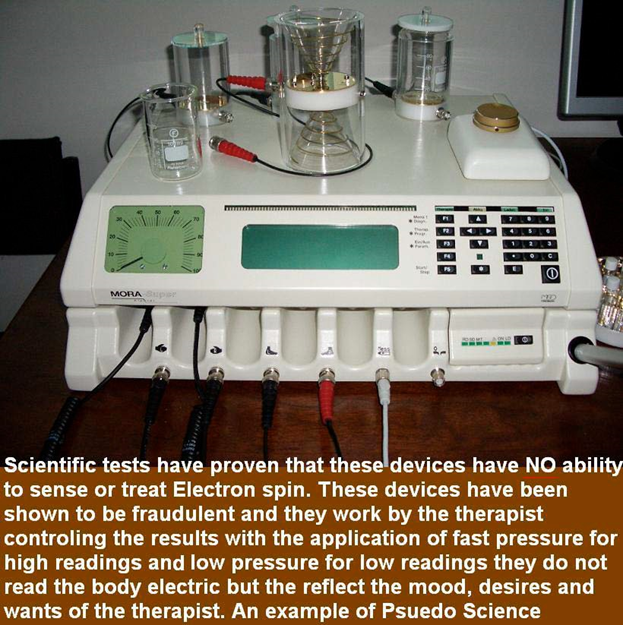
What is really happening at the quantum level?
There are four leading quantum theories, all of which work equally well at predicting the behavior of quantum particles. Whichever interpretation you prefer, remember
that it describes quantum particles as behaving non-locally according to
probabilities… and every time an observer makes any
measurement, that observation changes the world.
Copenhagen Interpretation
The Copenhagen interpretation of quantum physics was first described and presented by Niels Bohr in Italy in 1927. Bohr suggested that quantum particles exist as waves which might be anywhere until the wave function is collapsed. As long as nobody looks, each quantum particle is equally distributed in a series of overlapping probability waves, in a superposition of states.
Many Worlds Interpretation
In the 1950’s, Hugh Everett III proposed that every possibility inherent in each wave function is real, and that ALL of them occur. Possibilities become actualities with each measurement that is made, and infinite slightly different realities come into existence as each quantum event is observed. All possibilities are equally real.
Transactional Interpretation
John Cramer’s transactional interpretation of quantum physics suggests that „handshakes” take place between quantum particles in different points in time and space. In Cramer’s interpretation, a particle here and now on Earth instantaneously communicates with particles light-years away in time and space, as one particle sends an „offer” wave and another responds with a „confirmation” wave.
Holographic Interpretation
Physicist David Bohm and neurophysiologist Karl Pribram proposed that the universe may be like a giant hologram, containing both matter and consciousness as a single field. This model suggests that the objective world „out there” is a vast ocean of waves and frequencies which appears solid to us only because our brains convert that enfolded hologram into an unfolded sense of material we can perceive with our senses.
Alain Aspect of the University of Paris, in 1982 discovered that subatomic particles like electrons are capable of immediate communication no matter the distance. If a particle by interventions of the researcher received an opposite „spin”, this would have an immediate effect on its „twin particle” whether the distance was 10 miles or 10.000 miles, or 10.000.000 miles for that matter. This would mean that the transfer of communication between these particles took place faster than light, which is in contradiction with Einstein’s theories that tell us that nothing can go faster than light.
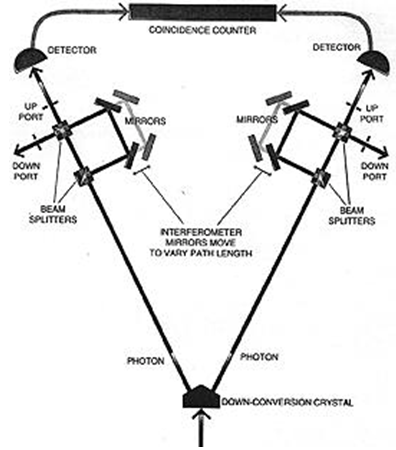
NONLOCAL CORRELATION by two
particles is demonstrated in the Franson experiment which sends two photons to separate but identical interferometer. Each photon may take a short route or a longer 'detour’ at the first beam splitter They may leave through the upper or lower exit ports. A detector looks at the photons leaving the upper exit ports. Before entering its interferometer, neither photon knows which way it will go. After leaving, each knows instantly and nonlocally what its twin has done and so behaves accordingly. Although in these experiments the photons were
separated by only a few feet, quantum mechanics predicts that the correlations would have been observed no matter how far apart the two interferometers were.
In order to keep Einstein’s theory of relativity and the principles of causality intact,
some scientists are explaining this effect away as being random.
really separate at all. Measure one, and as its spin becomes definite this triggers the other to respond. Its indeterminate spin also becomes definite, in the opposite direction to that of its partner. What is astonishing and disturbing is that this response happens instantaneously even if the particles are separated by huge distances. Consequently, quantum theory requires action at a distance. What happens in one part of the Universe can have instantaneous „nonlocal” consequences in other parts, no matter how far away they might be. And this poses a problem, because instantaneous action at a distance is a punch in the nose for Einstein. His theory of relativity-the cornerstone of physics -claims that our Universe has an absolute speed limit.
Nothing, according to Einstein, can travel faster than light. So you might wonder-do we really need to swallow this nonlocal quantum weirdness? Perhaps there is a better theory that accounts for these entanglements without action at a distance? Think of this: if someone separated a pair of your shoes by a great distance and then weighed one, they would immediately have a good estimate of the weight of the other. There’s no mystery here. Nothing nonlocal. Shoes have weight. And if they come from a pair, their weights are correlated from the outset. Could something similar be true for entangled particle pairs?
Despite what quantum theory says, perhaps the particles do have definite spins, arranged oppositely at all times, and measurements merely reflect this pre-existing situation. This is an obvious possibility. It might even be true. The trouble is, it doesn’t cushion the blow for relativity. In 1964, physicist John Bell of CERN, the European Laboratory for Particle Physics, examined this line of argument in detail and proved a famous theorem which fellow physicist Henry Stapp of the Lawrence Berkeley Laboratory in California calls „the greatest discovery of all science”. Bell first supposed that quantum theory doesn’t say all there is to say about quantum particles. He then proved that if any more complete theory – any theory imaginable – were to give predictions in agreement with quantum theory, it would necessarily still contain the same kind of nonlocal influences as ordinary quantum theory. „What Bell gave us,” says philosopher David Albert of Columbia University in New York, „is a proof that there is a genuine nonlocality in the workings of nature, however we attempt to describe it, period.” Every conceivable story about entangled states has to be nonlocal. There is no escape. Unless, of course, entangled states don’t really exist, and quantum theory is wrong.
Some extragalactic sources also seem to expand faster than Light.
Or maybe it is all part of the illusion.
Electroreception
While underwater sight and sound — however muted and distorted they may be — are within our realm of experience, sharks possess a sense that is so alien to us that we can neither relate to it nor fathom what it might feel like. That sense is electroreception: an acute sensitivity to electrical fields. Sharks receive tiny electrical signals from their environment via a series of pores peppered over the head, looking like a bad case of 5-O’clock shadow. These pores are distributed in discrete patterns, varying somewhat among elasmobranch species. In the White Shark, there is a pair of elongate clusters on top of the head above the eyes, another pair of V- shaped clusters surrounding the nostrils underneath the snout, a sausage-shaped cluster under each eye, and an oval cluster extending along each side of the chin.
These pores open to tiny bottle-shaped cells that are filled with an electrically conductive jelly. These cells are termed ampullae of Lorenzini, after the Italian anatomist who first described them in 1678. The ampullae are an extension of the lateral line system, and — like it — are based on hair cells as the key functional unit. Modified hair cells line the deepest part of the central lumen (cavity) of each ampulla. Instead of being responsive to bending, the klinocilium/lesser cilia mechanism of ampullary hair cells respond to a local reversal of electrical polarity. A net negative charge inside the ampullary lumen causes an
electrical change in each hair cell, triggering the release of neurotransmitters to adjacent clusters of sensory nerves which, in turn, signal the brain, where the stimulus is interpreted. That the same functional unit — the hair cell — has been adapted to sensing sound, vibration, and electrical stimuli testifies eloquently on behalf of the conservatism and creativity of evolutionary processes.
Seawater is an ion-rich
medium that conducts
electrical fields moderately well. Seawater moving over the magnetic
field lines of our planet provide a weak but richly textured
electrical 'map’
of the immediate
environment. A shark’s
body is contains a rich broth of electrically charged biomolecules
called electrolytes, which allow cells to communicate with each other. As it swims across geomagnetic field lines, electrical currents are induced in its body that provide navigational cues. Field studies by A. Peter Klimley have revealed that Scalloped Hammerheads (Sphyrna lewini) in the Sea of Cortez use this built-in compass sense to follow 'magnetic highways’ along the seafloor
between separate nocturnal feeding and diurnal socializing sites.
On a much smaller scale, cellular activity generates tiny electric fields that can betray the presence of potential prey that would otherwise be hidden from sharks. A particularly vivid example is provided by the Great Hammerhead (Sphyrna mokarran), which detects buried stingrays by sweeping its wide, ampullae-studded head over the bottom like the sensor plate of a metal detector.
These electrical cues would be meaningless to sharks, were it not for the astonishing sensitivity of their ampullae. Studies by Adrianus Kalmijn, a pioneer in elasmobranch electroreception, have demonstrated that some sharks — such as Smooth Dogfish (Mustelus canis) — are able to detect low frequency (from about 0.5 up to 8 Hertz) electric fields as tiny as 5 nanovolts (billionths of a volt) per square centimetre. In 1998, graduate student Steve Kaijura demonstrated that newborn Bonnethead Sharks (Sphyrna tiburo) can detect electric fields less than 1 nanovolt per square centimetre. This is equivalent to the electric field of a flashlight battery connected to electrodes some 10,000 miles (16,000 kilometres) apart in the ocean. Such incredible electrical sensitivity is over five million times greater than anything you or I could feel and is by far the most acute in the Animal Kingdom.
Testing the upper and lower limits of electrosensitivity in the White Shark requires precise measurements under controlled conditions that are presently only available in laboratory aquaria. Unfortunately, all attempts to maintain a Great White in captivity have thus far proved unsuccessful. The current record for survival in captivity, held by the Sea World Aquarium in San Diego for a 5.5-foot (1.7-metre) specimen, stands at a mere 16 days. But most captive White Sharks fare far worse. To date, most White Sharks have died within a few hours of being placed in an aquarium tank. Despite this logistical hurdle, some intriguing quantitative and qualitative observations suggest that the White Shark is highly sensitive to electric fields and that this ability is important to its survival in the wild.
The 72-hour captivity
of a 7.5-foot (2.3-metre), 300-pound (136-kilogram) female White Shark at San Francisco’s Steinhart Aquarium
during August 1980 provided
an unexpected opportunity to measure the electrosensitivity of this species.
Dubbed 'Sandy’, the juvenile
Great White was displayed in Steinhart’s torus-shaped 'fish roundabout’, becoming an instant
media celebrity and drawing some 40,000 visitors to the Aquarium over a three-and-a-half-day period. By the fourth day of her captivity, Aquarium
director John McCosker noticed that Sandy continually collided
with a particular five-degree arc of the tank. No visual, sonic, or vibratory cues were discernible at that particular segment of the roundabout. So McCosker and his co-workers suspected that a weak electrical field at that location
might be causing
her to bang her head against
the tank wall. A silver-chloride half cell was used to detect a small electric
potential difference between two of the tank’s windows
measuring 0.000125 volts — an amount so tiny that none of the other sharks in the roundabout seemed to notice.
Correcting the problem would have
required removing all the fish and draining the
tank, so it was reluctantly decided to release Sandy at the Farallon Islands, a location
that provided suitable habitat
yet was far enough away so as to not endanger San Franciscan swimmers and surfers. In addition to providing hope that another
of her species may one day be maintained in captivity, Sandy provided
an important clue about her electrosensitivity. Thanks to Sandy and the husbandry
team at Steinhart Aquarium, we now know that White Sharks can detect electric fields at least as minuscule as 125 microvolts (millionths of a volt).
Although the White Shark’s electrosensitivity may create problems for it in captivity, this ability probably helps it to survive in the wild. For example, pinnipeds (seals and sea lions) often haul out in large numbers on craggy rock islands that are geologically young. Such islands are often created by tectonic activity which leaves an enhanced magnetic signature with meandering lines of force radiating from them for many miles. White Sharks may, in part, locate pinniped rookeries (mass breeding sites) by following these 'magnetic highways’, much as Scalloped Hammerheads locate nocturnal feeding sites in the Sea of Cortez. The White Shark’s electrosensory talents may also help it capture prey. When a Great White bites into prey, its eyes roll tailward in their sockets to protect them from physical damage. Thus, at the moment of strike, the White Shark is temporarily blind. It may therefore rely on electrical cues to keep track of where its prey is at all times. Not only can the shark detect the electrical signature of its prey’s metabolizing cells, but — once it is wounded — the prey leaks charged electrolytes into the environment, creating an electric field as much as three times stronger than that of uninjured prey. In the bloody, thrashing confusion of a predatory attack, the White Shark’s acute sensitivity to electric fields may provide what JAWS author Peter Benchley called, „a beacon as clear and true as a lighthouse on a moonless night”.
Singular: ampulla. An ampoule is a small flask, hence these structures are sometimes referred to as 'flask cells’, but this term is less commonly used than ampullae of Lorenzini and is avoided here.
Mission Statement
Founded in 2001, the ReefQuest Centre for Shark Research is dedicated to shark and ray conservation through its scientific research and public education programs. The Centre maintains research equipment and facilities, reference collections of fossil and extant elasmobranch specimens, a scientific library, elasmobranch data bases, and public education materials.
The
Centre oversees the thesis research
of selected graduate
students as well as publishes
results of its own original
research and those resulting from collaboration with students or colleagues in the peer-reviewed scientific literature,
co-organizes international scientific conferences, and will begin producing its own
series of scientific reports in late 2003.
Sharks’ Electro-Sensing Organs Linked to Human Features
Maryann Mott
for National Geographic News February 14, 2006
Hunting sharks have the remarkable ability to sense the electric energy generated by prey. Using special head organs, the predators can detect even the slightest muscle twitch of a flounder buried in sand.
But the cellular origin of sharks’ electrical „ESP” has remained a mystery—until now.
Scientists at the University of Florida and the University of Louisiana have identified specialized cells as the sources of sharks’ powers.
Embryonic neural crest cells have the ability to become many different structures. In humans, for example, these cells give rise to head and facial features.
Using molecular tests of shark embryos, the researchers found genetic evidence of neural crest cells in the animals’ electricity-sensing organs.
The findings support the idea that the common ancestor of all vertebrates (animals with spinal columns) also detected electric fields. But over time mammals, reptiles, and birds lost the ability, the theory goes.
„Our work is really the first demonstration of the embryonic origin of these organs, and it gives us some insight into how they arose during evolution,” said Martin Cohn, a developmental biologist at the University of Florida Genetics Institute in Gainesville.
The discovery is reported in the current edition of the
journal Evolution and
Development.
Good Sense
Cohn, along with lead study author Renata Freitas, looked for genetic evidence of neural crest cells in embryos of the lesser spotted catshark, a species that mostly hunts at night. The team found indications of the cells in the embryos’ electro-sensory organs.
The scientists believe that during development neural crest cells migrate from the sharks’ brains into various regions of the head. There the cells create the framework for the electro-sensory system.
The process is similar to the development of the lateral line, a sensory organ in fish. The lateral line allows the animals to sense environmental conditions, such as temperature.
Scientists suspect that as ancient vertebrates emerged from the sea, they eventually lost their lateral lines as well as their ability to sense electric fields.
Today only a few species, such as sharks, sturgeons, and lampreys, have electro-sensing capabilities.
„You can imagine how valuable this system would be if you were aquatic, because water is so [electrically] conductive,” said James Albert, a study co-author.
But sensing electric signals doesn’t work as well on land, since air isn’t a good conductor of electricity.
„When it happens [on land], it’s called a lightning bolt, and you don’t need special receptors to sense it,” Albert said.
Dyeing to Know
Sebastian Shimeld, a zoology professor at the University of Oxford in England, is excited by the findings.
„It adds electro-sensation to the list of neural crest-derived novelties that appear to have been of fundamental importance for the early evolution of the vertebrates,” said Shimeld, who was not involved in the study.
But Glenn Northcutt, a professor of neuroscience at the University of California, San Diego, is skeptical about the claim that neural crest cells give rise to electro-receptors.
More tests are needed, he said.
„It still requires a definitive experiment, where the developing neural crest cells are marked with dye, the embryo develops, and the dye clearly shows up in the electro-receptors,” Northcutt said.
Dye tests are a classic
method for mapping cell movements. The tests have been used to examine the origins
of limbs and
brain cells and the activities of cancer cells.
Breathairians Exist
70 years without eating?
’Starving yogi’ says it’s true
Prahlad Jani, an 82-year-old Indian yogi, is making headlines once again by proving claims that for the past 70 years he has had nothing — not one calorie — to eat and not one drop of liquid to drink. To test his claims yet again as he has for many years now, Indian military doctors put him under round-the-clock observation during a two-week hospital stay that ended last week April 2010. During that time he didn’t ingest any food or water – and remained perfectly healthy, the researchers said. He has done this under close scrutiny many times, proving he can go without food or water for long periods of time.
But that’s simply impossible, said Dr. Michael Van Rooyen an emergency physician at Harvard’s Brigham and Women’s Hospital, an associate professor at the medical school, and the director of the Harvard Humanitarian Initiative – which focuses on aid to displaced populations who lack food and water. He represents the medical establishment which deny such things are possible in the face of evidence. They ignore such evidence that it shows them to be the most ignorant people alive.
Van Rooyen says that depending on climate conditions like temperature and humidity, a human could survive five or six days without water, maybe a day or two longer in extraordinary circumstances. We can go much longer without food – even up to three months if that person is taking liquids fortified with vitamins and electrolytes.
Bobby Sands, an Irish Republican convicted of firearms possession and imprisoned by the British, died in 1981 on the 66th day of his hunger strike. Gandhi was also known to go long stretches without food, including a 21-day hunger strike in 1932.
Prahlad Jani was studied for two weeks.
The effects of food and water deprivation are profound, Van Rooyen explained. “Ultimately, instead of metabolizing sugar and glycogen [the body’s energy sources] you start to metabolize fat and then cause muscle breakdown. Without food, your body chemistry changes. Profoundly malnourished people autodigest, they consume their own body’s resources. You get liver failure, tachycardia, heart strain. You fall apart.” But for certain spiritual adepts these factors can be overcome thru the powers of the mind.
The yogi, though, would already be dead from lack of hydration. If he really went without any liquids at all, his cardiovascular system would have collapsed. “You lose about a liter or two of water per day just by breathing,” Van Rooyen said. You don’t have to sweat, which the yogi claims he never does. That water loss results in thicker blood and a drop in blood pressure.
“You go from being a grape to a raisin,” Van Rooyen said and if you didn’t have a heart attack first, you’d die of kidney failure. But as Van Rooven watched with ignorant jaw drooping stare the yogis mind can overcome these forces.
Comments
What this yogi is doing has been done by vast numbers of yogi’s for millenia. It is an amazing feat in that it is real and it took this particular man an almost inconceivable amount of mental discipline to achieve. Our physicists are just beginning to skim the finest surface of understanding of our human potential and while going without food for so long may not seem to serve a purpose – it is one of many ways to make the journey inward that we all must make eventually. We are all connected and when one achieves the level of discipline and inward seeking that this man has – it is for all of us.
John Patton (Monday, May 10, 2010 8:27 PM)
What western medicine fails to recognize is that the human body has many secrets and capacities that few have explored. The human organism is not merely mechanical. And the capacity of the universe to surprise us with the unexpected should make modern doctors be more humble. For example: doctors dismissed germ theory as bunk just a 150 years ago. „Wash my hands? What rubbish.” Be open minded and humble you masters of medicine and the knife!!
Chuck Henderson (Monday, May 10, 2010 8:28 PM)
This can be a real event where a person gains his energy from other sources which are not nutritional in the usual sense. A term sometimes used is „breathers” getting energy from the prana in the environment.
F, Jackson, MS (Monday, May 10, 2010 8:30 PM)

The so called Buddha Boy of India pictured above was also seen to stop water and food for over 75 days. This is an easy feat to the Buddhists who accept and understand this.
The Roman Catholic Church has records of several saints (over 475 people) who have gone without any food for more than two years, some for decades. It is a massive display of medical ignorance to accuse these saints of cheating and deception, but the modern medical mind is ignorant and not as modern as he thinks he is.
The Buddhists have thousands on record, the Hindu many thousands more. And to accuse them all of deception is as stupid a thing an ill-informed, bad-mannered, impolite, IGNORANT Medical doctor can do. But arrogance and ignorance knows no bounds.
The religions of the world have tens of thousands maybe more cases of people living without food and or water beyond current medical doctrine. Hell’s Angels has none. They have Beerarians living on Beer alone but none living on Breath alone. This is because it takes a great amount of mental disciple to suspend the laws of normality and to control the laws with the power of the mind.
To make a new medicine and a new biology we must be able to account for the Breatharians and the powers of the human mind.
Quantum Levitation

Syndrome from Pixar’s The Incredibles levitates things on zero-point energy.
We study methods [1,2] for the manipulation of the force of the quantum vacuum known as the Casimir force. It is possible to turn the Casimir force from attraction to repulsion and to use it for levitating mirrors on, literally, nothing. This research may be interesting for applications in nanotechnology, because the Casimir force is the ultimate source of friction for micro- and nano-machines. In the following we explain the science behind Quantum Levitation [1]. See also the article Perfect lens could reverse Casimir force in PhysicsWeb.